Loading...
Done
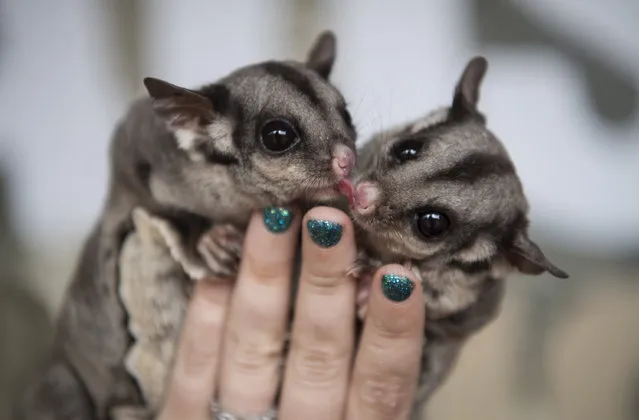
Sugar gliders, Candy and Popcorn, enjoy their favourite food, Nectar, at Wild Life Sydney Zoo on February 14, 2017 in Sydney, Australia. The treat made up of honey, high protein baby cereal and egg yolks is the human equivalent to chocolate to the Sugar Gliders. St. Valentine's Day or the Feast of Saint Valentine began as a celebration of the early Christian Saint Valentinus. From the 18th Century onwards it has steadily transformed into a celebration of romantic love and sentiment in many countries around the world. (Photo by James D. Morgan/Getty Images)

Sugar gliders, Candy and Popcorn, enjoy their favourite food, Nectar, at Wild Life Sydney Zoo on February 14, 2017 in Sydney, Australia. The treat made up of honey, high protein baby cereal and egg yolks is the human equivalent to chocolate to the Sugar Gliders. St. Valentine's Day or the Feast of Saint Valentine began as a celebration of the early Christian Saint Valentinus. From the 18th Century onwards it has steadily transformed into a celebration of romantic love and sentiment in many countries around the world. (Photo by James D. Morgan/Getty Images)
Details
19 Feb 2017 00:00:00
In this picture taken late on June 13, 2017, physiotherapist Masayuki Ozaki takes a bath with his silicone s*x doll Mayu at a love hotel in Yachimata, Chiba prefecture. Around 2,000 of the life- like dolls – which cost around 6,000 USD and come with adjustable fingers, removable head and life- like genitals – are sold each year in Japan, according to industry insiders. (Photo by Behrouz Mehri/AFP Photo)

In this picture taken late on June 13, 2017, physiotherapist Masayuki Ozaki takes a bath with his silicone s*x doll Mayu at a love hotel in Yachimata, Chiba prefecture. Around 2,000 of the life- like dolls – which cost around 6,000 USD and come with adjustable fingers, removable head and life- like genitals – are sold each year in Japan, according to industry insiders. (Photo by Behrouz Mehri/AFP Photo)
Details
28 Aug 2018 00:05:00
The Mayon volcano continues to erupt as the sun sets behind Legazpi city, Thursday, January 25, 2018 in Albay province, roughly 340 kilometers, (200 miles) southeast of Manila, Philippines. (Photo by Bullit Marquez/AP Photo)

The Mayon volcano continues to erupt as the sun sets behind Legazpi city, Thursday, January 25, 2018 in Albay province, roughly 340 kilometers, (200 miles) southeast of Manila, Philippines. (Photo by Bullit Marquez/AP Photo)
Details
27 Sep 2018 00:03:00
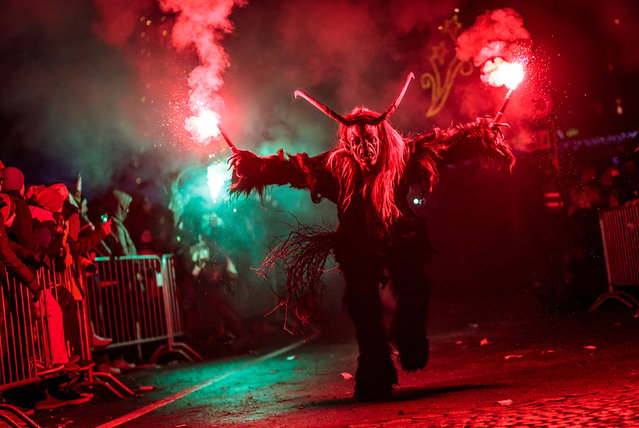
A man dressed as a devil performs during a Krampus parade in Kaprun, Austria on December 5, 2017. Krampus is a mythical creature that, according to legend, accompanies Saint Nicholas during the festive season. Instead of giving gifts to good children, he punishes the bad ones. (Photo by APA-PictureDesk GmbH/Rex Features/Shutterstock)

A man dressed as a devil performs during a Krampus parade in Kaprun, Austria on December 5, 2017. Krampus is a mythical creature that, according to legend, accompanies Saint Nicholas during the festive season. Instead of giving gifts to good children, he punishes the bad ones. (Photo by APA-PictureDesk GmbH/Rex Features/Shutterstock)
Details
09 Dec 2017 02:20:00
Elementary school sumo wrestlers compete in the sumo ring during the Wanpaku sumo-wrestling tournament in Tokyo, Japan July 30, 2017. (Photo by Kim Kyung-Hoon/Reuters)

Elementary school sumo wrestlers compete in the sumo ring during the Wanpaku sumo-wrestling tournament in Tokyo, Japan July 30, 2017. (Photo by Kim Kyung-Hoon/Reuters)
Details
09 Aug 2017 07:18:00
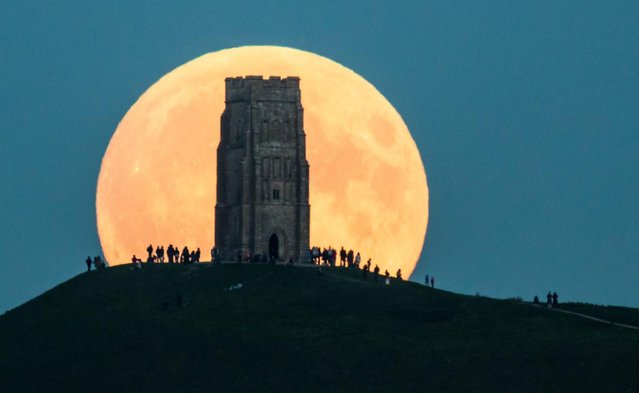
The supermoon rises behind Glastonbury Tor on September 27, 2015 in Glastonbury, England. Tonight's supermoon, so called because it is the closet full moon to the Earth this year, is particularly rare as it coincides with a lunar eclipse, a combination that has not happened since 1982 and won't happen again until 2033. (Photo by Matt Cardy/Getty Images)

The supermoon rises behind Glastonbury Tor on September 27, 2015 in Glastonbury, England. Tonight's supermoon, so called because it is the closet full moon to the Earth this year, is particularly rare as it coincides with a lunar eclipse, a combination that has not happened since 1982 and won't happen again until 2033. (Photo by Matt Cardy/Getty Images)
Details
02 Oct 2015 08:06:00
Sophia Fernandes, a member of the Kalunga quilombo, the descendants of runaway slaves, dons traditional afro braids, during the culmination of the week-long pilgrimage and celebration for the patron saint “Nossa Senhora da Abadia” or Our Lady of Abadia, in the rural area of Cavalcante in Goias state, Brazil, Saturday, August 13, 2022.  Devotees celebrate Our Lady of Abadia at this time of the year with weddings, baptisms and by crowning distinguished community members, as they maintain cultural practices originating from Africa that mix with Catholic traditions. (Photo by Eraldo Peres/AP Photo)

Sophia Fernandes, a member of the Kalunga quilombo, the descendants of runaway slaves, dons traditional afro braids, during the culmination of the week-long pilgrimage and celebration for the patron saint “Nossa Senhora da Abadia” or Our Lady of Abadia, in the rural area of Cavalcante in Goias state, Brazil, Saturday, August 13, 2022. Devotees celebrate Our Lady of Abadia at this time of the year with weddings, baptisms and by crowning distinguished community members, as they maintain cultural practices originating from Africa that mix with Catholic traditions. (Photo by Eraldo Peres/AP Photo)
Details
21 Aug 2022 03:48:00
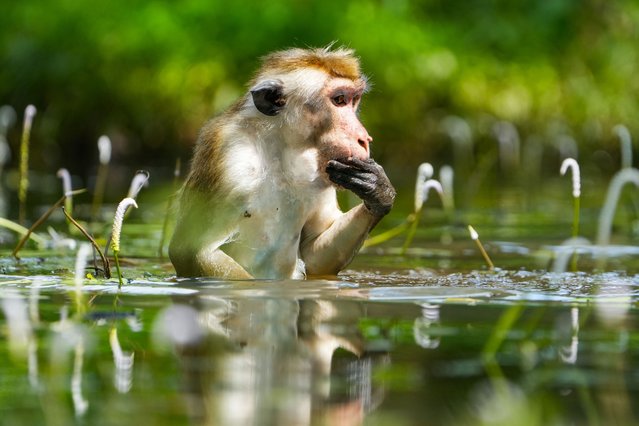
A toque macaque is eating flowers in the water at the pilgrimage site in Polonnaruwa, Sri Lanka, on January 13, 2024. The toque macaque (Macaca sinica), a reddish-brown-colored Old World monkey, is endemic to Sri Lanka, where it is known as the rilewa or rilawa. It is named for the whorl of hair at the crown of its head, which resembles a brimless toque cap. (Photo by Thilina Kaluthotage/NurPhoto/Rex Features/Shutterstock)

A toque macaque is eating flowers in the water at the pilgrimage site in Polonnaruwa, Sri Lanka, on January 13, 2024. The toque macaque (Macaca sinica), a reddish-brown-colored Old World monkey, is endemic to Sri Lanka, where it is known as the rilewa or rilawa. It is named for the whorl of hair at the crown of its head, which resembles a brimless toque cap. (Photo by Thilina Kaluthotage/NurPhoto/Rex Features/Shutterstock)
Details
10 Feb 2024 09:30:00