Loading...
Done
New Zealand Penguins in Need of Sweaters

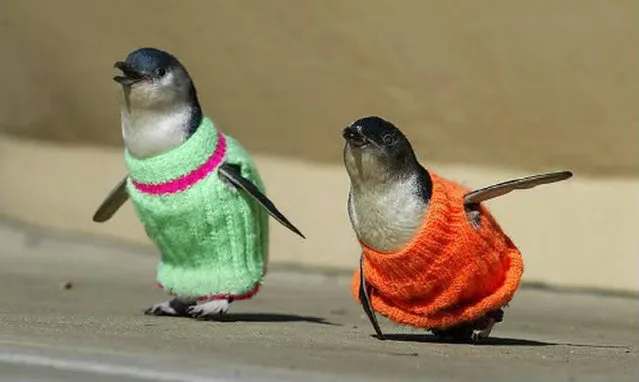
Penguin sweaters, also known as penguin jumpers, are sweaters which are knitted for penguins that have been caught in oil slicks. When an oil spill affects penguins, they are dressed in knitted sweaters to stop them preening their feathers and to keep them warm, since the spilled oil destroys their natural oils. This also prevents them from poisoning themselves by ingesting the oil. The sweaters are removed and discarded as soon as the penguins can be washed. The original project has been completed, but the knitting pattern is still available on-line, as subsequent oil spills make it necessary. The extra sweaters are kept on behalf of the Wildlife Rescue Team.
Details
31 Oct 2012 13:06:00
Oil Pumping From Rena Continues

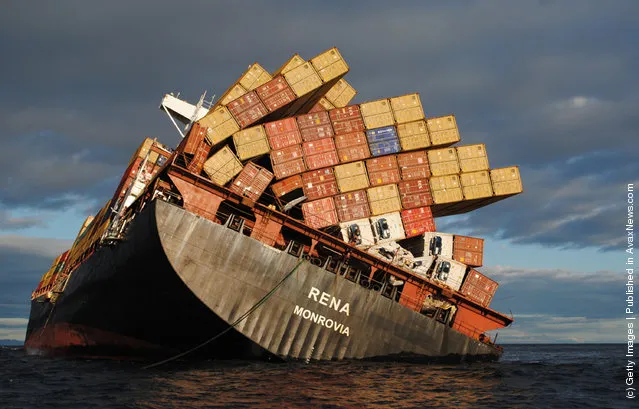
The stern of the stranded cargo vessel Rena grounded on the Astrolabe Reef is seen on October 20, 2011 in Tauranga, New Zealand. Salvage crews continue to pump oil off the ship in an effort to remove as much as possible before bad weather predicted for the evening threatens to break the vessel and release more oil into the sea. Over 300 tonnes of oil has leaked from Rena since it hit the reef on October 5. (Photo by New Zealand Defence Force via Getty Images)
Details
20 Oct 2011 09:11:00


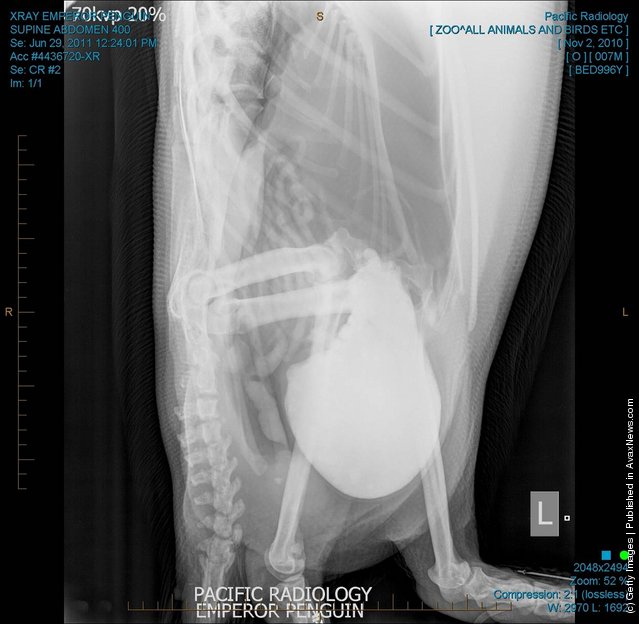
“Happy Feet” the emperor penguin that washed up on the Kapiti Coast last week, undergoes a medical examination at Wellington Zoo on June 29, 2011 in Wellington, New Zealand. The young penguin landed on NZ shores last week, after traveling over 3,000 kilometres from the antarctic. The ill penguin was operated on at Wellington Zoo several times this week to remove sand and sticks from it's stomach with hopes it will recover fully. A team of experts is likely to decide today, whether the bird will remain in captivity in New Zealand, or be transported back the the antarctic. (Photo by Hagen Hopkins/Getty Images)
Details
29 Jun 2011 11:26:00
Inside My Dreams By Achraf Baznani

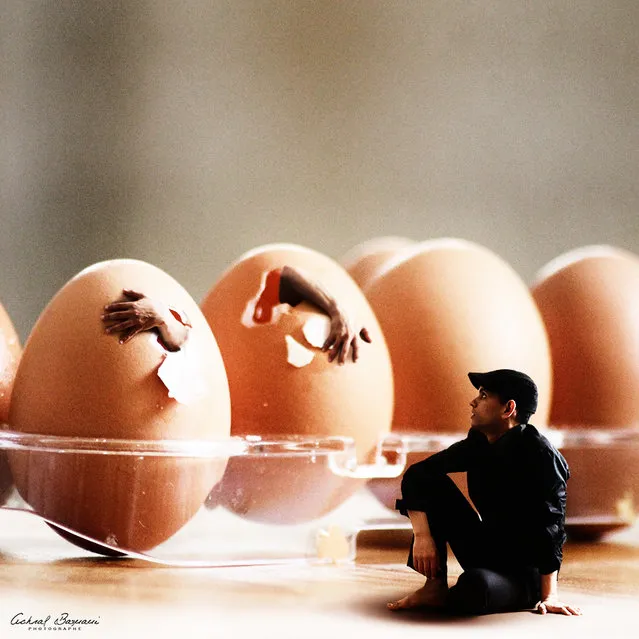
Moroccan photographer and filmmaker Achraf Baznani carries on the traditions of Surrealism with his wild, imaginative, and wholly impractical imagery. Among his inventive scenarios, small human figures—often the artist himself—appear trapped within glass jars or the size of a camera lens; in other works, Baznani more or less dissects his body, as for example, in one, he cleanly removes his brain from his cranium, or in another, twists off his hand, much as if it were a light bulb. Imparted throughout such works are strong senses of humor and wonder, and as such, Baznani’s art offers a Surrealistic take on life experience in the digital age.
Details
03 Aug 2014 12:04:00
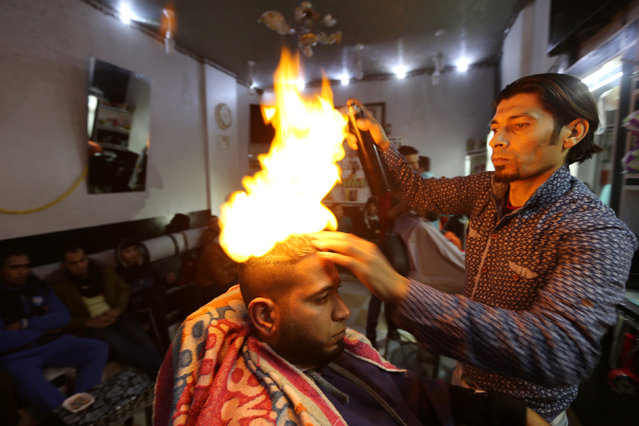
Palestinian barber Ramadan Odwan styles and straightens the hair of a customer with fire at his salon in Rafah, in the southern Gaza Strip February 2, 2017. In Ramadan Odwan's barbershop in Gaza, hair isn't just blow-dried, it's blowtorch-dried. “People have gone crazy about it, many people are curious to go through the experience and they are not afraid”, he told Reuters. “People here love adventures”. Odwan, 37, is not the first stylist in the world to use flame to straighten hair, but his craft is unique in the Gaza Strip. In his salon in the southern Gaza town of Rafah, Odwan applied what he described as a protective liquid coating to a customer's hair – he declined to disclose its contents – before aiming for the head and pressing the button on a small blowtorch. “I control how long I apply fire, I keep it on and off for 10 seconds or 15 seconds. It is completely safe and I have not encountered any accident since I started it two months ago”, Odwan added. Odwan charges 20 shekels ($5.20) for a haircut and fire-straightening. A barber for the past 18 years, he said part of the reason he uses the technique is to show that Palestinian barbers are as “professional as those out there around the world”. (Photo by Ibraheem Abu Mustafa/Reuters)

Palestinian barber Ramadan Odwan styles and straightens the hair of a customer with fire at his salon in Rafah, in the southern Gaza Strip February 2, 2017. In Ramadan Odwan's barbershop in Gaza, hair isn't just blow-dried, it's blowtorch-dried. “People have gone crazy about it, many people are curious to go through the experience and they are not afraid”, he told Reuters. “People here love adventures”. (Photo by Ibraheem Abu Mustafa/Reuters)
Details
11 Feb 2017 00:05:00


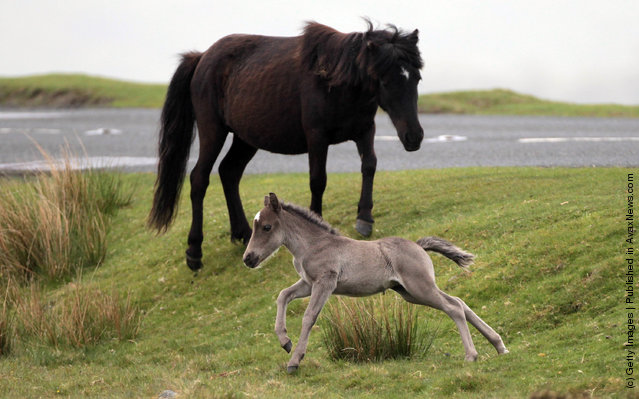
A Dartmoor Hill pony foal runs on the moor on Dartmoor on May 17, 2011 in Princetown England. Although a tourist attraction, especially during the foaling season and often seen as part of the landscape of Dartmoor, many ponies face an uncertain future due to unsustainable breeding and their falling market values. The charity South West Equine Protection estimates that last year 1500 ponies were slaughtered – with many being sold for lion meat to nearby zoos. Along with other equine charities, they are calling for the removal of stallions from the moor to bring numbers down to sustainable levels. (Photo by Matt Cardy/Getty Images)
Details
18 May 2011 11:15:00
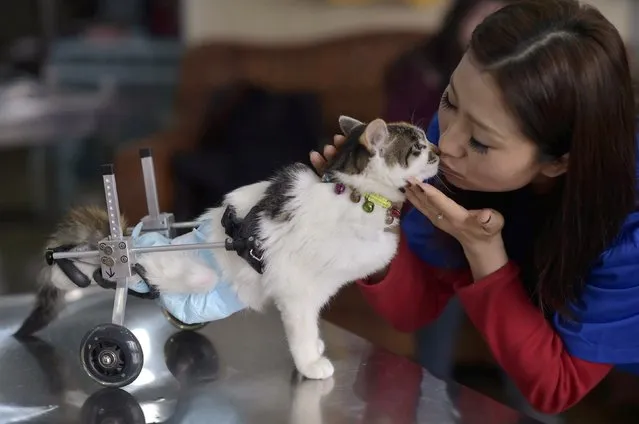
A veterinarian kisses an 8-month-old cat, wearing a prosthetic two-wheel device, at a veterinary hospital in Chongqing municipality, March 16, 2015. (Photo by Reuters/China Daily)

A veterinarian kisses an 8-month-old cat, wearing a prosthetic two-wheel device, at a veterinary hospital in Chongqing municipality, March 16, 2015. The cat's rear legs lost the abilty to walk after falling from the ninth to fifth floor of a building last November, its since undergone four major surgeries which included removing parts of its organs, local media reported. (Photo by Reuters/China Daily)
Details
19 Mar 2015 13:27:00
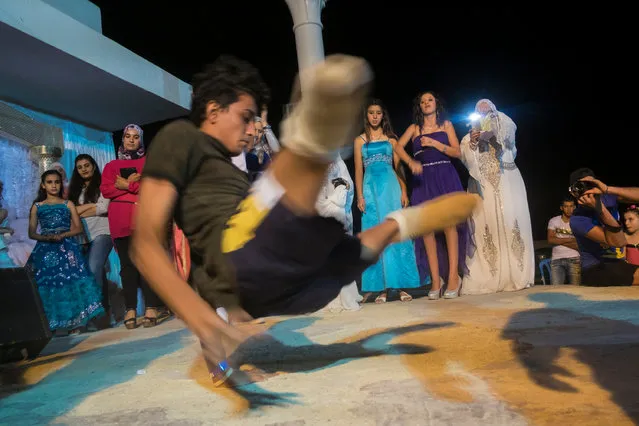
He performs his moves during the wedding celebrations, with his prosthetic limbs removed. (Photo by Yassine Alaoui Ismaili/The Guardian)

Street photographer Yassine Alaoui Ismaili follows 16-year-old Emeer Guesmi, aka B-boy Zulu Rema, as he trains and performs breakdance moves – all without the use of his legs. At a breakdance championship in Tunisia, Casablanca-based street photographer Yassine Alaoui Ismaili noticed an unusual competitor: Emeer Guesmi, dancing without the aid of his lower legs. He started following him as he trained and performed. (Photo by Yassine Alaoui Ismaili/The Guardian)
Details
23 Nov 2016 12:33:00