Loading...
Done
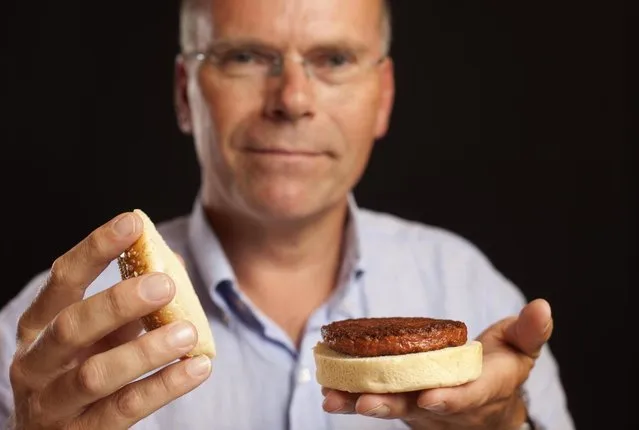
In this handout image provided by Ogilvy, a burger made from cultured beef, which has been developed by Professor Mark Post of Maastricht University in the Netherlands (pictured) is shown to the media during a press conference on August 5, 2013 in London, England. Cultured Beef could help solve the coming food crisis and combat climate change with commercial production of Cultured Beef beginning within ten to twenty years. (Photo by David Parry via Getty Images)

In this handout image provided by Ogilvy, a burger made from cultured beef, which has been developed by Professor Mark Post of Maastricht University in the Netherlands (pictured) is shown to the media during a press conference on August 5, 2013 in London, England. The in-vitro burger, cultured from cattle stem cells, the first example of what its creator says could provide an answer to global food shortages and help combat climate change, was fried in a pan and tasted by two volunteers. The burger is the result of years of research by Dutch scientist Mark Post, a vascular biologist at the University of Maastricht, who is working to show how meat grown in petri dishes might one day be a true alternative to meat from livestock.The meat in the burger has been made by knitting together around 20,000 strands of protein that has been cultured from cattle stem cells in Post's lab. (Photo by David Parry)
Details
06 Aug 2013 08:48:00
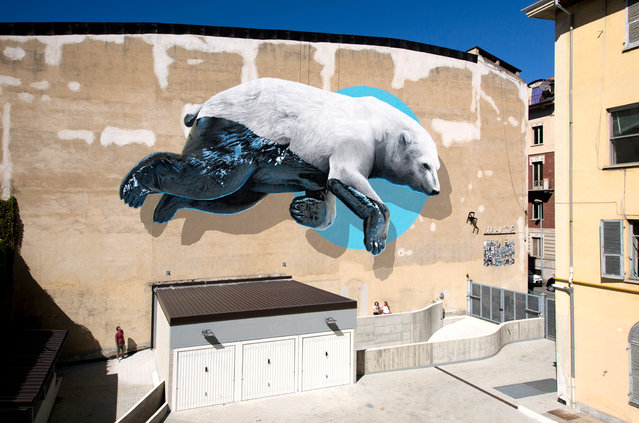
A polar bear whose bottom half is caked in oily black gunk. A whale wrapped in striped fabric: a pseudo straightjacket. These are the messes climate change leaves behind, the things we know are happening but often don’t have the opportunity to see with our own eyes. Swiss street art duo Christian Rebecchi and Pablo Togni, otherwise known as NeverCrew, met in art school when they were 15 and started making work together soon after. As a team, the artists adorn the world with eye-popping and gut-wrenching images depicting the consequences of humanity’s actions on earth. Here: “Black machine” mural painting and installation on the Colosseo theater in Turin, Italy, in September 2015. (Photo by NeverCrew/The Huffington Post)

A polar bear whose bottom half is caked in oily black gunk. A whale wrapped in striped fabric: a pseudo straightjacket. These are the messes climate change leaves behind, the things we know are happening but often don’t have the opportunity to see with our own eyes. Swiss street art duo Christian Rebecchi and Pablo Togni, otherwise known as NeverCrew, met in art school when they were 15 and started making work together soon after. As a team, the artists adorn the world with eye-popping and gut-wrenching images depicting the consequences of humanity’s actions on earth. (Photo by NeverCrew/The Huffington Post)
Details
13 Aug 2016 11:09:00
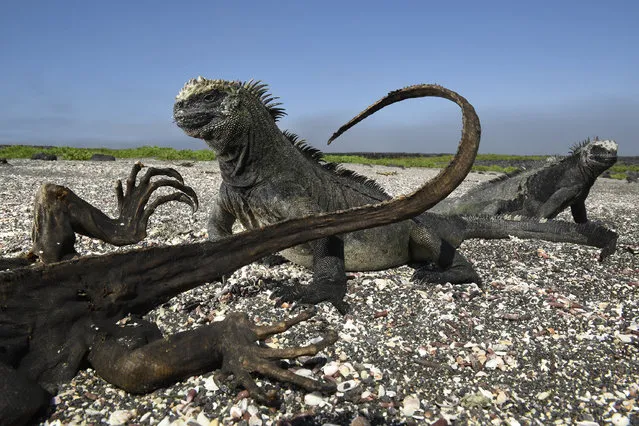
Galapagos – Rocking the Cradle: Four major ocean currents converge along the Galapagos archipelago, creating the conditions for an extraordinary diversity of animal life, April 25, 2016. The islands are home to at least 7,000 flora and fauna species, of which 97 percent of the reptiles, 80 percent of the land birds, 50 percent of the insects and 30 percent of the plants are endemic. The local ecosystem is highly sensitive to the changes in temperature, rainfall and ocean currents that characterize the climatic events known as El Niño and La Niña. These changes cause marked fluctuations in weather and food availability. Many scientists expect the frequency of El Niño and La Niña to increase as a result of climate change, making the Galapagos a possible early-warning location for its effects. (Photo by Thomas P. Peschak for National Geographic/World Press Photo)

Galapagos – Rocking the Cradle: Four major ocean currents converge along the Galapagos archipelago, creating the conditions for an extraordinary diversity of animal life, April 25, 2016. The islands are home to at least 7,000 flora and fauna species, of which 97 percent of the reptiles, 80 percent of the land birds, 50 percent of the insects and 30 percent of the plants are endemic. (Photo by Thomas P. Peschak for National Geographic/World Press Photo)
Details
16 Apr 2018 00:01:00
England's Longest Zip Wire Opens At The Eden Project

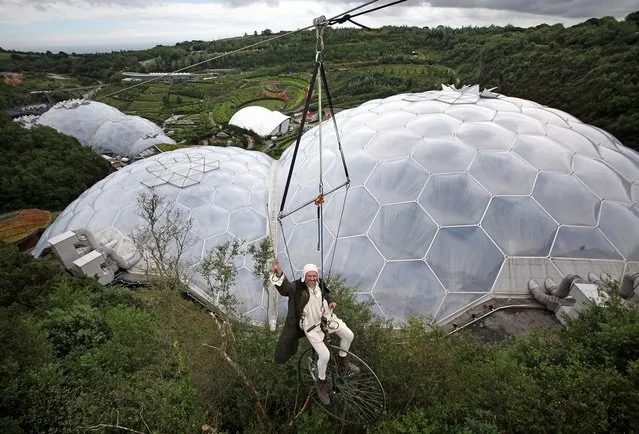
Marco Fiera from NoFit State Circus tries out the SkyWire, the new zip wire attraction which opens to the public this week at The Eden Project on July 17, 2012 in St Austell, England. The new 740m zip wire, currently the longest in England, allows the public a bird's eye view of the iconic Rainforest and Mediterranean Biome structures as well as the Cornish attractions outdoor gardens. The Eden Project – which opened in 2001 and has attracted over one million visitors – showcases 100,000 plants from around the world in two giant transparent domes, one of which is the world's largest greenhouse, each recreating different climate conditions. (Photo by Matt Cardy)
Details
19 Jul 2012 10:00:00
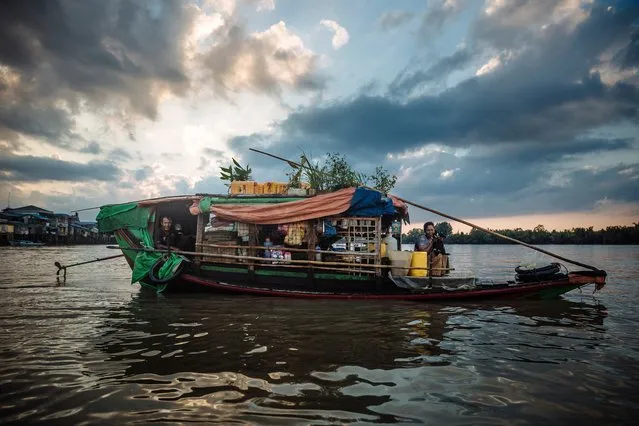
Tin and Naing win live on a small boat which they sail throughout the Delta region in Myanmar. The former gardeners once had a home on land but it was destroyed when a powerful cyclone ravaged the area in 2008. Since then, the couple have not been able to afford to rebuild their home, so they live on the boat from which they sell fish paste to make a living. (Photo by Muse Mohammed/IOM)

The ferocity of crises worldwide is forcing a record number of people to flee their homes, seeking some form of safety within their own country or across international borders. There are 65.3 million displaced people worldwide, including 21.3 million refugees. Most have lost their homes to armed conflict or natural disasters but other factors, such as extreme poverty and climate change, also drive displacement. The International Organisation for Migration commissioned photojournalist Muse Mohammed to document the plight of the displaced. (Photo by Muse Mohammed/IOM)
Details
02 Jan 2017 12:04:00
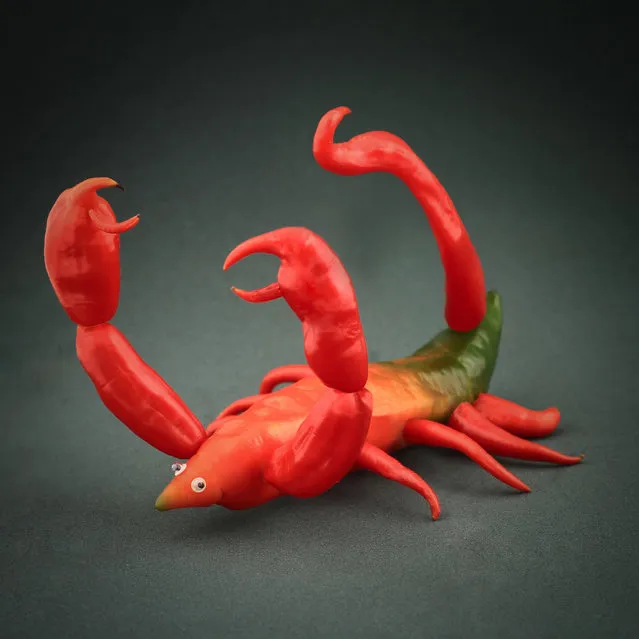
“Red Pepperpion. (Photo by Vanessa Dualib)

“Red Pepperpion. Red Pepperpions are secretive, nocturnal arachilli which can be spotted in kitchens of arid climates all around the world.

Red Pepperpions are equipped with a delicious (and depending on the quantity...deadly!) stinger at the end of its tail. If you happen to get bitten (or if you bite him!) it will produce a burning sensation on your taste nerves.

However, there is no need to worry, since the fact is that his potent stinger is usually only used when hunting or whenever the Pepperpion feels like he might become part of someones meal...

At daylight or when encountering a larger foe, such as a Saucier Chef, they retreat into burrows inside the fridge or hide beneath the oven”. (Photo and comment by Vanessa Dualib)


Details
08 Feb 2013 09:24:00
British Prime Minister Rishi Sunak is greeted by Italian Prime Minister Giorgia Meloni during a welcome ceremony on day one of the 50th G7 summit at Borgo Egnazia on June 13, 2024 in Fasano, Italy. The G7 summit in Puglia, hosted by Italian Prime Minister Giorgia Meloni, the seventh held in Italy, gathers leaders from the seven member states, the EU Council, and the EU Commission. Discussions will focus on topics including Africa, climate change, development, the Middle East, Ukraine, migration, Indo-Pacific economic security, and artificial intelligence. (Photo by Christopher Furlong/Getty Images)

British Prime Minister Rishi Sunak is greeted by Italian Prime Minister Giorgia Meloni during a welcome ceremony on day one of the 50th G7 summit at Borgo Egnazia on June 13, 2024 in Fasano, Italy. The G7 summit in Puglia, hosted by Italian Prime Minister Giorgia Meloni, the seventh held in Italy, gathers leaders from the seven member states, the EU Council, and the EU Commission. (Photo by Christopher Furlong/Getty Images)
Details
16 Jun 2024 06:00:00
In this photo taken on Monday, October 27, 2014, a cactus stands at a broken window in a damaged house after shelling not far from Donetsk airport in the town of Donetsk, eastern Ukraine. (Photo by Dmitry Lovetsky/AP Photo)

In this photo taken on Monday, October 27, 2014, a cactus stands at a broken window in a damaged house after shelling not far from Donetsk airport in the town of Donetsk, eastern Ukraine. Donetsk, which has lost about 400,000 of its 1 million pre-war population, is bracing to a winter ahead. In a climate like eastern Ukraine's, where temperatures typically stay below zero all winter, the damage to the critical infrastructure and lack of effort to provide adequate shelter to people whose homes were destroyed could literally mean a death from the cold. (Photo by Dmitry Lovetsky/AP Photo)
Details
06 Nov 2014 09:06:00