Loading...
Done
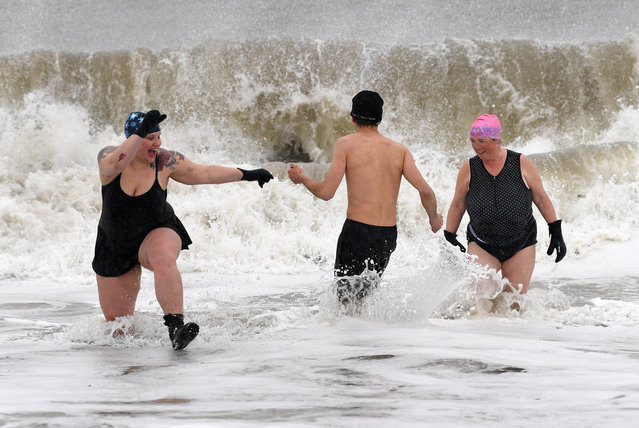
Despite the high winds and fright temperatures, about 1/2 dozen brave members of the Coney Island Polar Bear Club took a dip in the Atlantic Ocean at March 14, 2017, just of Stillwell avenue in Coney Island beach in Brooklyn NYC. Snow began blanketing northeastern United States on Tuesday as a winter storm packing blizzard conditions rolled into the region, prompting public officials to ask people to stay home while airlines grounded flights and schools canceled classes. The National Weather Service issued blizzard warnings for parts of eight states including New York, Pennsylvania, New Jersey and Connecticut, with forecasts calling for up to 2 feet of snow by early Wednesday, with temperatures 15 to 30 degrees below normal for this time of year. (Photo by Paul Martinka)

Despite the high winds and fright temperatures, about 1/2 dozen brave members of the Coney Island Polar Bear Club took a dip in the Atlantic Ocean at March 14, 2017, just of Stillwell avenue in Coney Island beach in Brooklyn NYC. (Photo by Paul Martinka)
Details
16 Mar 2017 00:00:00
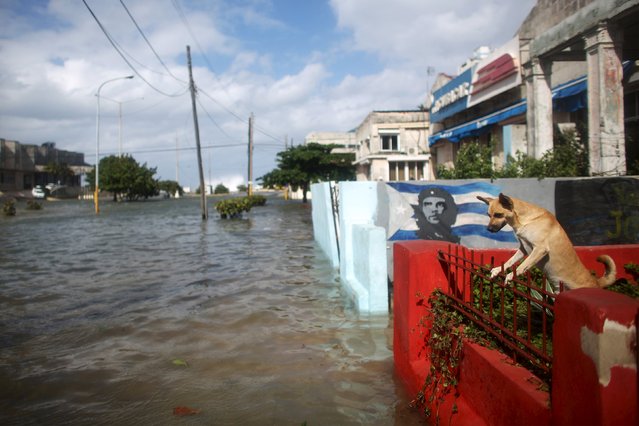
A four-year-old dog Nika stands next to an image of Cuba's revolutionary hero Ernesto “Che” Guevara in front of a flooded street in Havana, January 23, 2016. Havana's seafront Malecon continued to be slammed by massive waves that flooded parts of the seaside city on Saturday. As a result, Havana was confronting flooding as a cold front passes through the Caribbean island.  (Photo by Alexandre Meneghini/Reuters)

A four-year-old dog Nika stands next to an image of Cuba's revolutionary hero Ernesto “Che” Guevara in front of a flooded street in Havana, January 23, 2016. Havana's seafront Malecon continued to be slammed by massive waves that flooded parts of the seaside city on Saturday. As a result, Havana was confronting flooding as a cold front passes through the Caribbean island. The giant waves began washing up onto shore during sunrise. The waves have been accompanied by winds passing through at a speed between 35 and 50 km (21 to 31 miles) per hour. (Photo by Alexandre Meneghini/Reuters)
Details
24 Jan 2016 15:03:00
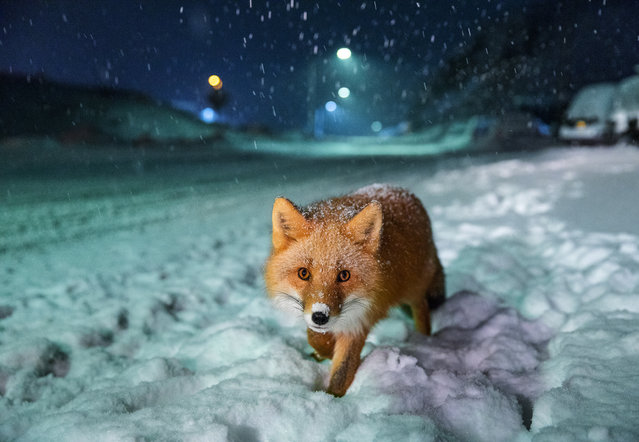
“Roadside Friend”. (Photo by Corey Arnold/Charles A. Harman Fine Art/The Guardian)

Corey Arnold is a fine art photographer and a commercial fisherman, working the stormy waters of the Bering Sea by Alaska. His latest work documents life in this remote wilderness, both at sea and on the shore, capturing trawlers, foxes, eagles and the grandeur of the scenery. “Aleutian Dreams” can be seen at Charles A Hartman Fine Art in Portland, Oregon, until 27 May. Here: “Roadside Friend”. (Photo by Corey Arnold/Charles A. Harman Fine Art/The Guardian)
Details
12 Apr 2017 09:51:00
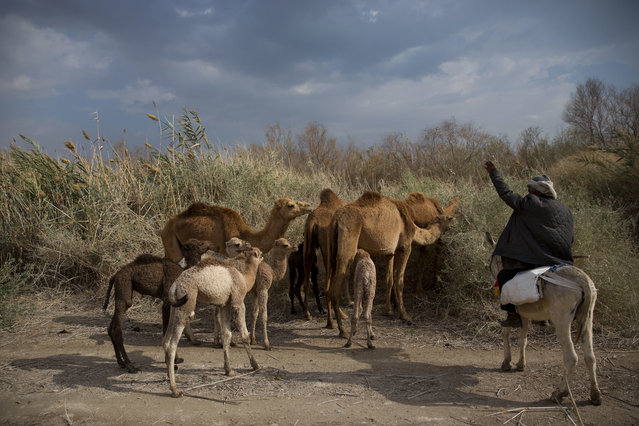
In this Sunday, February 18, 2018 photo, Palestinian camel herder Salem Rashaideh, leads the way for the camels in the territory of Israeli Kibbutz Kalya, near the Dead Sea in the West Bank. (Phoro by Oded Balilty/AP Photo)

In this Sunday, February 18, 2018 photo, Palestinian camel herder Salem Rashaideh, leads the way for the camels in the territory of Israeli Kibbutz Kalya, near the Dead Sea in the West Bank. For three months a year, in the winter time Bedouin Arab herders take their 130 camels to graze on the shores of the Dead Sea, at the lowest place on Earth. (Phoro by Oded Balilty/AP Photo)
Details
19 Mar 2018 00:03:00


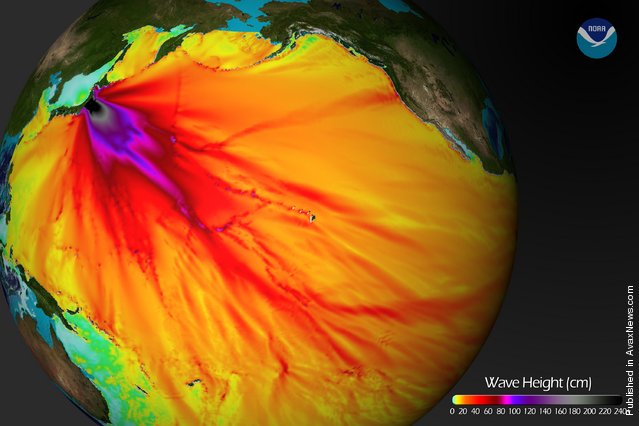
In this handout image provided by the National Oceanic and Atmospheric Administration (NOAA), model runs from the Center for Tsunami Research at the NOAA Pacific Marine Environmental Laboratory show the expected wave heights of the tsunami as it travels across the Pacific basin March 11, 2011. The largest wave heights are expected near the earthquake epicenter, off Japan. The wave will decrease in height as it travels across the deep Pacific but grow taller as it nears coastal areas. In general, as the energy of the wave decreases with distance, the near shore heights will also decrease (e.g., coastal Hawaii will not expect heights of that encountered in coastal Japan). (Photo by NOAA via Getty Images)
Details
13 Mar 2011 14:29:00


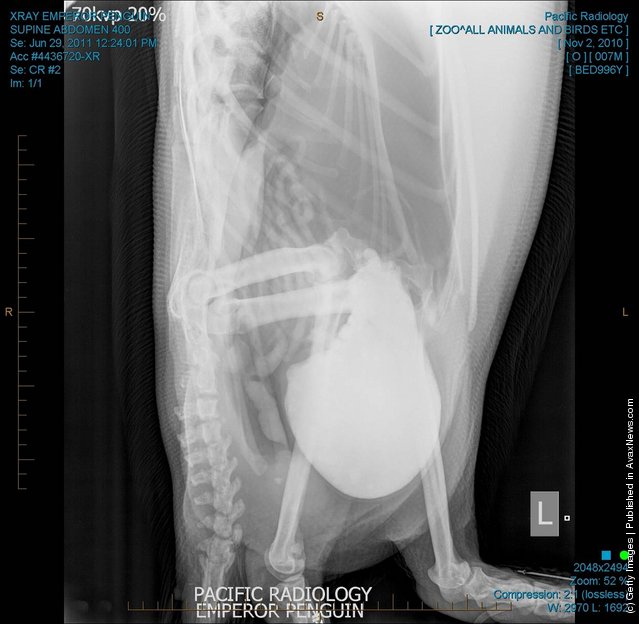
“Happy Feet” the emperor penguin that washed up on the Kapiti Coast last week, undergoes a medical examination at Wellington Zoo on June 29, 2011 in Wellington, New Zealand. The young penguin landed on NZ shores last week, after traveling over 3,000 kilometres from the antarctic. The ill penguin was operated on at Wellington Zoo several times this week to remove sand and sticks from it's stomach with hopes it will recover fully. A team of experts is likely to decide today, whether the bird will remain in captivity in New Zealand, or be transported back the the antarctic. (Photo by Hagen Hopkins/Getty Images)
Details
29 Jun 2011 11:26:00
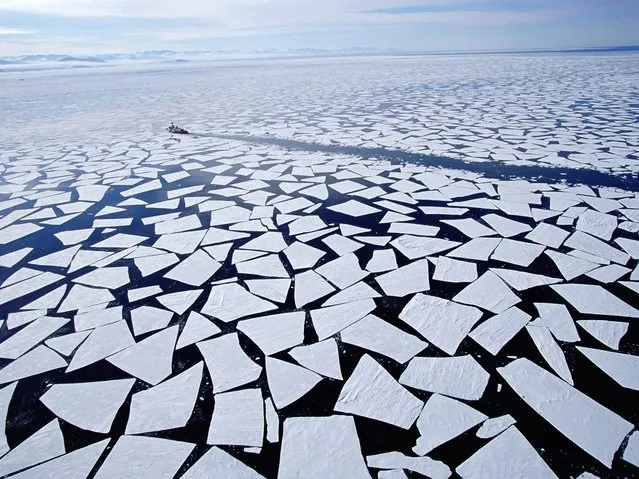
McMurdo Station Antarctic

McMurdo Station is a U.S. Antarctic research centre located on the southern tip of Ross Island, which is in the New Zealand-claimed Ross Dependency on the shore of McMurdo Sound in Antarctica. It is operated by the United States through the United States Antarctic Program, a branch of the National Science Foundation. The station is the largest community in Antarctica, capable of supporting up to 1,258 residents, and serves as the United States Antarctic science facility. All personnel and cargo going to or coming from Amundsen–Scott South Pole Station first pass through McMurdo.
Details
05 Sep 2013 10:18:00
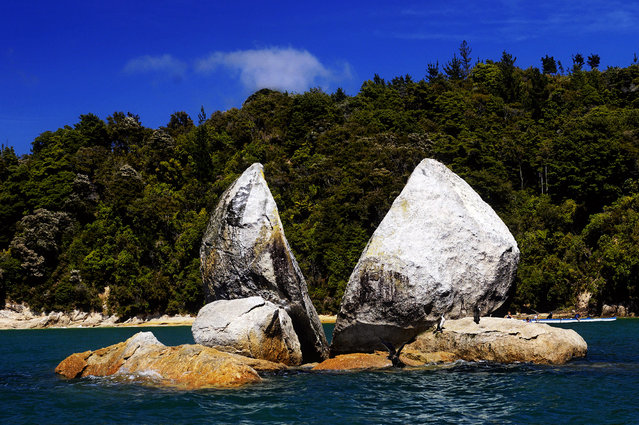
Split Apple Rock

Split Apple Rock is a geological rock formation in The Tasman Bay off the northern coast of the South Island of New Zealand. Made of granite, it is in the shape of an apple which has been cut in half. It is a popular tourist attraction in the waters of the Tasman Sea approximately 50 metres off the coast between Kaiteriteri and Marahau. The rock sits in shallow water at low tide and is accessible by wading. It is also a point of interest for the many tourist boats and pleasure craft which operate along the shores of the Abel Tasman National Park. The cleft to produce two sides of the 'apple' was a natural occurrence. It is unknown when this happened and therefore the cleaving of the rock has attracted mythological explanations.
Details
19 Oct 2013 10:58:00