Loading...
Done
Sculpture By Jessica Joslin

More great and peculiar work from Chicago based sculptor Jessica Joslin. Joslin assembles her hybrid creatures from objects found in obscure junk shops, flea markets, attics, taxidermy supply houses, specialty hardware distributors…or even just walking through the woods. “Miniature machine bolts, springs and couplings comprise anatomical structures. Many of the beasts have hidden movements: a spring loaded beak, snapping jaws, jointed legs and adjustable tails. Some creatures are free-standing but have mechanisms to allow for movement or multiple positions.”
Details
03 Nov 2013 14:28:00
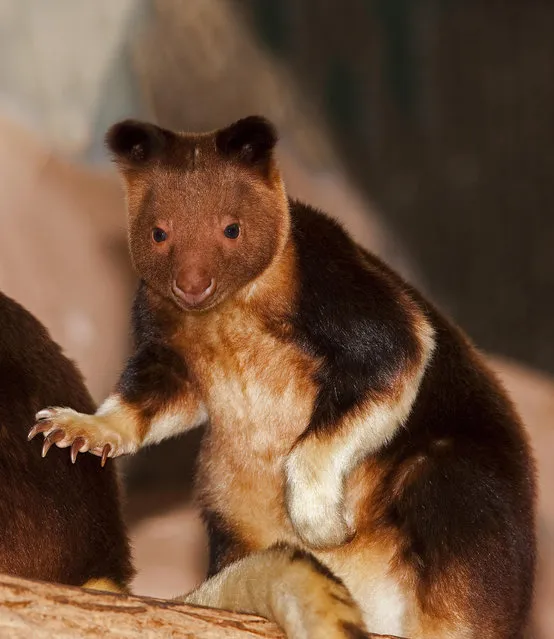
Goodfellow's Tree-Kangaroo

For some reason, everything that comes from Australia is either very cute or very poisonous; sometimes cute and poisonous at the same time. For example, Slow Loris, which you probably have seen eating a ball of rice on YouTube, is actually a very poisonous creature, despite its extreme cuteness. Goodfellow’s tree-kangaroos, on the other hand, are all cuteness and no poison. Just look at its cute little snout and furry paws, as it gingerly scratches its stomach, while sitting on its hind legs! If you don’t find this creature adorable, nothing will be able to thaw your stone-cold heart.
Details
30 Nov 2014 13:38:00
Once applied, the designs are washed using warm water and cow dung. Herbs are applied to promote faster healing. (Photo by Ronny Sen/WaterAid/The Guardian)

For more than 2,000 years, women from the Baiga tribe in the highland district of Dindori, in central India’s Madhya Pradesh state, have been tattooed. Sumintra, 25, from Bona village, has the markings across her forehead, legs and arms. The women who work as tattoo artists are knowledgable about the different types of designs and pigments preferred by various tribes, and their meanings are passed to them by their mothers. The tattooing ‘season’ begins with the approach of winter. (Photo by Ronny Sen/WaterAid/The Guardian)
Details
19 Aug 2017 08:48:00
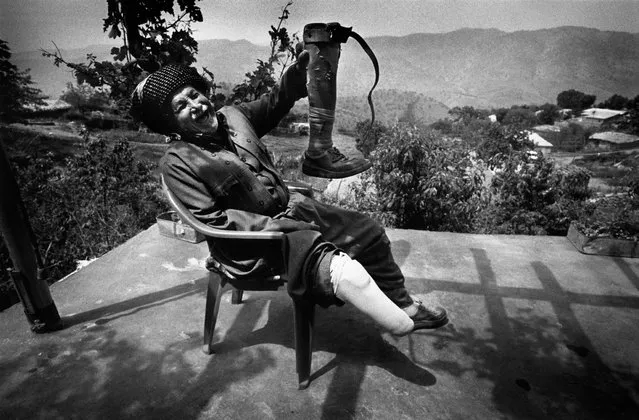
Ismail Mustafa, seen in 2007. “I was collecting mushrooms on the hill near here. I didn’t see the mine. There was a huge explosion. When I woke up I saw that both my legs were gone; I thought my life was over. My brother and another guy were with me. They made a stretcher from sticks and tied it together with clothing. It took two hours to get off the mountain. ‘My daughter has also been injured. She found a shell and brought it into the house and put it on the fire. She didn’t know what she was doing at the time – she was only three. She is blind and has lost an arm”. (Photo by Sean Sutton for the Mines Advisory Group/The Guardian)

Ismail Mustafa, seen in 2007. “I was collecting mushrooms on the hill near here. I didn’t see the mine. There was a huge explosion. When I woke up I saw that both my legs were gone; I thought my life was over. My brother and another guy were with me. They made a stretcher from sticks and tied it together with clothing. It took two hours to get off the mountain. ‘My daughter has also been injured. She found a shell and brought it into the house and put it on the fire. She didn’t know what she was doing at the time – she was only three. She is blind and has lost an arm”. (Photo by Sean Sutton for the Mines Advisory Group/The Guardian)
Details
08 Sep 2017 09:33:00
Photographers gather to take pictures of pilot Andre Borschberg (C) ahead of the take off of Solar Impulse 2-a solar powered plane- in Nanjing, China, May 31, 2015. The world's largest solar-powered airplane, Solar Impulse 2, took off from eastern China's Nanjing on Sunday to continue its round-the-world voyage. The Swiss-made plane left Nanjing's Lukou International Airport at 2:39 in the early morning, with former fighter pilot Borschberg at the controls alone for the entire 8,200-kilometer flight from Nanjing to Hawaii, the toughest leg of its marathon adventure.   REUTERS/Solar Impulse/Handout via Reuters

Photographers gather to take pictures of pilot Andre Borschberg (C) ahead of the take off of Solar Impulse 2-a solar powered plane- in Nanjing, China, May 31, 2015. The world's largest solar-powered airplane, Solar Impulse 2, took off from eastern China's Nanjing on Sunday to continue its round-the-world voyage. The Swiss-made plane left Nanjing's Lukou International Airport at 2:39 in the early morning, with former fighter pilot Borschberg at the controls alone for the entire 8,200-kilometer flight from Nanjing to Hawaii, the toughest leg of its marathon adventure. (Photo by Reuters/Solar Impulse)
Details
06 Jun 2015 12:09:00
The Dog Who Thinks He's A Human

Meet Rupert the whippet who loves nothing better than dressing up and posing for the camera. Whether playing a game of tennis, reading the morning newspaper or even doing the ironing, these hilarious pictures show the dog has a real knack for striking a fetching pose. Rupert began starring in the snaps at 10-months-old, when his owner Janet Burton, 56, noticed him standing with his front legs rested on the lawnmower.
Details
24 Nov 2016 08:04:00
Nine year old Maria Palkina dancing with dogs. (Photo by Andrey Seliverstov/Caters News Agency)

This beautiful set of images capture the moment a young ballet dancer interacts with her four-legged friends against some iconic backdrops including the Church of the Savior on Blood and the Admiralty building in Saint Petersburg. The enchanted photos were taken by Andrey Seliverstov, 59 from Saint Petersburg, Russia. Here: Nine year old Maria Palkina dancing with dogs. (Photo by Andrey Seliverstov/Caters News Agency)
Details
15 Oct 2017 07:56:00
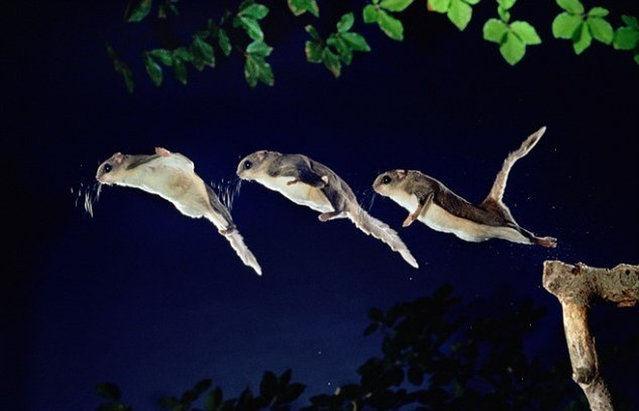
 Flying Squirrel

Flying squirrels are not capable of powered flight like birds or bats; instead, they glide between trees. They are capable of obtaining lift within the course of these flights, with flights recorded to 90 meters (295 ft). The direction and speed of the animal in midair is varied by changing the positions of its two arms and legs, largely controlled by small cartilaginous wrist bones. This changes the tautness of the patagium, a furry parachute-like membrane that stretches from wrist to ankle. It has a fluffy tail that stabilizes in flight. The tail acts as an adjunct airfoil, working as an air brake before landing on a tree trunk.
Details
07 Aug 2012 16:29:00