Loading...
Done
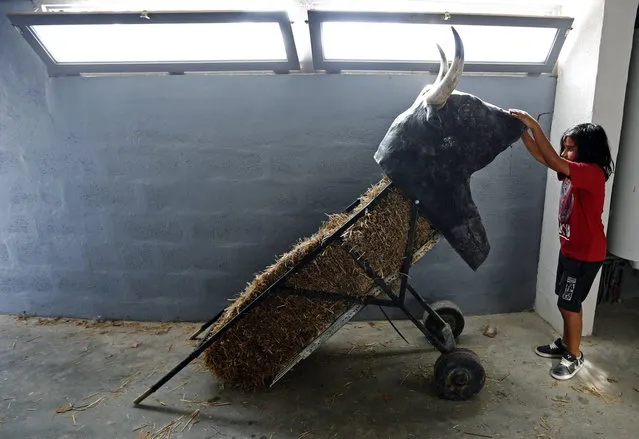
Nino, a ten-year-old toreador apprentice of the French Tauromachy Centre, nicknamed El Nino, touches a practice bull at the bullring of Garons, near Nimes, September 25, 2013. (Photo by Jean-Paul Pelissier/Reuters)

Nino, a ten-year-old toreador apprentice of the French Tauromachy Centre, nicknamed El Nino, touches a practice bull at the bullring of Garons, near Nimes, September 25, 2013. Since 1983, the French Tauromachy Centre in Nimes has trained some 1,000 youths in the art of bullfighting. Twenty of them have gone on to become professional matadors, facing fighting bulls in the arena. Twice a week, students take courses with a matador to learn the movements and gestures of the bullfighter in the ring, but without an animal present. Students train with calves in the surrounding fields during spring, and regularly participate in beginner's bullfights (becerradas) without killing calves. Solal has been taking courses for three years and Nino, for just a year now. Both are normally enrolled in French public schools, but have one thought in mind – bullfighting. They share a passion linked to the city of Nimes, famous for its ferias and bullring. (Photo by Jean-Paul Pelissier/Reuters)
Details
06 Nov 2013 10:12:00
Mayu adjusts Koiku’s kimono, as Koiku wears a protective face mask while posing for a photograph, before they work at a party where they will entertain with other geisha at Japanese luxury restaurant Asada in Tokyo, Japan, June 23, 2020. The coronavirus pandemic has made Tokyo's geisha fear for their centuries-old profession as never before. Though the number of geisha - famed for their witty conversation, beauty and skill at traditional arts - has been falling for years, they were without work for months due to Japan's state of emergency and now operate under awkward social distancing rules. Engagements are down 95 percent, and come with new rules: no pouring drinks for customers or touching them even to shake hands, and sitting 2 meters apart. Masks are hard to wear with their elaborate wigs, so they mostly don't. “I was just full of anxiety”, said Mayu, 47. “I went through my photos, sorted my kimonos ... The thought of a second wave is terrifying”. (Photo by Kim Kyung-Hoon/Reuters)

Mayu adjusts Koiku’s kimono, as Koiku wears a protective face mask while posing for a photograph, before they work at a party where they will entertain with other geisha at Japanese luxury restaurant Asada in Tokyo, Japan, June 23, 2020. (Photo by Kim Kyung-Hoon/Reuters)
Details
23 Jul 2020 00:03:00
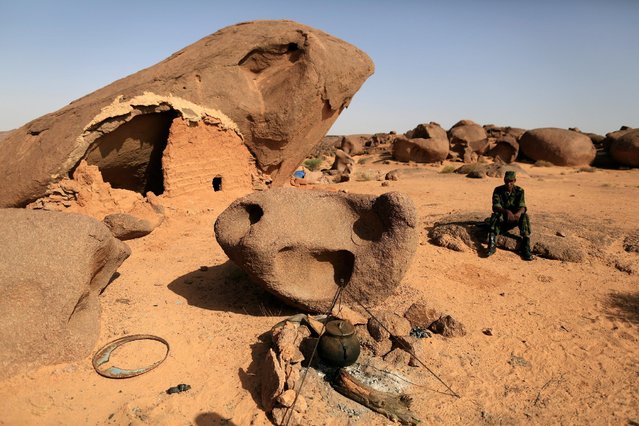
A Polisario fighter sits on a rock at a forward base on the outskirts of Tifariti, Western Sahara, September 9, 2016. At a rocky outpost in Western Sahara, a new generation of soldiers who have never known war are mobilising as tensions resurface in one of Africa's oldest disputes after a quarter century of uneasy peace. Young Sahrawi troops man new desert posts for the Polisario Front, which for more than 40 years has sought independence for the vast desert region - first in a guerrilla war against Morocco and then politically since a ceasefire deal in 1991. Now a standoff with Morocco, which controls the majority of Western Sahara, is renewing pressure for a diplomatic solution to ensure foot soldiers don't return to fighting as the last generation of commanders once did. The standoff since August has brought Moroccan and Polisario forces within 200 metres of each other in a narrow strip of land near the Mauritanian border. Rich in phosphate, Western Sahara has been contested since 1975 when Spanish colonial powers left. Morocco claimed the territory and fought the 16-year war with Polisario. (Photo by Zohra Bensemra/Reuters)

A Polisario fighter sits on a rock at a forward base on the outskirts of Tifariti, Western Sahara, September 9, 2016. At a rocky outpost in Western Sahara, a new generation of soldiers who have never known war are mobilising as tensions resurface in one of Africa's oldest disputes after a quarter century of uneasy peace. (Photo by Zohra Bensemra/Reuters)
Details
04 Nov 2016 12:09:00
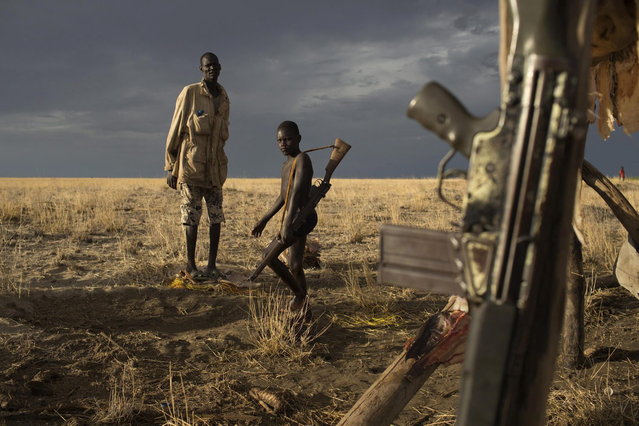
A Turkana man and a boy carrying a gun look on as a G3 battle rifle hangs from a structure used to dry fish at a fishing camp on the shores of Lake Turkana, some kilometres from Todonyang near the Kenya-Ethiopia border in northwestern Kenya October 12, 2013. (Photo by Siegfried Modola/Reuters)

A Turkana man and a boy carrying a gun look on as a G3 battle rifle hangs from a structure used to dry fish at a fishing camp on the shores of Lake Turkana, some kilometres from Todonyang near the Kenya-Ethiopia border in northwestern Kenya October 12, 2013The Turkana are traditionally nomadic pastoralists, but they have seen the pasture that they need to feed their herds suffer from recurring droughts and many have turned to fishing. However, Lake Turkana is overfished, and scarcity of food and pastureland is fuelling long-standing conflict with Ethiopian indigenous Dhaasanac, who have seen grazing grounds squeezed by large-scale government agricultural schemes in southern Ethiopia. The Dhaasanac now venture ever deeper into Kenyan territory in search of fish and grass, clashing with neighbours. Fighting between the communities has a long history, but the conflict has become ever more fatal as automatic weapons from other regional conflicts seep into the area. While the Turkana region is short of basics like grass and ground-water, it contains other resources including oil reserves and massive, newly discovered underground aquifers. (Photo by Siegfried Modola/Reuters)
Details
05 Dec 2013 12:08:00


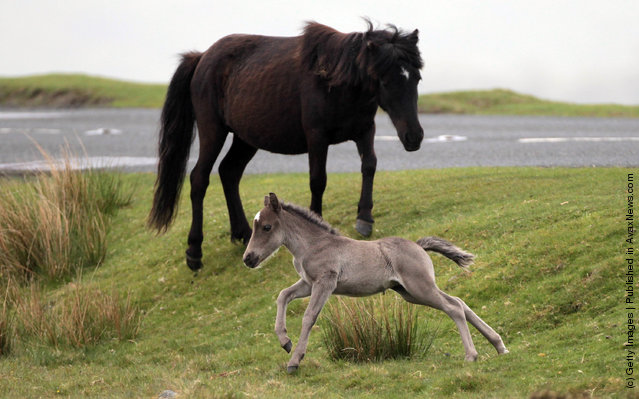
A Dartmoor Hill pony foal runs on the moor on Dartmoor on May 17, 2011 in Princetown England. Although a tourist attraction, especially during the foaling season and often seen as part of the landscape of Dartmoor, many ponies face an uncertain future due to unsustainable breeding and their falling market values. The charity South West Equine Protection estimates that last year 1500 ponies were slaughtered – with many being sold for lion meat to nearby zoos. Along with other equine charities, they are calling for the removal of stallions from the moor to bring numbers down to sustainable levels. (Photo by Matt Cardy/Getty Images)
Details
18 May 2011 11:15:00
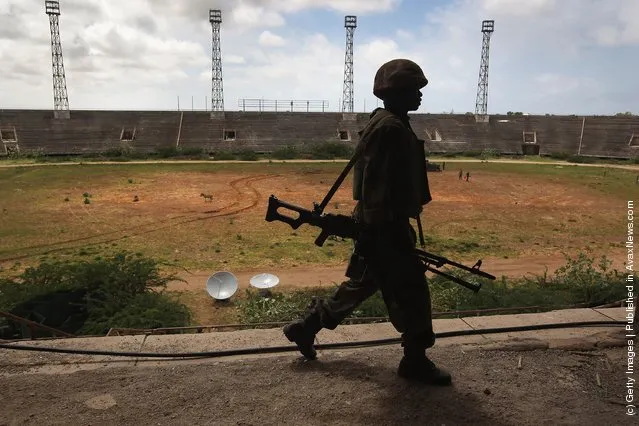
A Ugandan soldier, part of the 9,000-strong African Union Mission in Somalia, (AMISOM) walks through the Banadir soccer stadium in Mogadishu, Somalia

A Ugandan soldier, part of the 9,000-strong African Union Mission in Somalia, (AMISOM) walks through the Banadir soccer stadium on August 15, 2011 in Mogadishu, Somalia. The stadium, Somalia's largest soccer facility, had been under control by Islamic extremist Shabab militants for the past two years until they withdrew from the capital more than a week ago. (Photo by John Moore/Getty Images)
Details
18 Aug 2011 10:56:00
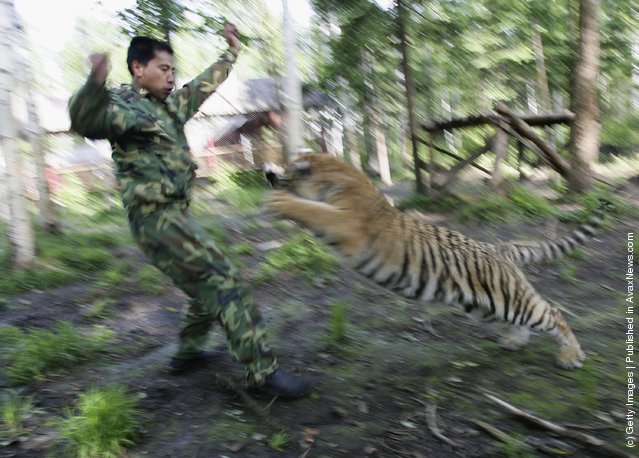
A feeder trains a Siberian tiger cub

A feeder trains a Siberian tiger cub at Erdaohe Tiger Park July 2, 2006 in Antu County of Yanbian Chaoxian Autonomous Prefecture, Jilin Province, China. About 15 artificially-fed Siberian tigers from Harbin Siberian Tiger Park are being trained to develop their ability to live in the wild. The wild Siberian tiger is listed as one of the most endangered species in the world, with its existing number estimated at around 400 worldwide, mainly in the northeastern part of China and the Far East of Russia. Reportedly there are more than 1,300 Siberian tigers which have been raised in China. (Photo by China Photos/Getty Images)
Details
01 Oct 2011 12:23:00
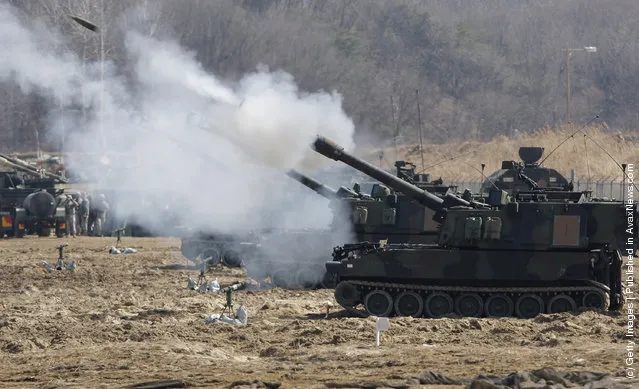
U.S. soldiers from 145th Field Artillery Battalion deployed from the United States fire Paladin self propelled gun during the Foal Eagle training exercise at firing point 180 at the Rodriguez Live Fire Range

U.S. soldiers from 145th Field Artillery Battalion deployed from the United States fire Paladin self propelled gun during the Foal Eagle training exercise at firing point 180 at the Rodriguez Live Fire Range on March 15, 2012 in Pocheon, South Korea. (Photo by Chung Sung-Jun/Getty Images)
Details
16 Mar 2012 11:23:00