Loading...
Done
Galapagos – Rocking the Cradle: Four major ocean currents converge along the Galapagos archipelago, creating the conditions for an extraordinary diversity of animal life, April 25, 2016. The islands are home to at least 7,000 flora and fauna species, of which 97 percent of the reptiles, 80 percent of the land birds, 50 percent of the insects and 30 percent of the plants are endemic. The local ecosystem is highly sensitive to the changes in temperature, rainfall and ocean currents that characterize the climatic events known as El Niño and La Niña. These changes cause marked fluctuations in weather and food availability. Many scientists expect the frequency of El Niño and La Niña to increase as a result of climate change, making the Galapagos a possible early-warning location for its effects. (Photo by Thomas P. Peschak for National Geographic/World Press Photo)

Galapagos – Rocking the Cradle: Four major ocean currents converge along the Galapagos archipelago, creating the conditions for an extraordinary diversity of animal life, April 25, 2016. The islands are home to at least 7,000 flora and fauna species, of which 97 percent of the reptiles, 80 percent of the land birds, 50 percent of the insects and 30 percent of the plants are endemic. (Photo by Thomas P. Peschak for National Geographic/World Press Photo)
Details
16 Apr 2018 00:01:00
Police officers stand near a fishing boat, the Carolina Queen III, as it rests in shallow water just off Rockaway Beach, Thursday, February 25, 2016, in the Queens borough of New York. Authorities say a Coast Guard vessel overturned while assisting the fishing boat that ran aground in an inlet off New York City. (Photo by Frank Franklin II/AP Photo)

Police officers stand near a fishing boat, the Carolina Queen III, as it rests in shallow water just off Rockaway Beach, Thursday, February 25, 2016, in the Queens borough of New York. Authorities say a Coast Guard vessel overturned while assisting the fishing boat that ran aground in an inlet off New York City. (Photo by Frank Franklin II/AP Photo)
Details
26 Feb 2016 10:29:00
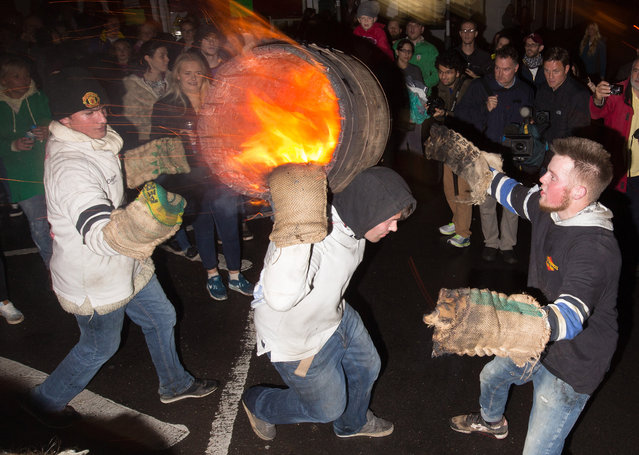
A boy runs with a burning barrel soaked in tar at the annual Ottery St Mary tar barrel festival on November 5, 2015 in Ottery St. Mary, England. The tradition, which is over 400 years old, sees competitors (who must have been born in the town to take part) running with burning barrels on their backs through the village, until the heat becomes too unbearable or the barrel breaks down, starting with junior barrels carried by children and continuing all evening with ever larger and larger barrels. (Photo by Matt Cardy/Getty Images)

A boy runs with a burning barrel soaked in tar at the annual Ottery St Mary tar barrel festival on November 5, 2015 in Ottery St. Mary, England. The tradition, which is over 400 years old, sees competitors (who must have been born in the town to take part) running with burning barrels on their backs through the village, until the heat becomes too unbearable or the barrel breaks down, starting with junior barrels carried by children and continuing all evening with ever larger and larger barrels. The event, which has been threatened with closure on previous years due to increasing public liability insurance costs, raises thousands of pounds for charity and attracts spectators from around the world. (Photo by Matt Cardy/Getty Images)
Details
07 Nov 2015 08:07:00
Young revelers take part in a parade called "La Calabiuza" on November 1, 2015, on the eve of the Day of the Dead in Tonacatepeque, 20 kms (13 miles) north of San Salvador. During the celebration, the residents of Tonacatepeque, originally an indigenous community, recall the characters from the mythology of Cuscatlan – pre-Columbian west and central regions of El Salvador – and their dead relatives. (Photo by Marvin Recinos/AFP Photo)

Young revelers take part in a parade called "La Calabiuza" on November 1, 2015, on the eve of the Day of the Dead in Tonacatepeque, 20 kms (13 miles) north of San Salvador. During the celebration, the residents of Tonacatepeque, originally an indigenous community, recall the characters from the mythology of Cuscatlan – pre-Columbian west and central regions of El Salvador – and their dead relatives. (Photo by Marvin Recinos/AFP Photo)
Details
04 Nov 2015 11:50:00
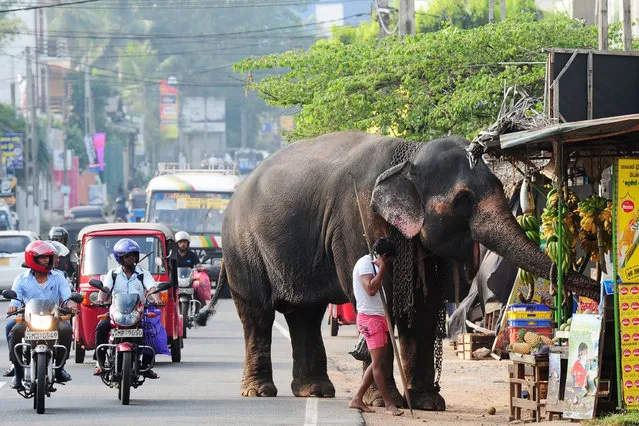
A Sri Lankan elephant, accompanied by his mahout, browse through a roadside fruit stall in Colombo on January 19, 2015. The Sri Lankan elephant is listed as endangered by the International Union for Conservation of Nature (IUCN) as the population has declined by at least 50 percent over the last three generations, with the species threatened by habitat loss, degradation and fragmentation. (Photo by Lakruwan Wanniarachchi/AFP Photo)

A Sri Lankan elephant, accompanied by his mahout, browse through a roadside fruit stall in Colombo on January 19, 2015. The Sri Lankan elephant is listed as endangered by the International Union for Conservation of Nature (IUCN) as the population has declined by at least 50 percent over the last three generations, with the species threatened by habitat loss, degradation and fragmentation. (Photo by Lakruwan Wanniarachchi/AFP Photo)
Details
23 Jan 2015 13:21:00
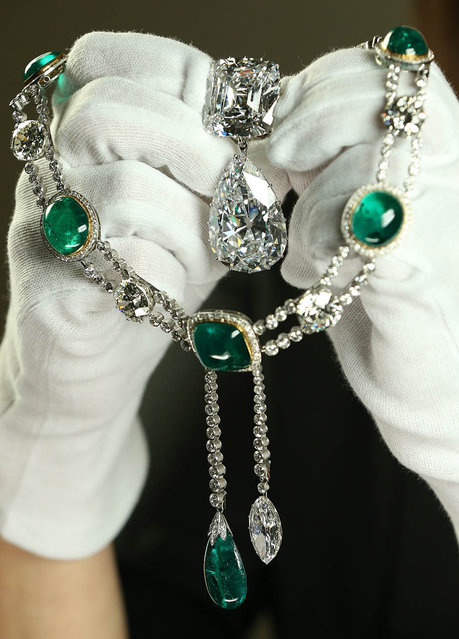
Caroline de Guitaut, Curator of Royal Collections, holds the Cullinan III and IV Broach and the Cullinan VII Delhi Durbar Necklace and Cullinan Pendant at The Queen's Gallery, Buckingham Palace

“A dazzling exhibition featuring jewelry made with the world’s largest diamond will be part of the celebrations marking the 60th anniversary of Queen Elizabeth II’s reign. The jewelry was made with a 3,106-carat diamond discovered in 1905 at the Cullinan Diamond Mine near Pretoria, the capital of South Africa. The diamond was so large that miners initially thought it was a worthless crystal and almost threw it away”... – Vidya Kauri via News.nationalpost.com

Photo: Caroline de Guitaut, Curator of Royal Collections, holds the Cullinan III and IV Broach and the Cullinan VII Delhi Durbar Necklace and Cullinan Pendant at The Queen's Gallery, Buckingham Palace on May 15, 2012 in London, England. (Photo by Peter Macdiarmid)
Details
17 May 2012 10:59:00
Tourists dressed in yukatas, a light, unlined, summer kimono made of cotton instead of the traditional silk, climb steps to visit a temple on April 27, 2016 in Kyoto, Japan. Now the seventh largest city in Japan, Kyoto was once the Imperial capital for more than one thousand years, it is now the capital city of Kyoto Prefecture and a major part of the Kyoto-Osaka-Kobe metropolitan area. (Photo by Carl Court/Getty Images)

Tourists dressed in yukatas, a light, unlined, summer kimono made of cotton instead of the traditional silk, climb steps to visit a temple on April 27, 2016 in Kyoto, Japan. Now the seventh largest city in Japan, Kyoto was once the Imperial capital for more than one thousand years, it is now the capital city of Kyoto Prefecture and a major part of the Kyoto-Osaka-Kobe metropolitan area. (Photo by Carl Court/Getty Images)
Details
21 May 2016 10:48:00
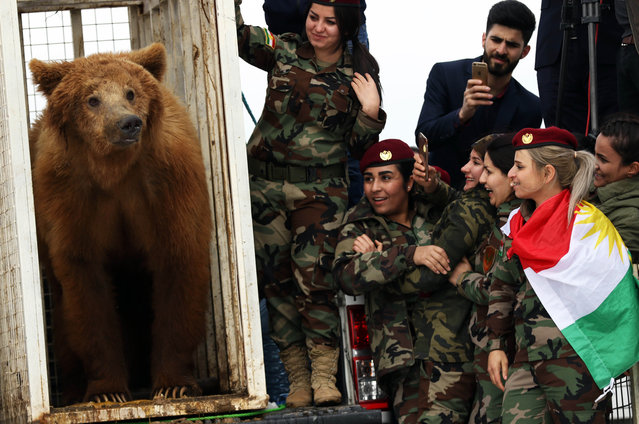
Female Iraqi Kurdish peshmerga fighters watch on as they release a bear into the wild in the Gara Mountains near the northern Iraqi city of Dohuk on March 4, 2018, after Iraqi Kurdish Animal rights activists from a local NGO rescued it from a private home. (Photo by Safin Hamed/AFP Photo)

Female Iraqi Kurdish peshmerga fighters watch on as they release a bear into the wild in the Gara Mountains near the northern Iraqi city of Dohuk on March 4, 2018, after Iraqi Kurdish Animal rights activists from a local NGO rescued it from a private home. (Photo by Safin Hamed/AFP Photo)
Details
06 Mar 2018 09:27:00