Girls refresh themselves and their dog with water spray frames set along the central street of the Ukrainian capital of Kiev during a heatwave on June 25, 2020. (Photo by Sergei Supinsky/AFP Photo)
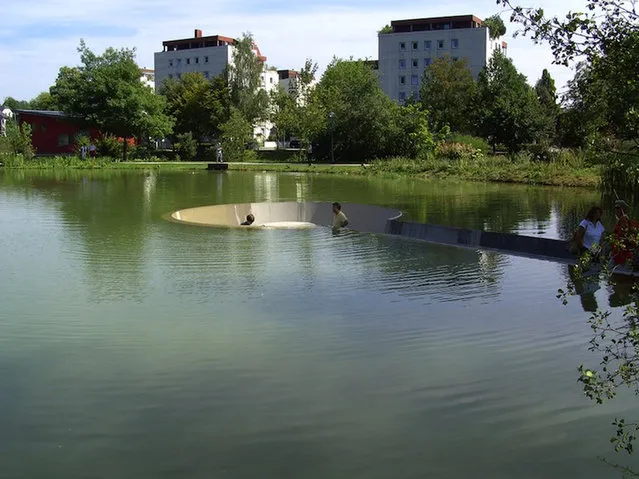
There's a wonderfully picturesque spot in Vöcklabruck, Austria where visitors are able to sit in the middle of a pond without getting wet. The scenic landscape includes a path leading down to a hollowed out circular area where people can take a seat and relax amongst nature. It's a surreal journey along the gradual ramp to the observational platform as the water level gains height either side. Once in the resting area, depending on perspective, visitors seem like they're wading in the lake without a drop of water on them.
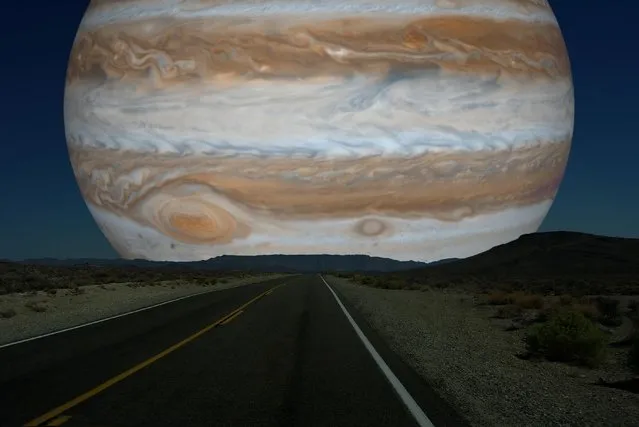
Our moon is a pretty big object. It's big enough to be a respectable planet in its own right, if it were orbiting the sun instead of the Earth. (Actually, it is orbiting the sun in a nearly perfectly circular orbit, that the Earth only slightly perturbs... but that's a topic for another day.) The Moon is a quarter the diameter of the Earth. Only Pluto has a satellite that is larger, in proportion to the size of the planet it orbits.
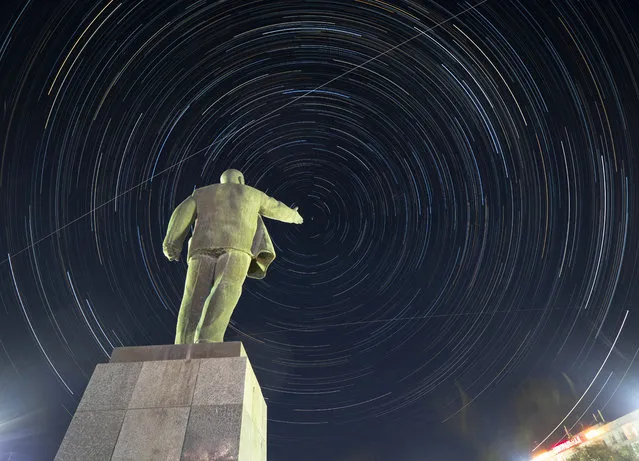
The International Space Station (ISS) moves along its orbit above at the Russian leased Baikonur cosmodrome, Kazakhstan, Thursday, July 18, 2019, with a statue of Soviet Union founder Vladimir Lenin in the foreground. Circular star tracks around the Polar Star and tracks of the ISS is the result of the camera multiple exposure with a total duration of two hours. (Photo by Dmitri Lovetsky/AP Photo)
In northwest Russia, in a small village called Alekhovshchina, Nadia Sablin's aunts spend the warmer months together in the family home and live as the family has always lived, chopping wood to heat the house and making their own clothes. Sablin's book of photographs, “Aunties: The Seven Summers of Alevtina and Ludmila”, is published by Duke University Press. Here: “Two-Handed Saw, 2014”. (Photo by Nadia Sablin)
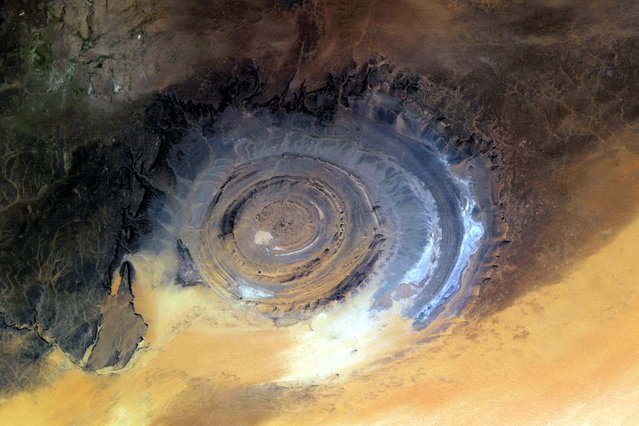
The Richat Structure, also known as the Eye of the Sahara and Guelb er Richat, is a prominent circular feature in the Sahara desert of west–central Mauritania near Ouadane. This structure is a deeply eroded, slightly elliptical, 40 km in diameter, dome. The sedimentary rock exposed in this dome range in age from Late Proterozoic within the center of the dome to Ordovician sandstone around its edges.