Loading...
Done
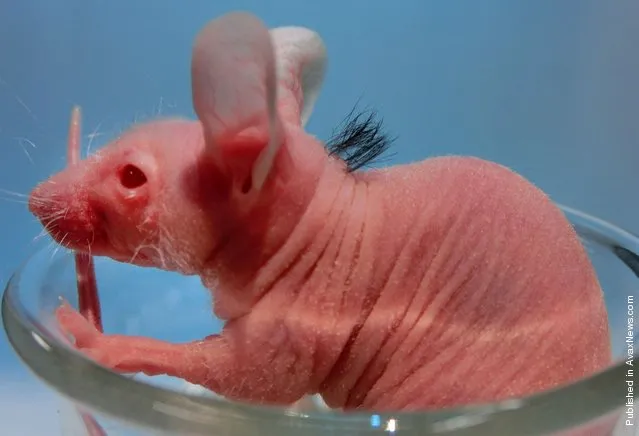
A hairless mouse with black hair on its back at the laboratory in Noda, Chiba Prefecture

Japanese researchers have sparked hopes of finding a cure for human baldness after successfully growing hair on hairless mice by implanting follicles created from stem cells, Agence France Presse reports. A picture taken on April 13, 2012 and released by the Tsuji Lab Research Institute for Science and Technology of the Tokyo University of Science shows a hairless mouse with black hair on its back at the laboratory in Noda, Chiba Prefecture. (Photo by Tokyo University of Science via AFP)
Details
22 Apr 2012 11:53:00
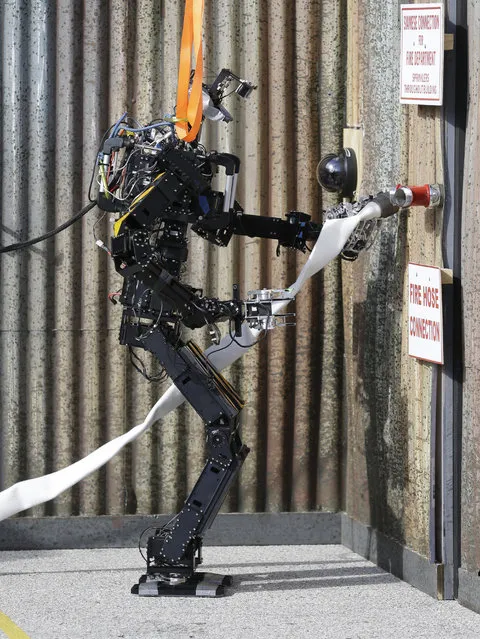
Thor, Virginia Tech College of Engineering, Robotics and Mechanisms Laboratory, tries to connect the hose to a firehose connection during the hose task at the Homestead-Miami Speedway, Friday, December 20, 2013, in Homestead, Fla. Seventeen teams from the United States, China, Japan, and Korea are participating in the DARPA Rpbotics Challenge Trials. The event is a test of some of the most advanced robots in the world. (AP Photo/Alan Diaz)

Thor, Virginia Tech College of Engineering, Robotics and Mechanisms Laboratory, tries to connect the hose to a firehose connection during the hose task at the Homestead-Miami Speedway, Friday, December 20, 2013, in Homestead, Fla. (Photo by Alan Diaz/AP Photo)
Details
03 Jan 2014 09:26:00
Animal rights activists covered with fake blood sit on the floor during a protest against the use of animals in research to mark World Day for Animals in Laboratories in central Madrid April 24, 2014. The sign reads, “How many rabbits do your shampoo kill?”. (Photo by Andrea Comas/Reuters)

Animal rights activists covered with fake blood sit on the floor during a protest against the use of animals in research to mark World Day for Animals in Laboratories in central Madrid April 24, 2014. The sign reads, “How many rabbits do your shampoo kill?”. (Photo by Andrea Comas/Reuters)
Details
26 Apr 2014 11:44:00
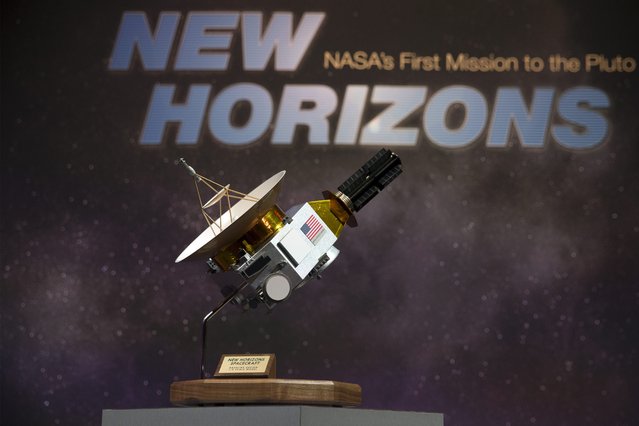
A model of the New Horizons spacecraft is seen at a live television program on NASA television celebrating the spacecraft's closest proximity to Pluto, at Johns Hopkins University Applied Physics Laboratory, site of the mission operations center, in Laurel, Maryland, USA, 14 July 2015. (Photo by Michael Reynolds/EPA)

A model of the New Horizons spacecraft is seen at a live television program on NASA television celebrating the spacecraft's closest proximity to Pluto, at Johns Hopkins University Applied Physics Laboratory, site of the mission operations center, in Laurel, Maryland, USA, 14 July 2015. At approximately 7:49 am ET (11:49 am GMT), 14 July, New Horizons was scheduled to be as close to Pluto as the spacecraft will get; about 7,800 miles (12,500 kilometers) above the surface, following a journey of more than nine years and three billion miles. This is the first mission to the Pluto System and the Kuiper Belt. (Photo by Michael Reynolds/EPA)
Details
15 Jul 2015 10:08:00
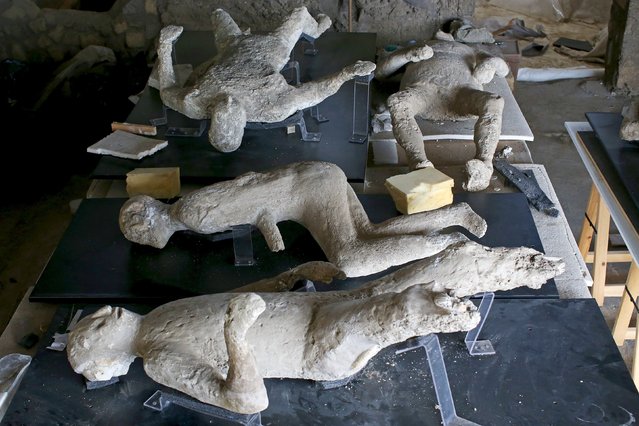
Plaster cast moulds of victims of the Mount Vesuvius eruption lie on a display table in a laboratory at Pompeii October 13, 2015. An expert team made up of archaeologists, radiologists, orthodontists and anthropologists began on September 2015 to use CAT scan technology (computerised axial tomography) to peer inside the plaster cast moulds of Pompeii's victims, in a study that has added more detail to previous findings. (Photo by Alessandro Bianchi/Reuters)

Plaster cast moulds of victims of the Mount Vesuvius eruption lie on a display table in a laboratory at Pompeii October 13, 2015. An expert team made up of archaeologists, radiologists, orthodontists and anthropologists began on September 2015 to use CAT scan technology (computerised axial tomography) to peer inside the plaster cast moulds of Pompeii's victims, in a study that has added more detail to previous findings. A 16-layer scan had to be used in order to penetrate the hardened plaster but the results showed up impressive skeletal remains and near perfect teeth. (Photo by Alessandro Bianchi/Reuters)
Details
22 Oct 2015 08:02:00
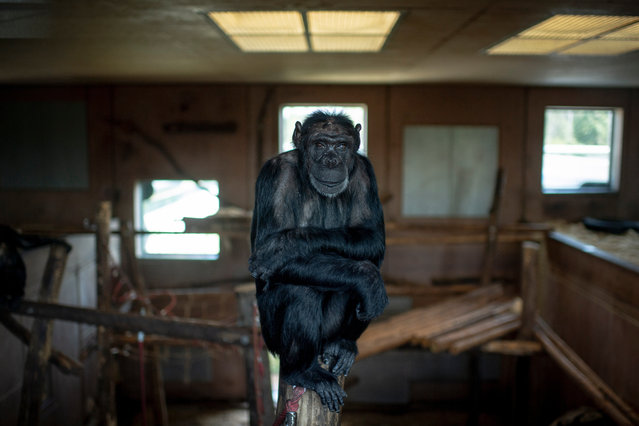
A chimpanzee looks in the direction of a camera at the Gut Aiderbichl Sanctuary for Traumatized Chimpanzees and other Primates in Gaenserndorf, near Vienna, 17 September 2018. 34 former laboratory chimpanzees of former Austrian pharmaceutical company Immuno AG spend their lives at the Gut Aiderbichl Sanctuary for Traumatized Chimpanzees and other Primates since 2009. U.S.-based Baxter International Inc. took over the Immuno AG in 1996, banned experiments with primates and rebuilt a former safari park for the Gut Aiderbichl Sanctuary for Traumatized Chimpanzees and other Primates. After three decades in captivity in too small cages, the chimpanzees, most of them came from Sierra Leone as cubs, have species-appropriate indoor and outdoor enclosures. The financial support by Baxter International Inc. and Austrian officials will end by 2019. (Photo by Christian Bruna/EPA/EFE)

A chimpanzee looks in the direction of a camera at the Gut Aiderbichl Sanctuary for Traumatized Chimpanzees and other Primates in Gaenserndorf, near Vienna, 17 September 2018. 34 former laboratory chimpanzees of former Austrian pharmaceutical company Immuno AG spend their lives at the Gut Aiderbichl Sanctuary for Traumatized Chimpanzees and other Primates since 2009. (Photo by Christian Bruna/EPA/EFE)
Details
23 Sep 2018 00:03:00
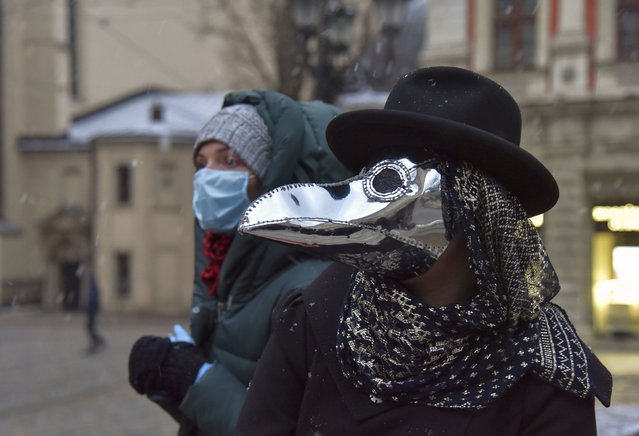
A woman wearing a protective mask is seen behind a girl dressed in a Plague Doctor Mask in Western-Ukrainian city of Lviv, Ukraine, 22 March 2020. Ukrainian Designer Anastasia Markovska sewed protective masks looking like Plague Doctor Masks, the traditional costume of Venice Carnival, for herself and her friends due to the ongoing pandemic of the COVID-19 disease caused by the SARS-CoV-2 coronavirus. In Ukraine had been 47 laboratory-confirmed cases of COVID-19, including three deaths and one recovery as Ukraine's Health Ministry announced. (Photo by Pavlo Palamarchuk/EPA/EFE)

A woman wearing a protective mask is seen behind a girl dressed in a Plague Doctor Mask in Western-Ukrainian city of Lviv, Ukraine, 22 March 2020. Ukrainian Designer Anastasia Markovska sewed protective masks looking like Plague Doctor Masks, the traditional costume of Venice Carnival, for herself and her friends due to the ongoing pandemic of the COVID-19 disease caused by the SARS-CoV-2 coronavirus. In Ukraine had been 47 laboratory-confirmed cases of COVID-19, including three deaths and one recovery as Ukraine's Health Ministry announced. (Photo by Pavlo Palamarchuk/EPA/EFE)
Details
02 May 2020 00:05:00
Atomic Annie at work during the Upshot-Knothole test series, 1953. (Photo by Los Alamos National Laboratory/US Army)

“A fter the former Soviet Union conducted its first nuclear test in August 1949, the US reevaluated its postwar defense policies. With the US monopoly on atomic weapons broken, military and political leaders chose to diversify the American stockpile by developing thermonuclear and tactical nuclear weapons. One of the more interesting concepts to come out of this period was atomic artillery, which was successfully tested at the Nevada Proving Grounds (now the Nevada Test Site) in May 1953”. – Alan Carr. Photo: Atomic Annie at work during the Upshot-Knothole test series, 1953. (Photo by Los Alamos National Laboratory/US Army)
Details
11 Mar 2013 11:43:00