Artist Kong Ning wears a wedding dress made from respirators to highlight concerns about air quality and pollution in Beijing, China on December 1, 2015. (Photo by Luo Xiaoguang/Xinhua Press/Corbis)
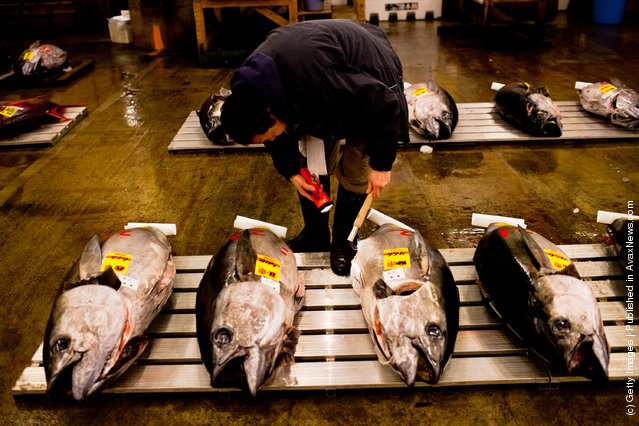
A potential bidder carefully examines pieces of Tuna in order to ascertain the quality and to estimate its price ahead of the Tuna auction at the Tsukiji fish market on February 28, 2012 in Tokyo, Japan. (Photo by Daniel Berehulak /Getty Images)
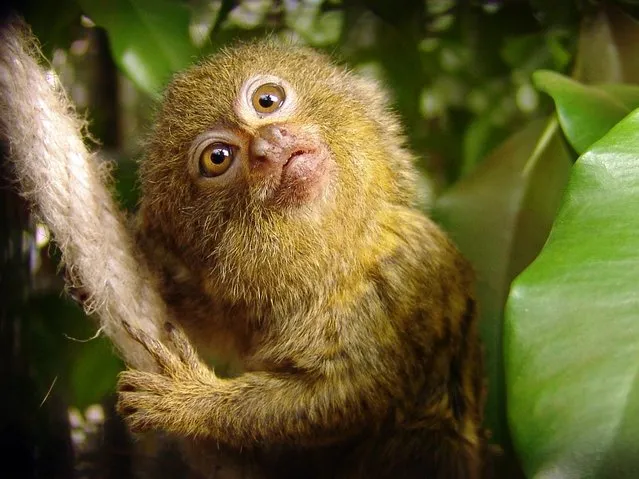
The pygmy marmoset (Cebuella pygmaea) is a small New World monkey native to rainforests of the western Amazon Basin in South America. It is notable for being the smallest monkey in the world at just over 100 grams (3.5 oz). It is generally found in evergreen and river edge forests and is a gum-feeding specialist
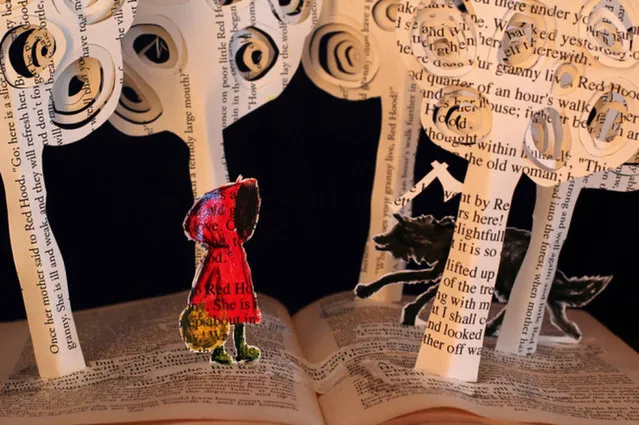
Justin Rowe creates these magical sculptures from hand cut books and found images with the help of just a touch of gum arabic and 24 carat gold or palladium leaf. Some are very much in the realms of fairy stories like the one above, but my favourites are the stories below where Justin’s skill brings the book’s own illustrations to life.
Girls in red neckerchiefs dance on Red Square, with the GUM, the State Department Store and the Historical Museum in the background, during a ceremony to celebrate joining the Pioneers organization and 100th anniversary of the All-Union Pioneer Organization, in Moscow, Russia, Sunday, May 22, 2022. Pro-Communist Russians are trying to preserve the Young Pioneers, which used to be the Communist league for pre-teens in the Soviet Union. (Photo by AP Photo/Stringer)
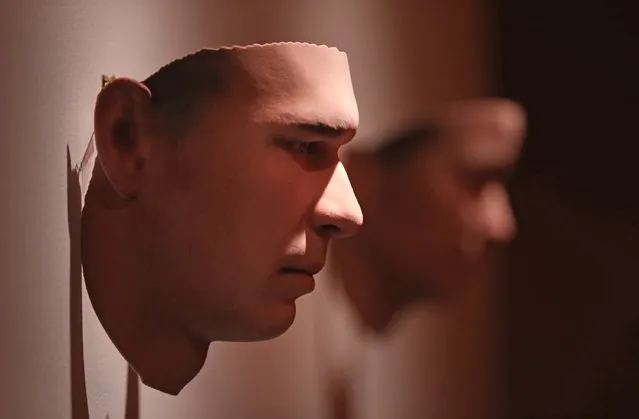
Artist Heather Dewey-Hagborg's 'Stranger Visions', comprising of 3D printed faces extracted from DNA taken from discarded cigarette butts and chewing gum, is displayed at the Big Bang Data exhibition at Somerset House on December 2, 2015 in London, England. The show highlights the data explosion that's radically transforming our lives. It opens on December 3, 2015 and runs until February 28, 2016 at Somerset House. (Photo by Peter Macdiarmid/Getty Images for Somerset House)
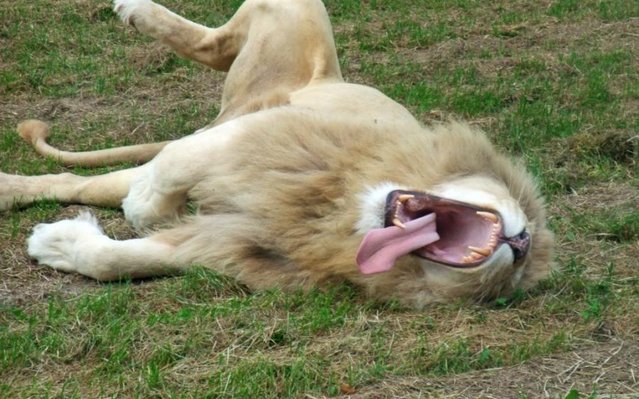
In animals, yawning can serve as a warning signal. For example, Charles Darwin, in his book The Expression of the Emotions in Man and Animals, mentioned that baboons yawn to threaten their enemies, possibly by displaying large canine teeth. Similarly, Siamese fighting fish yawn only when they see a conspecific (same species) or their own mirror-image, and their yawn often accompanies aggressive attack. Guinea pigs also yawn in a display of dominance or anger, displaying their impressive incisor teeth. This is often accompanied by teeth chattering, purring and scent marking.
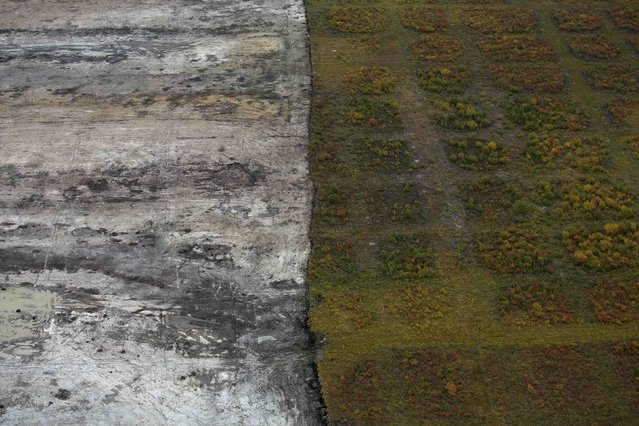
The top layer of muskeg and earth (L) is removed at the Syncrude tar sands operations near Fort McMurray, Alberta, September 17, 2014. Syncrude currently produces 350,000 barrels per day of high quality light, low sulphur crude oil according to company reports. (Photo by Todd Korol/Reuters)