Loading...
Done
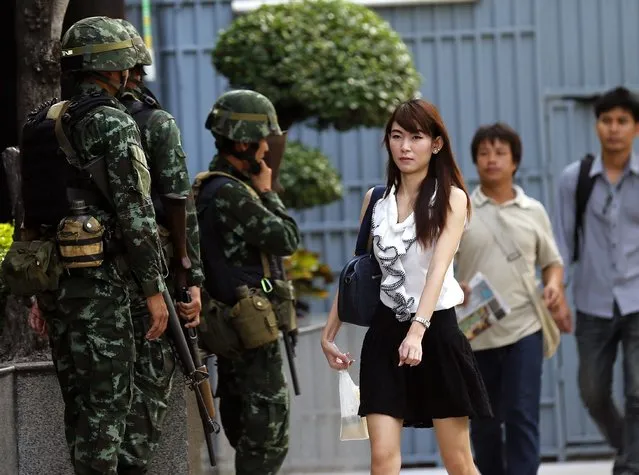
Thai office workers walk past armed soldiers standing guard outside the Shinawatra Tower Two in Bangkok, Thailand, 20 May 2014. Thai army Chief Prayuth Chan-ocha early on 20 May 2014, declared martial law giving the military full control to prevent further protest-related violence in the country. (Photo by Narong Sangnak/EPA)

Thai office workers walk past armed soldiers standing guard outside the Shinawatra Tower Two in Bangkok, Thailand, 20 May 2014. Thai army Chief Prayuth Chan-ocha early on 20 May 2014, declared martial law giving the military full control to prevent further protest-related violence in the country. The statement was issued about 3 am on 20 May (2000 GMT), according to local media reports. Prayuth has the authority to declare martial law without the consent of the government, which has had caretaker status since 09 December 2013. Thailand has been wracked by six months of non-stop protests seeking to topple the government. At least 25 people have died in political-related violence and more than 700 injured. (Photo by Narong Sangnak/EPA)
Details
21 May 2014 10:09:00
Fun Laws In America By Olivia Locher

Many laws still in existence throughout the united states are wildly outdated, rendering them completely ridiculous, useless and bizarre. The absurdity is illustrated by new York-based photographer Olivia Locher, who catalogs the crazy rules and regulations of each state in a playful photographic series ‘I fought the law’. Readers might be surprised to learn that in Rhode island, it is illegal to wear transparent clothing, nobody is allowed to ride a bicycle in a swimming pool in California and Arizona residents may not have more than two dildos in a house. Take a look at the ongoing series below to find out more about the peculiar oddities present in the American legal system.
Details
09 Jun 2014 11:36:00
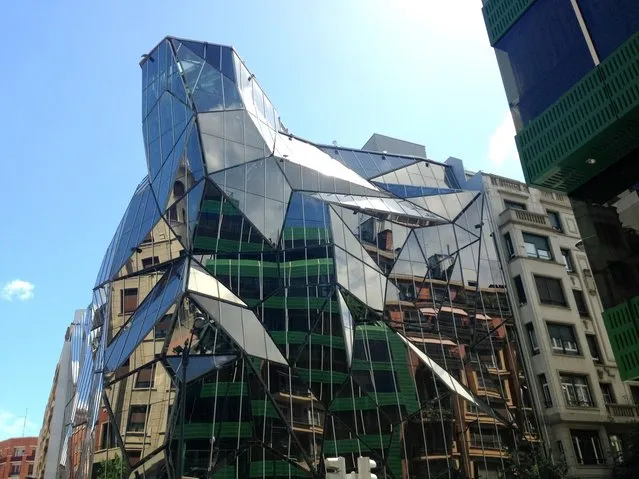
Basque Health Department Headquarters In Bilbao

The Spanish city of Bilbao, known architecturally for its Guggenheim, has a new(ish) architectural icon. Not that it’s replacing Ghery’s work, just another one.
Details
01 May 2014 11:38:00
Crystal, 15, a part-time boutique sales assistant, poses on Nathan Road in Mongkok shopping district in Hong Kong October 7, 2014. Holding a walkie talkie for fast communication with other supporters, Crystal said, “I am not demanding Chief Executive Leung Chun-ying to quit, but (want) to protect protesters from being threatened badly by opponents and the police”. (Photo by Bobby Yip/Reuters)

Reuters photographers Carlos Barria and Bobby Yip photographed protestors and details of life on the barricades, asking demonstrators what their role was in the movement, and what they wanted to happen. Here: Crystal, 15, a part-time boutique sales assistant, poses on Nathan Road in Mongkok shopping district in Hong Kong October 7, 2014. Holding a walkie talkie for fast communication with other supporters, Crystal said, “I am not demanding Chief Executive Leung Chun-ying to quit, but (want) to protect protesters from being threatened badly by opponents and the police”. (Photo by Bobby Yip/Reuters)
Details
09 Oct 2014 12:53:00
Lv Mengmeng, who was born in 1995, poses for a photograph in Shanghai August 22, 2014. When asked if she would like siblings, Mengmeng said: “Maybe brothers, because I think they could protect me”. (Photo by Carlos Barria/Reuters)

Reuters Photographer Carlos Barria photographed a person born in each year China's one child policy has been in existence; from a man born in 1979, to a baby born in 2014, and asked them if they would have like to have siblings. Here: Lv Mengmeng, who was born in 1995, poses for a photograph in Shanghai August 22, 2014. When asked if she would like siblings, Mengmeng said: “Maybe brothers, because I think they could protect me”. (Photo by Carlos Barria/Reuters)
Details
06 Oct 2014 08:20:00
Kawakanih Yawalapiti, 9, Upper Xingu region of Mato Grosso, Brazil, 2018: Kawakanih lives with her tribe, the Yawalapiti, in Xingu national park, a preserve in the Amazon basin of Brazil. The Yawalapiti collect seeds to preserve species unique to their ecosystem, which lies between the rain forest and savannah. Kawakanih’s diet is simple, consisting mainly of fish, cassava, porridge, fruit and nuts. “It takes five minutes to catch dinner”, says Kawakanih. “When you’re hungry, you just go to the river with your net”. (Photo by Gregg Segal/The Guardian)

Photographer Gregg Segal travelled the world to document children and the food they eat in a week. Partly inspired by the increasing problems of childhood obesity, he tracked traditional regional diets as yet unaffected by globalisation, and ironically, found that the healthiest diets were often eaten by the least well off. (Photo by Gregg Segal/The Guardian)
Details
03 Jul 2019 00:03:00
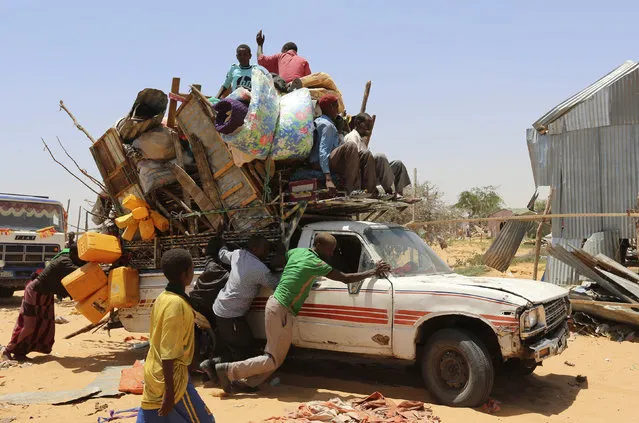
More than 6 billion people live in countries where serious levels of public sector corruption are fueling inequality and exploitation, according to Transparency International's 2015 index of perceived public sector corruption. The group's annual report measures perceptions of corruption due to the secrecy surrounding most corrupt dealings. Two thirds of the 168 countries assessed were identified as having a serious corruption problem. Somalia, which has been mired in conflict since civil war broke out in 1991, ranks bottom of the list. (Photo by Feisal Omar/Reuters)

More than 6 billion people live in countries where serious levels of public sector corruption are fueling inequality and exploitation, according to Transparency International's 2015 index of perceived public sector corruption. The group's annual report measures perceptions of corruption due to the secrecy surrounding most corrupt dealings. Two thirds of the 168 countries assessed were identified as having a serious corruption problem. Somalia, which has been mired in conflict since civil war broke out in 1991, ranks bottom of the list. (Photo by Feisal Omar/Reuters)
Details
13 May 2016 12:10:00


A man speaks on his mobile phone on May 31, 2011 in New York City. In a new report by 31 scientists meeting at the World Health Organization's International Agency for Research on Cancer (WHO/IARC) it was found that using a mobile phone may increase your risk for certain kinds of brain cancers. While further scientific work will be conducted, the group of scientists from 14 countries classified cell phones in the carcinogenic category 2B, which is similar to the pesticide DDT and gasoline engine exhaust. (Photo by Spencer Platt/Getty Images)
Details
01 Jun 2011 06:40:00