Loading...
Done
Afghanistan: Dogs of War Part 1

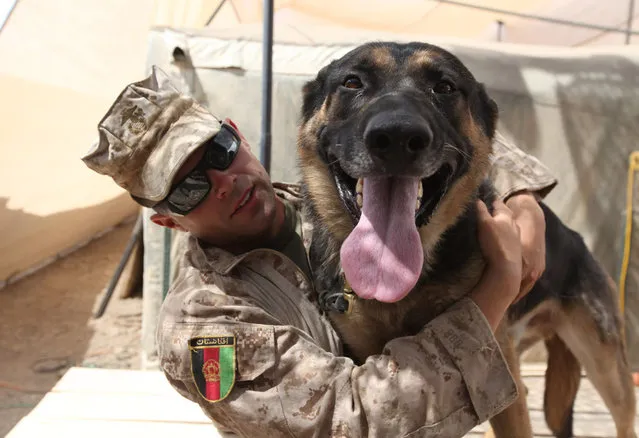
Throughout the course of the long war in Afghanistan, Coalition troops have relied on thousands of military working dogs to help keep them safe, and make their jobs easier. The dogs are trained to detect explosives, to find illegal drugs, to search for missing comrades, or target enemy combatants. Not only are they active on the front lines, but behind the lines they serve as therapy dogs, service dogs, and loyal companions. They also share the same risks as the ground troops, suffering injuries and sometimes death on the battlefields. Gathered here are images of these dogs and their handlers in Afghanistan and back home, from over the past several years, part of the ongoing series here on Afghanistan.
Details
03 Jun 2014 21:02:00
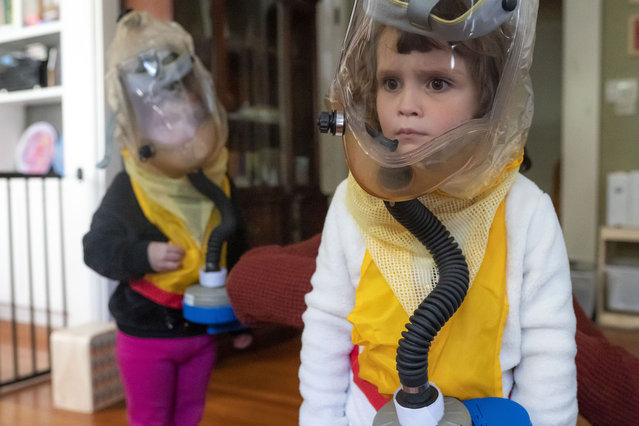
Buddy Mae Walker (R), 4, looks at herself in the mirror while trying on a child respirator provided by the non-profit TeamRaccoonPDX on October 6, 2020 in Portland, Oregon. (Photo by Nathan Howard/Getty Images)

Buddy Mae Walker (R), 4, looks at herself in the mirror while trying on a child respirator provided by the non-profit TeamRaccoonPDX on October 6, 2020 in Portland, Oregon. We told them their grandparents sent them space suits to keep them safe, Jessica Walker said of the respirators, which the family sought out after police used tear gas near their residential street. (Photo by Nathan Howard/Getty Images)
Details
13 Oct 2020 00:05:00
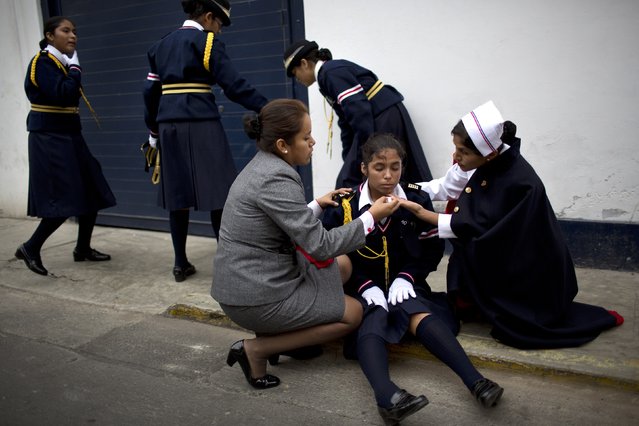
A student is assisted by teachers after she fell ill while marching in a parade celebrating Saint Peter's day in Lima, Peru, Monday, June 29, 2015. (Photo by Rodrigo Abd/AP Photo)

A student is assisted by teachers after she fell ill while marching in a parade celebrating Saint Peter's day in Lima, Peru, Monday, June 29, 2015. During the feast day of the Catholic saint, who is the patron saint of fishermen, coastal communities pay homage to St. Peter, whose statue is paraded to the sea and petitions are made to keep their vessels and all who work on them safe. (Photo by Rodrigo Abd/AP Photo)
Details
01 Jul 2015 13:46:00
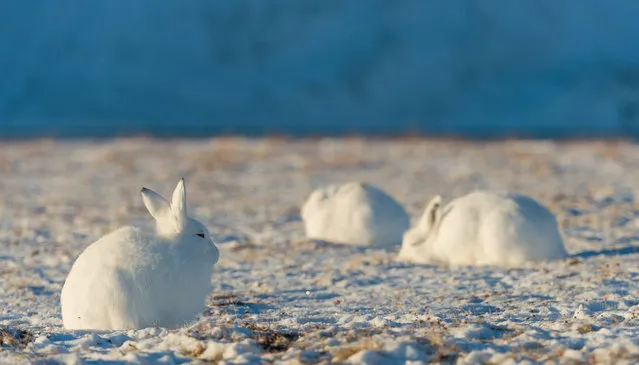
Arctic Hare

The arctic hare, or polar rabbit, is a species of hare which is adapted largely to polar and mountainous habitats. The arctic hare survives with a thick coat of fur and usually digs holes in the ground or under snow to keep warm and sleep. Arctic hares look like rabbits but have shorter ears, are taller when standing, and, unlike rabbits, can thrive in cold climates. They can travel together with many other hares, sometimes huddling with dozens or more, but are usually found alone, taking, in some cases, more than one partner. The arctic hare can run up to 60 kilometres per hour (40 mph). Its predators include the arctic wolf, arctic fox, and ermine.
Details
17 Mar 2014 13:56:00
How To Pass Time On Your Commute To Work

We all have our own ways of passing time on our daily commutes. Some people read, others try to sleep, and many listen to music or play on their phones. But one creative commuter has a simple and highly entertaining way that hopefully more people will embrace. By placing a face from a newspaper in front of a person at just the right angle, they transform other commuters into recognizable celebrities while keeping the unbeknownst participant obscured.
Details
02 Jul 2013 10:46:00
Moon jellyfish and cross jellies. (Photo by David Hall)

David Hall’s photographs of scenery and creatures off the coast of Canada in the Pacific Northwest portray serenity under the water, which belie the extreme challenges he faces to get his images. For each shoot, Hall wears a dry suit, a neoprene body suit that covers all of his body but his head and traps air inside to keep him warm. Water temperature in Canada’s British Columbia typically ranges between 45 and 50 degrees Fahrenheit. Photo: Moon jellyfish and cross jellies. (Photo by David Hall)
Details
16 Sep 2014 12:57:00
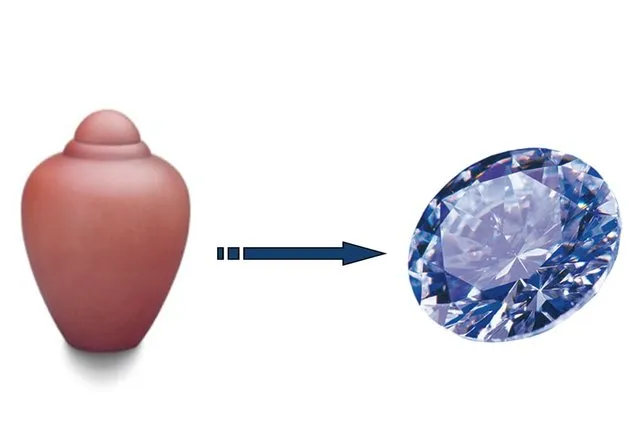
Swiss Company Turns People’s Ashes Into Diamonds

In the past people used to bury their loved ones or turn them into ashes. However, now there is a completely new possibility. Since having an urn with ashes in your house may be a bit weird, you may want to choose the option of turning your deceased relative into a diamond. Yes, diamond! You’ve heard us correctly. By using immense heat and pressure, the ashes you get after cremating a person can be turned into a real diamond. After this, the diamond can be left as it is, and stored in a jewelry box, or it can be used as a piece of jewelry, such as a ring or a pendant, allowing you to always keep your loved one close to your heart. (Photo by djd/Algordanza memorial diamonds)
Details
20 Oct 2014 08:52:00
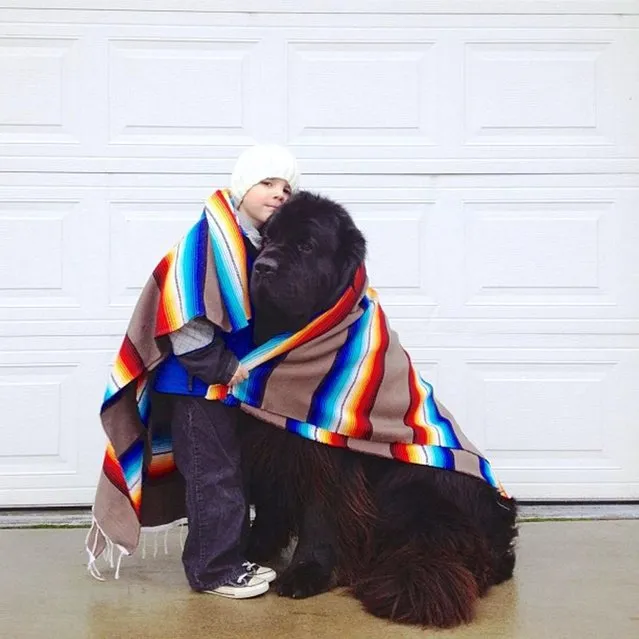
Hats off (or on) to Julian for sharing his blanket with his good buddy. Not that the furry beast needs it... (Photo by Stasha Becker/Rex Features)

Five-year-old Julian Becker and his 165 pound pet Newfoundland Max have been best buds around all their lives. To commemorate the friendship and to keep Julian's father, a Naval officer who is often away, in the loop, Julian's mom Stasha began taking photos. Photo: Hats off (or on) to Julian for sharing his blanket with his good buddy. Not that the furry beast needs it... (Photo by Stasha Becker/Rex Features)
Details
12 Apr 2013 11:29:00