Loading...
Done
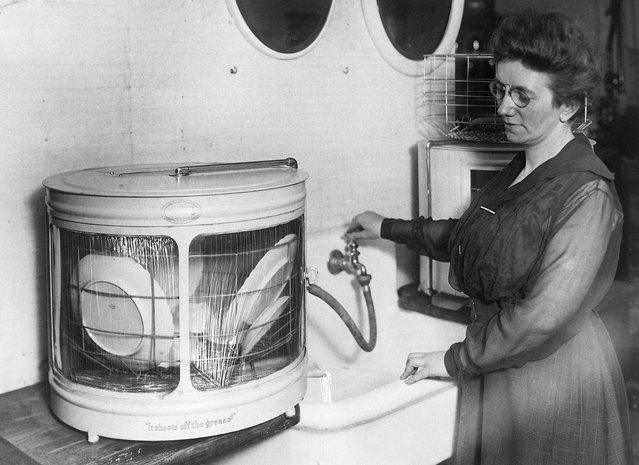
All the drugery of dishwashing in this three-times -a day task, which comes to the house wife who does her own house work, has been eliminated by the new dish washer shown in the photograph on April 25, 1921. It is the invention of a Cincinnati school teacher, who sought to make things a bit more pleasant for his wife. Incedently, his idea was worth 12,00 to him, for a manufacturing concern thought so much of the “dish-washer” they purchased the rights and will seek to add a little joy to thousands of other housewives. With the aid of only hot water, dishes placed in a wire rack and set into the drum are made clean and spotless in two minutes. (Photo by Bettmann Archive/Getty Images)

All the drugery of dishwashing in this three-times -a day task, which comes to the house wife who does her own house work, has been eliminated by the new dish washer shown in the photograph on April 25, 1921. It is the invention of a Cincinnati school teacher, who sought to make things a bit more pleasant for his wife. Incedently, his idea was worth 12,00 to him, for a manufacturing concern thought so much of the “dish-washer” they purchased the rights and will seek to add a little joy to thousands of other housewives. With the aid of only hot water, dishes placed in a wire rack and set into the drum are made clean and spotless in two minutes. (Photo by Bettmann Archive/Getty Images)
Details
08 Jul 2021 10:25:00
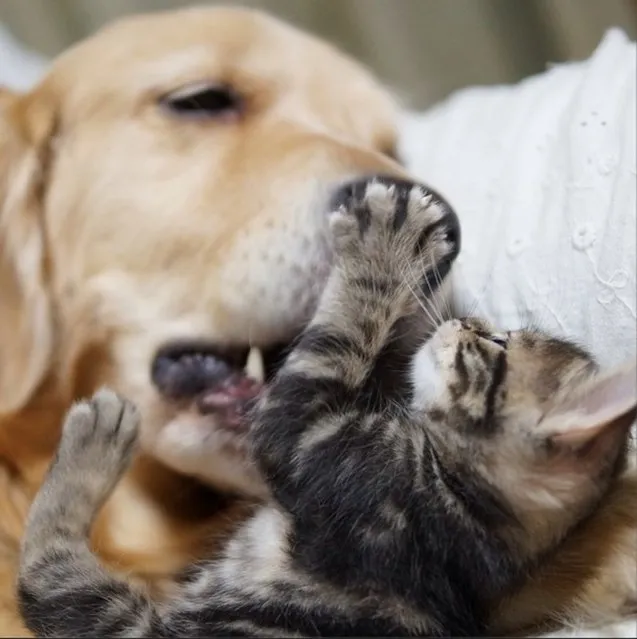
Golden Retriever Adopted A Kitten

There is nothing more endearing than seeing true friendship and love. Especially, if it as improbable as that of a big dog and a tiny kitten. Somehow, animals feel when they are dealing with a baby. For example, no matter how much a toddler will tug on the tail of a cat and play roughly with it, it will never or very rarely fight back. This set of pictures taken by Jessie Pon shows a tiny kitten mistaking an adult golden retriever for his mother. Though it may hurt the dog’s nose with its sharp claws, the dog does nothing to harm the kitty. On the contrary, it’s watching over the kitty-cat as if it were her own puppy. (Photo by Jessie Pon)
Details
03 Nov 2014 12:34:00
Moraine Lake Canada

Moraine Lake is a glacially-fed lake in Banff National Park, 14 kilometres (8.7 mi) outside the Village of Lake Louise, Alberta, Canada. It is situated in the Valley of the Ten Peaks, at an elevation of approximately 6,183 feet (1,885 m). The lake has a surface area of .5 square kilometres (0.19 sq mi). The lake, being glacially fed, does not reach its crest until mid to late June. When it is full, it reflects a distinct shade of blue. The colour is due to the refraction of light off the rock flour deposited in the lake on a continual basis.
Details
15 Oct 2013 11:56:00
Audi E-Bike Worthersee

One of the highlights on the Audi stand is the bicycle technology concept known as the Audi e-bike Wörthersee – a sport bike that does not fit into any of the usual categories. It is neither a pedelec nor a conventional bike, but is best described as a high-end pedelec made by Audi for sport, fun and tricks. The Audi e-bike Wörthersee combines the Audi brand’s principal competences – design, ultra, connect and e-tron – and explores the limits of what is technically feasible in terms of design, lightweight construction, networking and electric mobility.
Details
11 Jul 2014 11:34:00
An Afghan woman fills containers with water near her temporary shelter at an internally displaced person's (IDP) camp on the outskirts of Herat, Afghanistan, January 21, 2015. Dozens of families are living in temporary shelters even in harsh winters and most depend on aid distributions by the United Nations High Commissioner for Refugees (UNHCR). (Photo by Jalil Rezayee/EPA)

An Afghan woman fills containers with water near her temporary shelter at an internally displaced person's (IDP) camp on the outskirts of Herat, Afghanistan, January 21, 2015. Dozens of families are living in temporary shelters even in harsh winters and most depend on aid distributions by the United Nations High Commissioner for Refugees (UNHCR). (Photo by Jalil Rezayee/EPA)
Details
23 Jan 2015 12:35:00
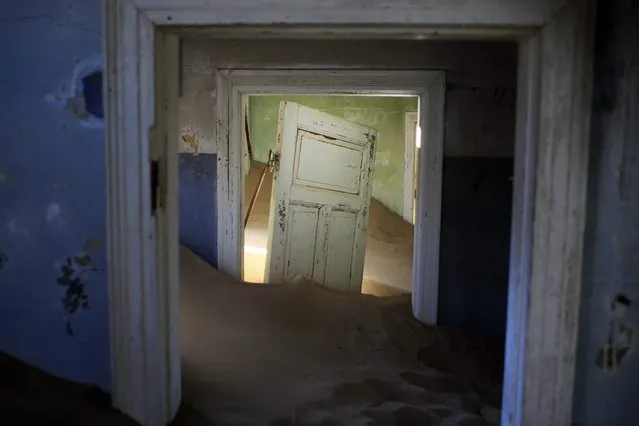
In this July 23, 2013 photo, sand fills an abandoned house in Kolmanskop, Namibia. Kolmanskop, was a diamond mining town south of Namibia, build in 1908 and deserted in 1956. SInce then, the desert slowly reclaims its territory, with sand invading the buildings where 350 German colonists and more than 800 local workers lived during its hay-days of the 1920s. (Photo by Jerome Delay/AP Photo)

In this July 23, 2013 photo, sand fills an abandoned house in Kolmanskop, Namibia. Kolmanskop, was a diamond mining town south of Namibia, build in 1908 and deserted in 1956. SInce then, the desert slowly reclaims its territory, with sand invading the buildings where 350 German colonists and more than 800 local workers lived during its hay-days of the 1920s. (Photo by Jerome Delay/AP Photo)
Details
14 Nov 2014 14:34:00
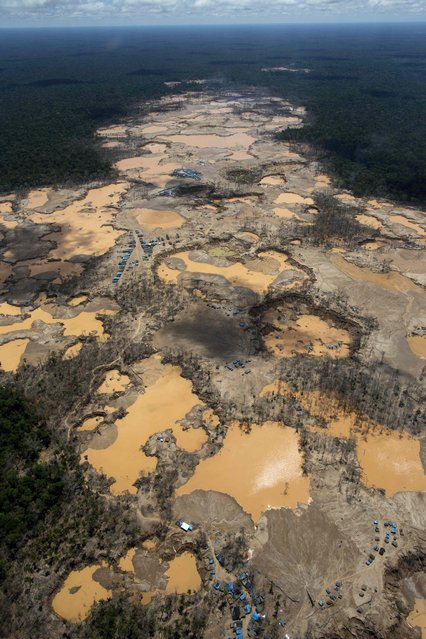
This November 11, 2014 aerial photo, shows a deforested area dotted with blue tarps, marking the area where miners reside, and craters filled with water, caused by illegal gold mining activities, in La Pampa, in Peru's Madre de Dios region. (Photo by Rodrigo Abd/AP Photo)

This November 11, 2014 aerial photo, shows a deforested area dotted with blue tarps, marking the area where miners reside, and craters filled with water, caused by illegal gold mining activities, in La Pampa, in Peru's Madre de Dios region. Less than a month before Peru plays host to global climate talks, the government sent a battalion of police into southeastern jungles to dismantle illegal gold-mining mining camps. Peru's anti-illegal mining czar, retired army Gen. Augusto Soto, marched the men to the wasteland known as La Pampa, where 50,000 hectares of rainforest have been obliterated in the past six years. (Photo by Rodrigo Abd/AP Photo)
Details
21 Nov 2014 12:35:00


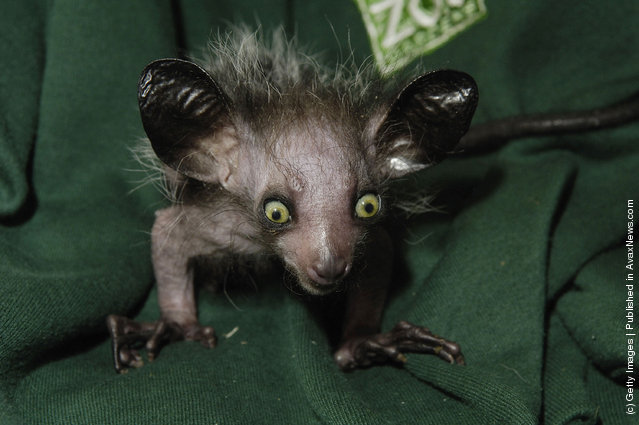
“The aye-aye (Daubentonia madagascariensis) is a lemur, a strepsirrhine primate native to Madagascar that combines rodent-like teeth and a special thin middle finger to fill the same ecological niche as a woodpecker. It is the world's largest nocturnal primate, and is characterized by its unusual method of finding food; it taps on trees to find grubs, then gnaws holes in the wood and inserts its narrow middle finger to pull the grubs out. The only other animal species known to find food in this way is the striped possum. From an ecological point of view the aye-aye fills the niche of a woodpecker as it is capable of penetrating wood to extract the invertebrates within”. – Wikipedia

Photo: In this handout image from Bristol Zoo is seen the first captive bred aye-aye in the UK named “Kintana” (meaning star in Malagasy) April 15, 2005 at Bristol Zoo Gardens, England. The zoo announced today only the second baby aye-aye to be hand-reared in the world (the first was in Jersey Zoo) and has now made his first public appearance since his birth on 11 February 2005. (Photo by Rob Cousins/Bristol Zoo via Getty Images)
Details
13 Apr 2011 13:33:00