Loading...
Done
Burning Man Festival

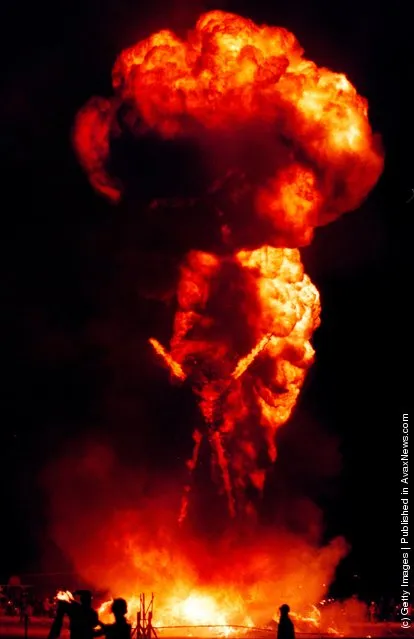
“Burning Man is a week-long annual event held in the Black Rock Desert in northern Nevada, in the United States. The event starts on the Monday before the American Labor Day holiday, and ends on the holiday itself. It takes its name from the ritual burning of a large wooden effigy on Saturday evening. The event is described by many participants as an experiment in community, radical self-expression, and radical self-reliance”. – Wikipedia

Photo: A fireball billows up from a 52-foot tall wooden man as it goes up in flames September 2, 2000 during the15th annual Burning Man festival in the Black Rock Desert near Gerlach, Nevada. Despite high winds, dust storms, and a bit of rain, some 27,000 people camped out on a remote desert playa, or dry lake, for the week-long counter-cultural celebration of art and “radical self-expression”. (Photo by David McNew/Newsmakers)
Details
15 Oct 2011 10:41:00
A porter stands at the bottom of the Illimani mountain, on the outskirts of La Paz, Bolivia, April 16, 2016. (Photo by David Mercado/Reuters)

A porter stands at the bottom of the Illimani mountain, on the outskirts of La Paz, Bolivia, April 16, 2016. For years, Lydia Huayllas, 48, has worked as a cook at base camps and mountain-climbing refuges on the steep, glacial slopes of Huayna Potosi, a 19,974-foot (6,088-meter) Andean peak outside of La Paz, Bolivia. But two years ago, she and 10 other Aymara indigenous women, ages 42 to 50, who also worked as porters and cooks for mountaineers, put on crampons – spikes fixed to a boot for climbing – under their wide traditional skirts and started to do their own climbing. (Photo by David Mercado/Reuters)
Details
22 Apr 2016 12:33:00
The Ivanpah Solar Electric Generating System is seen in an aerial view on February 20, 2014 in the Mojave Desert in California near Primm, Nevada. (Photo by Ethan Miller/Getty Images)

The Ivanpah Solar Electric Generating System is seen in an aerial view on February 20, 2014 in the Mojave Desert in California near Primm, Nevada. The largest solar thermal power-tower system in the world, owned by NRG Energy, Google and BrightSource Energy, opened last week in the Ivanpah Dry Lake and uses 347,000 computer-controlled mirrors to focus sunlight onto boilers on top of three 459-foot towers, where water is heated to produce steam to power turbines providing power to more than 140,000 California homes. (Photo by Ethan Miller/Getty Images)
Details
14 Apr 2014 11:01:00
Dive The Deadly Jacob’s Well In Texas

Jacob's Well is a perennial karstic spring in the Texas Hill Country flowing from the bed of Cypress Creek, located northwest of Wimberley, Texas. The twelve foot (four meter) diameter mouth of the spring serves as a popular swimming spot for the local land owners whose properties adjoin Cypress Creek. From the opening in the creek bed, Jacob's Well cave descends vertically for about thirty feet (ten meters), then continues downward at an angle through a series of silted chambers separated by narrow restrictions, finally reaching a depth of one hundred and twenty feet (forty meters). Until the modern era, the Trinity Aquifer-fed natural artesian spring gushed water from the mouth of the cave, with a measured flow in 1924 of one hundred and seventy gallons per second (six hundred and forty liters per second) discharging six feet (two meters) into the air. The spring is the greatest source of water recharging the Edwards Aquifer.
Details
03 Jan 2014 08:20:00
Justin Nelzen, in red vest, joins others as they work to rescue up to 70 horses along Cypresswood Drive near Humble along Cypress Creek, Monday, April 18, 2016, in Houston. (Photo by Mark Mulligan/Houston Chronicle via AP Photo)

Justin Nelzen, in red vest, joins others as they work to rescue up to 70 horses along Cypresswood Drive near Humble along Cypress Creek, Monday, April 18, 2016, in Houston. More than a foot of rain fell Monday in parts of Houston, submerging scores of subdivisions and several major interstate highways, forcing the closure of schools and knocking out power to thousands of residents who were urged to shelter in place. (Photo by Mark Mulligan/Houston Chronicle via AP Photo)
Details
19 Apr 2016 13:21:00
British artist Lucy Sparrow, 32, adjusts bottles of alcohol on shelves in her art installation supermarket in which everything is made of felt, in Los Angeles, California on July 31, 2018. (Photo by Lucy Nicholson/Reuters)

British artist Lucy Sparrow makes her West Coast debut this week with a nearly 2,800-square-foot supermarket in which everything is made completely of the crafting fabric beloved by kindergarten teachers and camp counselors. The installation, which is staged inside the Standard, Downtown L.A. and runs August 1 to 31, is fully shoppable. Here: Lucy Sparrow, 32, adjusts bottles of alcohol on shelves in her art installation supermarket in which everything is made of felt, in Los Angeles, California on July 31, 2018. (Photo by Lucy Nicholson/Reuters)
Details
02 Aug 2018 00:01:00
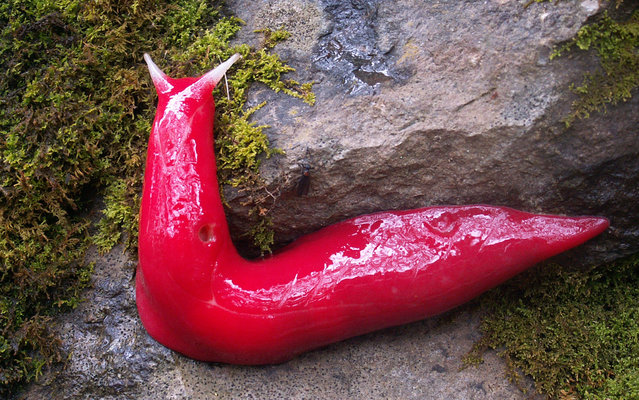
It would seem to be something you'd see only in a cartoon or at a Phish concert, but according to park rangers in New South Wales, Australia, dozens of giant, fluorescent pink slugs have been popping up on a mountaintop there. (Photo by Michael Murphy/AFP Photo/NSW Environment Office)

It would seem to be something you'd see only in a cartoon or at a Phish concert, but according to park rangers in New South Wales, Australia, dozens of giant, fluorescent pink slugs have been popping up on a mountaintop there. The eight-inch creatures have been spotted only on Mount Kaputar, a 5,000-foot peak in the Nandewar Range in northern New South Wales. Scientists believe the eye-catching organisms are survivors from an era when Australia was home to rainforests. A series of volcanoes, millions of years of erosion and other geological changes “have carved a dramatic landscape at Mount Kaputar”, the park service wrote on its Facebook page, and unique arid conditions spared the slugs from extinction. (Photo by Michael Murphy/AFP Photo/NSW Environment Office)
Details
01 Jun 2013 14:09:00
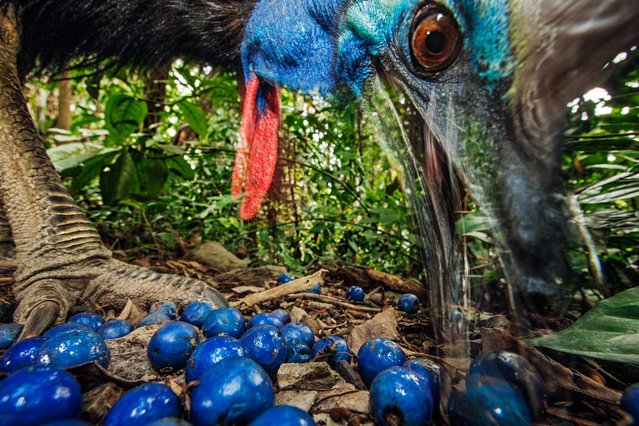
“Cassowaries are large, flightless birds related to emus and (more distantly) to ostriches, rheas, and kiwis”, writes Olivia Judson in the September issue of National Geographic magazine. (Photo by Christian Ziegler/National Geographic)

“Cassowaries are large, flightless birds related to emus and (more distantly) to ostriches, rheas, and kiwis”, writes Olivia Judson in the September issue of National Geographic magazine. How large? People-size: Adult males stand well over five foot five and top 110 pounds. Females are even taller, and can weigh more than 160 pounds. Dangerous when roused, they’re shy and peaceable when left alone. But even birds this big and tough are prey to habitat loss. The dense New Guinea and Australia rain forests where they live have dwindled. Today cassowaries might number 1,500 to 2,000. And because they help shape those same forests – by moving seeds from one place to another – “if they vanish”, Judson writes, “the structure of the forest would gradually change” too. (Photo by Christian Ziegler/National Geographic)
Details
06 Jan 2014 12:21:00