Loading...
Done
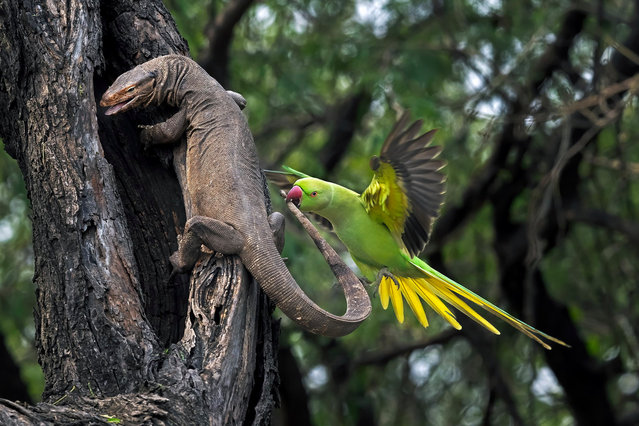
Hira Punjabi, from Maharashtra, India, took this stunning photo of a parakeet attacking a tree-climbing lizard, which has won the SINWP Bird Photographer of the Year 2024, in aid of RSPB. She had to wait by the same tree for four days to get the perfect action shot. (Photo by Hira Punjabi/SINWP via SWNS)

Hira Punjabi, from Maharashtra, India, took this stunning photo of a parakeet attacking a tree-climbing lizard, which has won the SINWP Bird Photographer of the Year 2024, in aid of RSPB. She had to wait by the same tree for four days to get the perfect action shot. (Photo by Hira Punjabi/SINWP via SWNS)
Details
22 Dec 2024 04:25:00
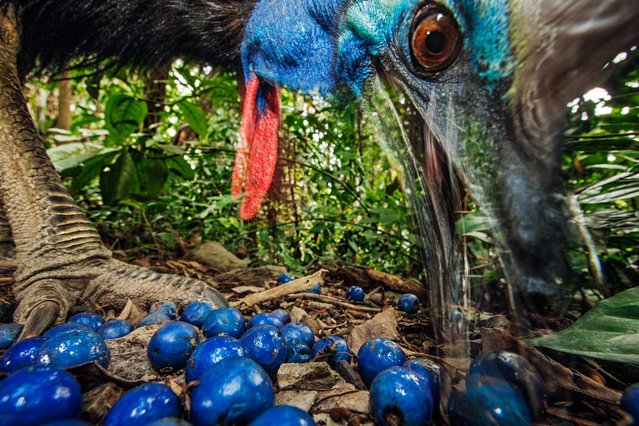
“Cassowaries are large, flightless birds related to emus and (more distantly) to ostriches, rheas, and kiwis”, writes Olivia Judson in the September issue of National Geographic magazine. (Photo by Christian Ziegler/National Geographic)

“Cassowaries are large, flightless birds related to emus and (more distantly) to ostriches, rheas, and kiwis”, writes Olivia Judson in the September issue of National Geographic magazine. How large? People-size: Adult males stand well over five foot five and top 110 pounds. Females are even taller, and can weigh more than 160 pounds. Dangerous when roused, they’re shy and peaceable when left alone. But even birds this big and tough are prey to habitat loss. The dense New Guinea and Australia rain forests where they live have dwindled. Today cassowaries might number 1,500 to 2,000. And because they help shape those same forests – by moving seeds from one place to another – “if they vanish”, Judson writes, “the structure of the forest would gradually change” too. (Photo by Christian Ziegler/National Geographic)

Details
06 Jan 2014 12:21:00
Bob The Golden Retriever And His friends

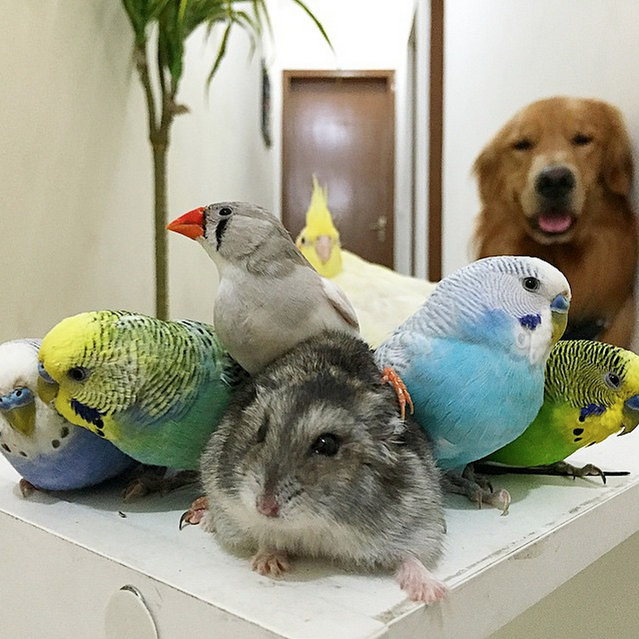
Meet Bob, an adorable Golden Retriever that lives in Brazil with his 9 best friends; 8 birds and one hamster to be exact. Bob likes to share pictures of him and his friends on Facebook and Instagram, where he has over 169,000 followers!
Details
31 Aug 2015 09:46:00
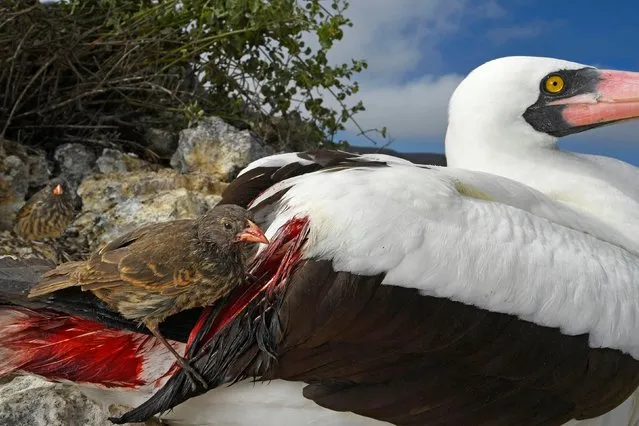
Bloodthirsty by Thomas P Peschak, Germany/South Africa — winner, Behaviour: birds. When rations run short on Wolf Island, in the remote northern Galápagos, the sharp-beaked ground finches become vampires. Their sitting targets are Nazca boobies and other large birds. The finches rely on a scant diet of seeds and insects, which regularly dries up, so they drink blood to survive. ‘I’ve seen more than half a dozen finches drinking from a single Nazca booby,’ says Tom. Rather than leave their nests the boobies tolerate the vampires, and the blood loss doesn’t seem to cause permanent harm. (Photo by Thomas P Peschak/2018 Wildlife Photographer of the Year)

Bloodthirsty by Thomas P. Peschak, Germany/South Africa — winner, Behaviour: birds. When rations run short on Wolf Island, in the remote northern Galápagos, the sharp-beaked ground finches become vampires. Their sitting targets are Nazca boobies and other large birds. The finches rely on a scant diet of seeds and insects, which regularly dries up, so they drink blood to survive. ‘I’ve seen more than half a dozen finches drinking from a single Nazca booby,’ says Tom. Rather than leave their nests the boobies tolerate the vampires, and the blood loss doesn’t seem to cause permanent harm. (Photo by Thomas P. Peschak/2018 Wildlife Photographer of the Year)
Details
19 Oct 2018 00:05:00
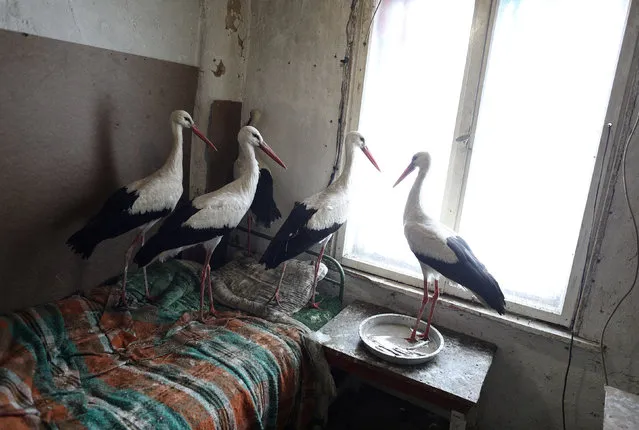
Storks that were saved by Bulgarian farmer Safet Ismail are pictured in the village of Zaritsa, Bulgaria, March 21, 2018. Dozens of people from villages in north-eastern Bulgaria took storks to their houses as a lot of the birds got injured due to freezing temperatures and snowfalls in the area over the last few days. (Photo by Stoyan Nenov/Reuters)

Storks that were saved by Bulgarian farmer Safet Ismail are pictured in the village of Zaritsa, Bulgaria, March 21, 2018. Dozens of people from villages in north-eastern Bulgaria took storks to their houses as a lot of the birds got injured due to freezing temperatures and snowfalls in the area over the last few days. (Photo by Stoyan Nenov/Reuters)
Details
22 Mar 2018 08:26:00
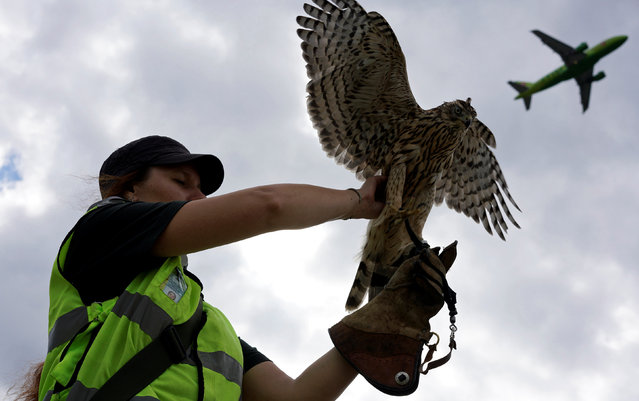
Employee of ornithological flight support service Nika Ryzhova-Alenicheva holds her hawk, which is used to control fauna to avoid bird strikes during takeoffs and landings, at Domodedovo airport outside Moscow, Russia September 2, 2016. (Photo by Maxim Zmeyev/Reuters)

Employee of ornithological flight support service Nika Ryzhova-Alenicheva holds her hawk, which is used to control fauna to avoid bird strikes during takeoffs and landings, at Domodedovo airport outside Moscow, Russia September 2, 2016. (Photo by Maxim Zmeyev/Reuters)
Details
06 Sep 2016 10:41:00
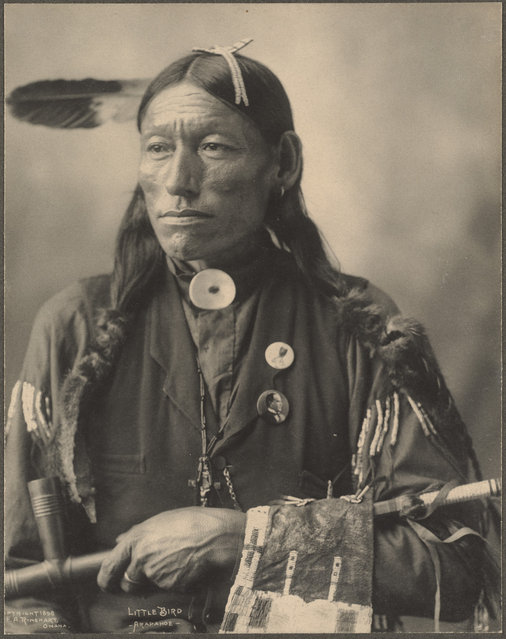
Little Bird, Arapahoe, 1899. (Photo by Frank A. Rinehart)

Frank A. Rinehart, a commercial photographer in Omaha, Nebraska, was commissioned to photograph the 1898 Indian Congress, part of the Trans-Mississippi International Exposition. More than five hundred Native Americans from thirty-five tribes attended the conference, providing the gifted photographer and artist an opportunity to create a stunning visual document of Native American life and culture at the dawn of the 20th century. Photo: Little Bird, Arapahoe, 1899. (Photo by Frank A. Rinehart)
Details
25 Apr 2013 11:30:00
Greater Sage-Grouse

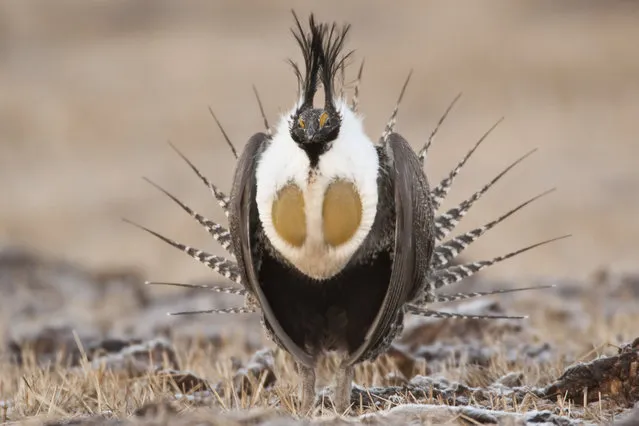
The Greater Sage-Grouse is certainly a formidable-looking bird. Being the largest grouse in North America and having tail feathers, which look like giant spikes, make for a ferocious sight. These birds are well known for their complicated courtship rituals, in which the males perform a special “strutting display” to attract the females. Another distinct feature of the Greater Sage-Grouse is two large yellow throat sacs (gular sacs), which are inflated by the males during the courtship display. Unlike pelicans, whose gular sacs are used to store fish while hunting, the throat sacks of the Greater Sage-Grouse are merely for display.
Details
21 Nov 2014 12:25:00