Loading...
Done
Viewing The Earth From Space

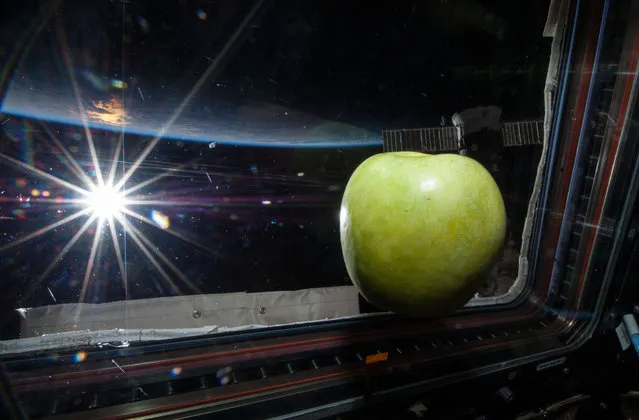
Despite any political differences between the United States and Russia, the space agencies of the two countries continue their cooperative work in Earth's orbit, aboard the International Space Station. Apart from the research being done in microgravity, ISS crew members continue to send back amazing images of our home world, photographed from low Earth orbit. Gathered here are recent images of Earth from aboard the ISS, and from a handful of other NASA satellites.
Details
01 Jun 2014 12:36:00
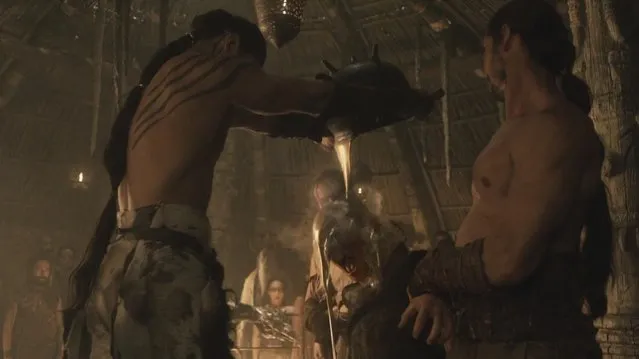
Game Of Thrones  Stars Take The Ice Bucket Challenge

George R.R. Martin, Lena Headey, Sophie Turner, and other cast and crew of Game of Thrones have faced the winds of winter – or anyway, a bucket of ice water – with the popular charity challenge. HBO’s Game of Thrones gives fans chills in every episode. But as the Ice Bucket Challenge for ALS research has exploded across the internet, the cast and crew of the shocking show gave themselves goosebumps as they stepped up to get soaked.

Details
16 Sep 2014 13:58:00
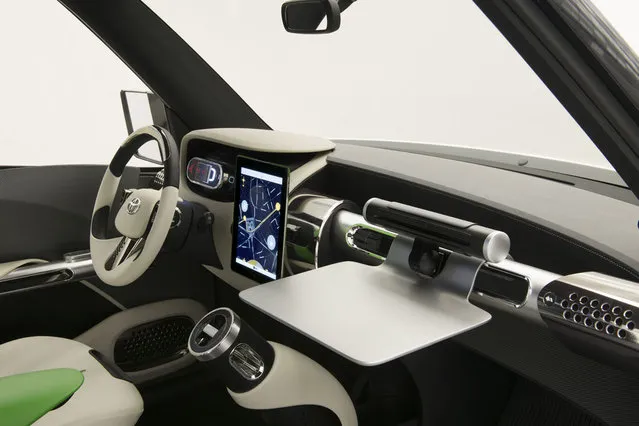
Toyota Urban Utility Vehicle Concept

Makers, meet your DIY dream car. Toyota‘s Calty Design Research Studio just unveiled its brand new Urban Utility concept car – an ultra flexible vehicle with a transforming interior designed to meet the needs of today’s on-the-go makers. Toyota packed an amazing amount of space into a footprint the size of a compact car. The U-squared can seat up to four passengers, or you can fold down three seats and roll out an array of racks, movable rails, and storage trays that can accommodate everything from surfboards and bikes to bulky equipment (like your homemade tesla coil).
Details
19 Sep 2014 11:08:00


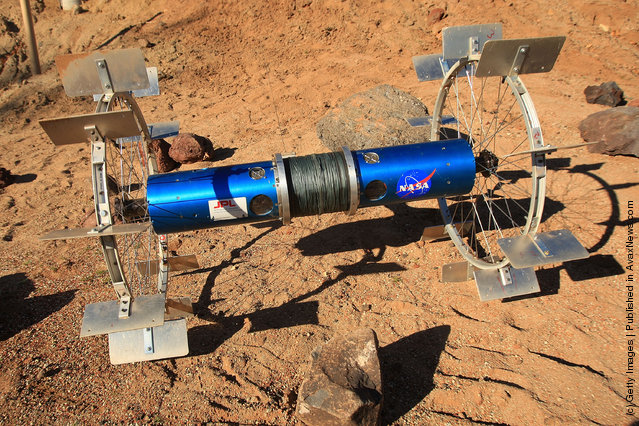
Axel, a research prototype rover for exploring the Moon, Mars and other planets, is remotely driven over rocks as engineers from Jet Propulsion (JPL) and grad students from Caltech (California Institute of Technology) demonstrate its mobile over the steep and rocky grounds of the JPL Mars Yard on January 14, 2009 in Pasadena, California. The rover is capable of descending cliffs or into craters and returning by a cable tethered to its starting point. Development of the Axel rover is a point effort funded by NASA Exploration Systems Mission Directorate (ESMD) and lead by Principal Investigator Issa Newnas and Co-Investigator and Caltech professor of mechanical engineering bio engineering Joel Burdick. (Photo by David McNew/Getty Images)
Details
05 Apr 2011 07:47:00
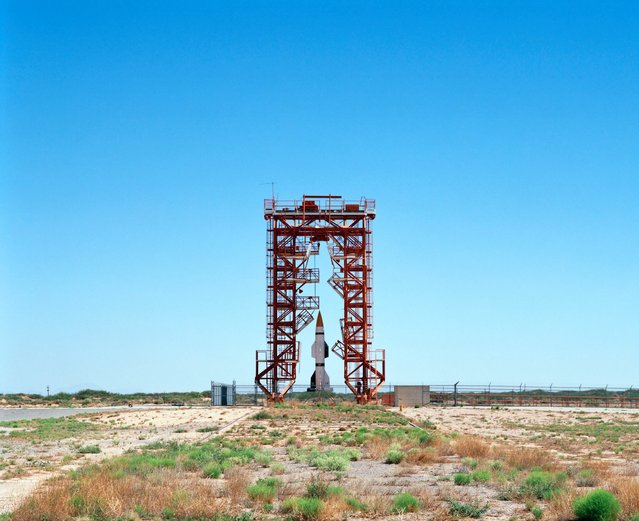
Launch Pad and Gantry with Hermes A-1 Rocket – V2 Launch Complex 33, White Sands missile range, New Mexico in 2006. (Photo by Roland Miller)

Roland Miller is on a mission to document the deserted sites of America’s space race. He has photographed launch pads, bunkhouses and research facilities across the country, some of which no longer exist or are closed to the public on secure military bases. His book, “Abandoned in Place”, is published by the University of New Mexico Press in March. Here: Launch Pad and Gantry with Hermes A-1 Rocket – V2 Launch Complex 33, White Sands missile range, New Mexico in 2006. (Photo by Roland Miller)
Details
25 Feb 2016 11:38:00
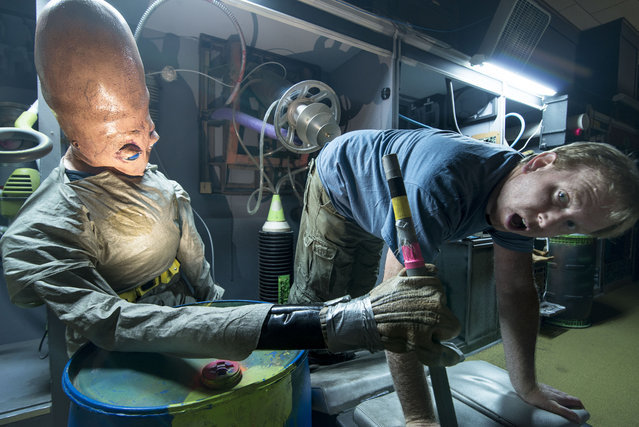
Chris has fun with one of the exhibits. (Photo by Chris Burton/Caters News Agency)

A UFO enthusiast who found himself locked in the iconic Roswell museum has shared the pictures he took with aliens to pass the time. Chris Burton, from the U.K., had dreamed of visiting Roswell, N.M., since he was a child but was stunned when he found himself locked in the International UFO Museum and Research Center during a recent trip. The 42-year-old used the unique opportunity to get interactive with the usually out of bounds exhibits and set up some funny snaps with the extraterrestrials – posing for a beer with one alien and taking a nap with another. (Photo by Chris Burton/Caters News Agency)
Details
24 Dec 2017 08:48:00
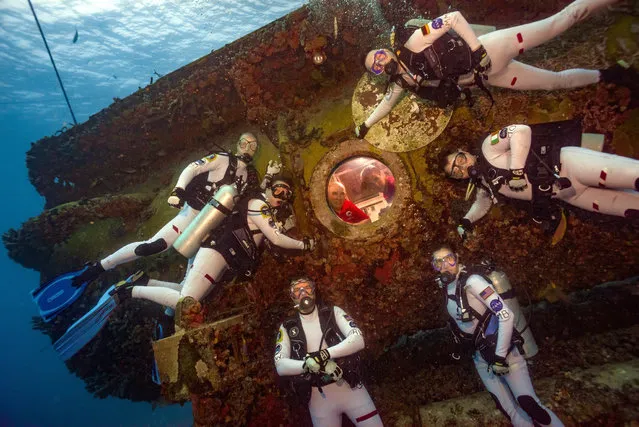
The NASA Extreme Environment Mission Operations (NEEMO) 21 mission began on July 21 as an international crew of aquanauts splashed down to the undersea Aquarius Reef Base, located 62 feet below the surface of the Atlantic Ocean in the Florida Keys National Marine Sanctuary. The NEEMO 21 crew will perform research both inside and outside the habitat during a 16-day simulated space mission. During simulated spacewalks carried out underwater, they will evaluate tools and mission operation techniques that could be used in future space missions, including journeys to Mars. (Photo by Karl Shreeves/NASA)

The NASA Extreme Environment Mission Operations (NEEMO) 21 mission began on July 21 as an international crew of aquanauts splashed down to the undersea Aquarius Reef Base, located 62 feet below the surface of the Atlantic Ocean in the Florida Keys National Marine Sanctuary. The NEEMO 21 crew will perform research both inside and outside the habitat during a 16-day simulated space mission. During simulated spacewalks carried out underwater, they will evaluate tools and mission operation techniques that could be used in future space missions, including journeys to Mars. (Photo by Karl Shreeves/NASA)
Details
31 Jul 2016 11:29:00
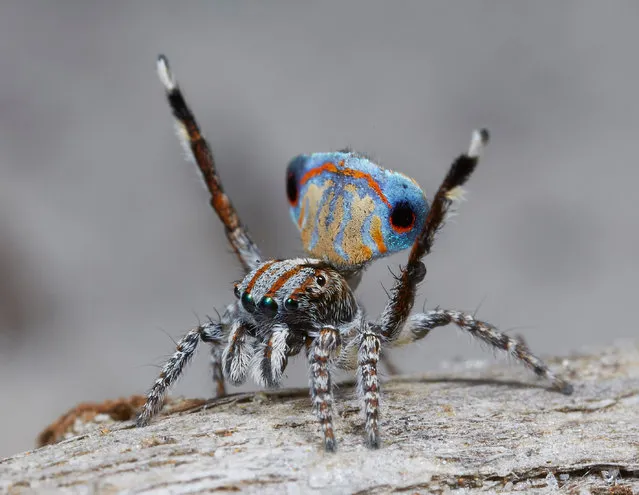
Several new species of peacock spider – just a few millimetres long and featuring extraordinary colours – have been discovered in Western Australia and South Australia. Jürgen Otto, a biologist from Sydney, has been researching the arachnids since 2005, and has gained a significant following online with his footage. He believes there are now 48 confirmed species of peacock spider within the Maratus genus, found across Australia but particularly in Western Australia – and many more awaiting confirmation. Here: Maratus Tasmanicus, one of seven new species of peacock spiders studied by the Sydney biologist Jürgen Otto. (Photo by Jürgen Otto)

Several new species of peacock spider – just a few millimetres long and featuring extraordinary colours – have been discovered in Western Australia and South Australia. Jürgen Otto, a biologist from Sydney, has been researching the arachnids since 2005, and has gained a significant following online with his footage. He believes there are now 48 confirmed species of peacock spider within the Maratus genus, found across Australia but particularly in Western Australia – and many more awaiting confirmation. Here: Maratus Tasmanicus, one of seven new species of peacock spiders studied by the Sydney biologist Jürgen Otto. (Photo by Jürgen Otto)
Details
30 May 2016 08:40:00