Loading...
Done
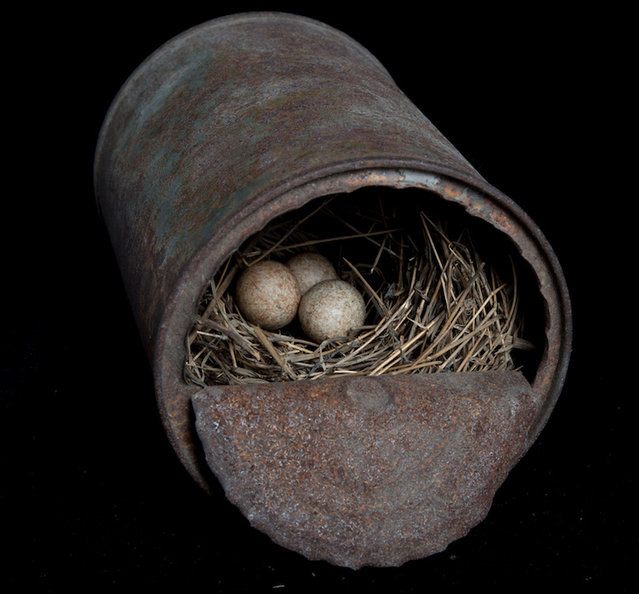
Bird Nest By Sharon Beals Part2

Sharon Beals is a San Francisco based photographer who has photographed nest and eggs specimens collected over the last two centuries at The California Academy of Sciences, The Museum of Vertebrate Zoology, and The Western Foundation of Vertebrate Zoology. While few nests are collected today, these nests and eggs are used for research, providing important information about their builder’s habitats, DNA, diseases and other survival issues.
Details
21 Aug 2013 11:34:00
Tim Tadder’s Water Wigs

Art and science collide in photographer Tim Tadder’s series “Water Wigs” and “Water Wigs Women”. In these perfectly timed photographs, Tadder captures his models wearing hair that’s made out of water. He achieves the process with water balloons, tacks, a creative vision that defies ordinary poses, and, no doubt, extreme patience. (Photo by Tim Tadder)
Details
13 Mar 2014 12:20:00
Dogs and Children

It’s the topic of one never-ending conundrum — do dogs look like their owners? If this is indeed true, do dogs grow to mimic their owners, or do owners choose a dog in their own image? It’s great when science confirms something we already instinctively know. According to a U.S. study, it’s official — dogs do look like their owners.
Details
25 Aug 2012 12:33:00
BERTI the robot interacts with a Sony AIBO robot dog

“Life-size humanoid robot BERTI (Bristol EluMotion Robotic Torso number 1 or RT-1) is a self contained, fully automated Robotic Torso, designed and built by Elumotion to provide a robotic platform based on human anatomy. RT-1 is a highly articulated manipulating platform and includes novel dexterous hands that allow emulation of human gesturing”. – Elumotion.com

Photo: BERTI the robot interacts with a Sony AIBO robot dog at The Science Museum's Antenna Gallery on February 17, 2009 in London. (Photo by Peter Macdiarmid/Getty Images)
Details
12 Sep 2011 10:53:00
MB&F Horological Machine No. 6 Space Pirate

All throughout history of mankind people were fascinated by time, its flow, and how to measure it. Thus, the science of horology can into being, as people invented more and more sophisticated ways of measuring the passage of time. Truly, it’s one of the most profound characteristics of being a human, to feel and to ponder the meaning of time, its properties, and will we ever be able to move through it, not with it. Now, however, horology is mainly referred to the art of mechanical watchmaking. (Photo by MB&F)
Details
14 Nov 2014 13:51:00
In this Saturday, September 5, 2015, photo, three women in costumes look at sea life swimming above them during a private party held at the Georgia Aquarium as part of Dragon Con in Atlanta. (Photo by Ron Harris/AP Photo)

In this Saturday, September 5, 2015, photo, three women in costumes look at sea life swimming above them during a private party held at the Georgia Aquarium as part of Dragon Con in Atlanta. The convention draws fans from around the country to take part in sci-fi and fantasy costume contests, a massive parade through downtown Atlanta and educational seminars about science and costume making. (Photo by Ron Harris/AP Photo)
Details
07 Sep 2015 14:19:00
Super Cats By Jenny Parks

Jenny Parks is a scientific illustrator that also happens to be a shameless nerd, with a penchant for drawing animals, dinosaurs, imaginary creatures… and occasionally, people as cats. Somehow, she found herself with a bit of internet fame with the illustration ‘Doctor Mew’, and has been baffled ever since. With a BFA in illustration from the California College of the Arts, and a graduate degree in Science Illustration from UC Santa Cruz, she now resides in San Francisco as a freelance illustrator, fulfilling her destiny to make a living drawing cute, fuzzy things.
Details
25 Jul 2013 10:50:00
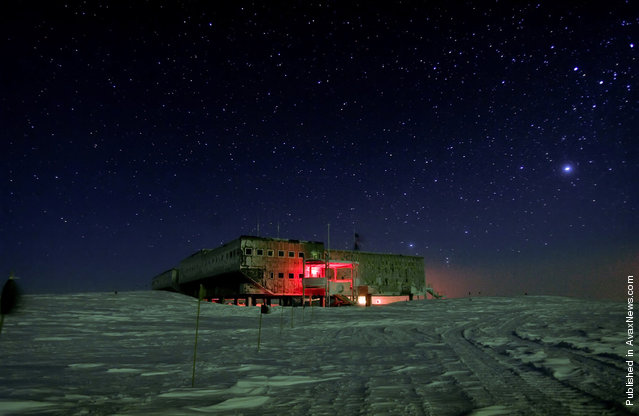
Amundsen-Scott South Pole Station experiences months of darkness. The sun dips below the horizon on March 21, after which follows several weeks of twilight before complete darkness results

Amundsen-Scott South Pole Station experiences months of darkness. The sun dips below the horizon on March 21, after which follows several weeks of twilight before complete darkness results. Photo taken on June 25, 2009. (National Science Foundation/Jeremy Johnson)
Details
08 Apr 2012 13:07:00