Loading...
Done
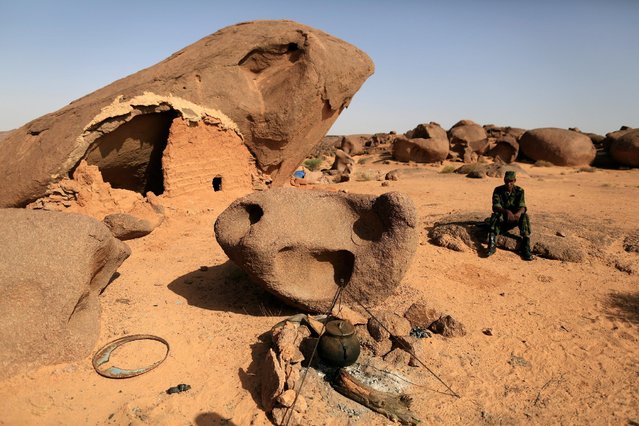
A Polisario fighter sits on a rock at a forward base on the outskirts of Tifariti, Western Sahara, September 9, 2016. At a rocky outpost in Western Sahara, a new generation of soldiers who have never known war are mobilising as tensions resurface in one of Africa's oldest disputes after a quarter century of uneasy peace. Young Sahrawi troops man new desert posts for the Polisario Front, which for more than 40 years has sought independence for the vast desert region - first in a guerrilla war against Morocco and then politically since a ceasefire deal in 1991. Now a standoff with Morocco, which controls the majority of Western Sahara, is renewing pressure for a diplomatic solution to ensure foot soldiers don't return to fighting as the last generation of commanders once did. The standoff since August has brought Moroccan and Polisario forces within 200 metres of each other in a narrow strip of land near the Mauritanian border. Rich in phosphate, Western Sahara has been contested since 1975 when Spanish colonial powers left. Morocco claimed the territory and fought the 16-year war with Polisario. (Photo by Zohra Bensemra/Reuters)

A Polisario fighter sits on a rock at a forward base on the outskirts of Tifariti, Western Sahara, September 9, 2016. At a rocky outpost in Western Sahara, a new generation of soldiers who have never known war are mobilising as tensions resurface in one of Africa's oldest disputes after a quarter century of uneasy peace. (Photo by Zohra Bensemra/Reuters)
Details
04 Nov 2016 12:09:00
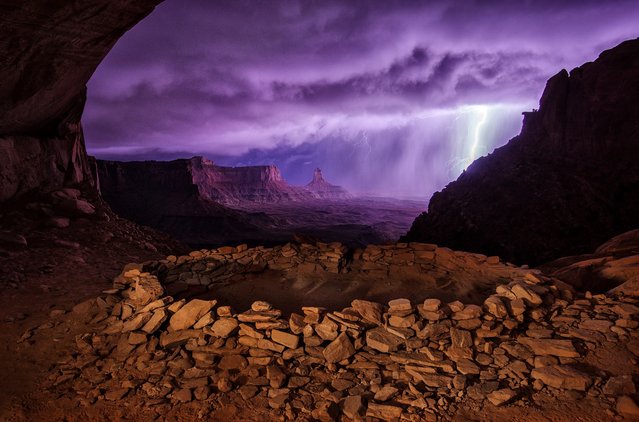
Second Place Winner: “Thunderstorm at False Kiva”. I hiked out to these ruins at night hoping to photograph them with the Milky Way, but instead a thunderstorm rolled through, creating this dramatic image. – Max Seigal. (Photo and caption by Max Seigal/National Geographic Traveler Photo Contest)

Second Place Winner: “Thunderstorm at False Kiva”. I hiked out to these ruins at night hoping to photograph them with the Milky Way, but instead a thunderstorm rolled through, creating this dramatic image. – Max Seigal. National Geographic Traveler Director of Photography Dan Westergren, one of this year's judges, shares his thoughts on the second place winner: “This photo combines two different scenes into one: the small kiva in a cliff dwelling and the grand vista of Canyonlands National Park across the valley. I really like the two different color palettes – warm inside and purple outside. This two-for-one scene was caused by the lightning storm outside the dwelling, which lit up the landscape like it was a huge electronic flash. Looking at this picture I can imagine what a wonderful sight it must have been for the ancient people who lived here. It doesn't seem too amazing now in our modern world, but might have been mind-blowing for the prehistoric residents”. Location: Utah. (Photo and caption by Max Seigal/National Geographic Traveler Photo Contest)

Details
02 Aug 2013 06:16:00
Bo (pictured) is president and co-founder of Grown Men On Bikes (GMOB), one of the oldest groups at Slow Roll. Bo spent $1,300 getting a one-off low-rider custom bike build – but that’s just the start. “Once I go back in it’s going to get big”, he says. “I’m going to get a custom seat, wheels, paint” … The finished bike could cost around $3,000 – but would still be far cheaper than pimping a car. “This is much better. It’s a community. We party”. (Photo by Nick Van Mead)

“We take rusty old junk and we put love into it”. The old Motor City has a unique style in bicycles these days: from fat wheels and fake fuel tanks to stretched cycles with powerful sound systems – and even a family-sized BBQ. “Detroit’s custom bike scene developed alongside Slow Roll, a weekly cycle ride started in 2010 by Jason Hall and Mike MacKool. Now upwards of 2,000 people turn up each Monday to cruise a different part of the city. The week I go the crowd seems evenly split between black and white, male and female, city and suburbs. It’s the most inclusive cycle event I’ve ever witnessed”. (Photo by Jason Walker/Slow Roll Monday Nights)
Details
03 Nov 2016 12:33:00
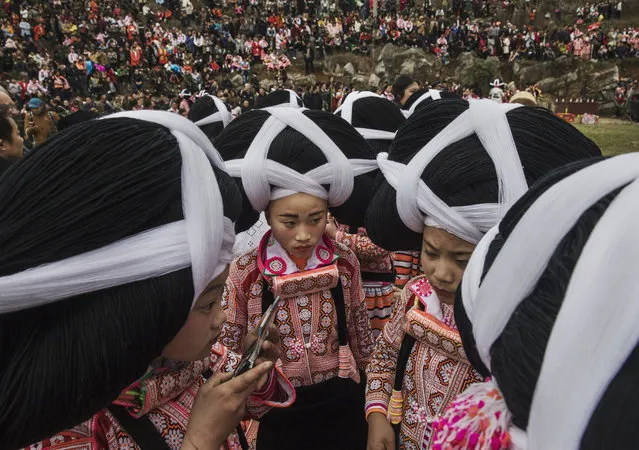
Girls of the Long Horn Miao ethnic minority group wear headdresses as they prepare gather for Tiaohua or Flower Festival as part of the Lunar New Year on February 6, 2017 in Longga village, Guizhou province, southern China. The Long Horn Miao are recognized for their declining practice of wrapping a blend of linen, wool, and the hair of their ancestors around animal horns or a wooden clip to make headdresses. Many young women say they now wear the headdresses only for special occasions and festivals, as the ornaments, which are attached by the horns to their real hair, have proved impractical for modern daily life in a fast changing world. China officially recognizes 56 different ethnic minorities, and statistics show over 7 million Chinese identifying themselves as Miao. But the small Long Horn Miao community counts only around 5000 people living in 12 villages, whose age-old traditions, language, and culture are fading. It is increasingly difficult in a modernizing China, as young people are drawn from remote rural villages to opportunities in bigger cities amongst wide-scale urbanization. Farming and labour remain the mainstays of life for the Long Horn Miao, leaving the area relatively poor in comparison with many parts of China. The government has invested significant amounts into local infrastructure and the tourism industry to try to bolster the local economy. (Photo by Kevin Frayer/Getty Images)

Girls of the Long Horn Miao ethnic minority group wear headdresses as they prepare gather for Tiaohua or Flower Festival as part of the Lunar New Year on February 6, 2017 in Longga village, Guizhou province, southern China. (Photo by Kevin Frayer/Getty Images)
Details
13 Feb 2017 00:01:00
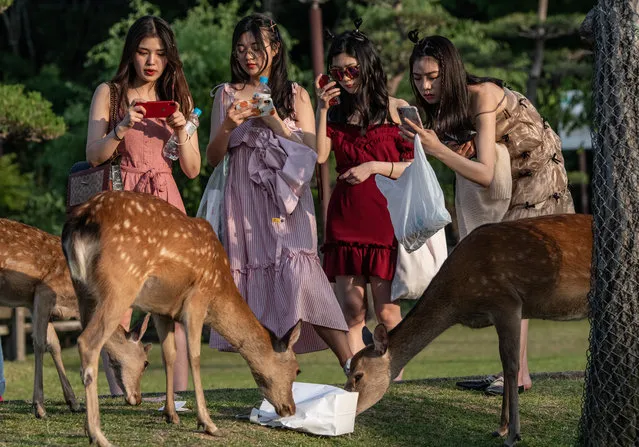
Tourists take photographs as a wild sika deer eats a bag on June 6, 2019 in Nara, Japan. Nara's free-roaming deer have become a huge attraction for tourists. However, an autopsy on a deer that was recently found dead near one of the city's famous temples discovered 3.2kg of plastic in its stomach and caused concern at the effect of tourism as Japan struggles to cope with a huge increase in domestic and international tourists. Alongside a growing Japanese tendency to holiday domestically, a record 31 million people visited the country in 2018 up 8.7 percent from the previous year, with many people now worrying about the environmental impact caused by such large visitor numbers. (Photo by Carl Court/Getty Images)

Tourists take photographs as a wild sika deer eats a bag on June 6, 2019 in Nara, Japan. Nara's free-roaming deer have become a huge attraction for tourists. However, an autopsy on a deer that was recently found dead near one of the city's famous temples discovered 3.2kg of plastic in its stomach and caused concern at the effect of tourism as Japan struggles to cope with a huge increase in domestic and international tourists. (Photo by Carl Court/Getty Images)
Details
19 Jun 2019 00:03:00
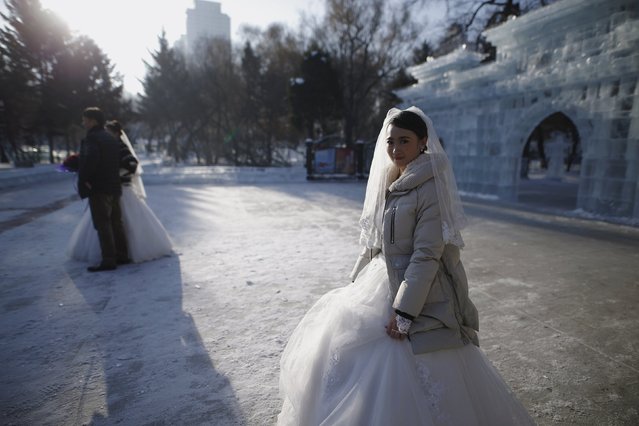
Newly-wed couples attend their group wedding ceremony which was held as part of the Harbin International Ice and Snow Festival in the northern city of Harbin, Heilongjiang province January 6, 2016. (Photo by Aly Song/Reuters)

Newly-wed couples attend their group wedding ceremony which was held as part of the Harbin International Ice and Snow Festival in the northern city of Harbin, Heilongjiang province January 6, 2016. As many as 15 couples attend this mass wedding ceremony. (Photo by Aly Song/Reuters)
Details
08 Jan 2016 08:02:00
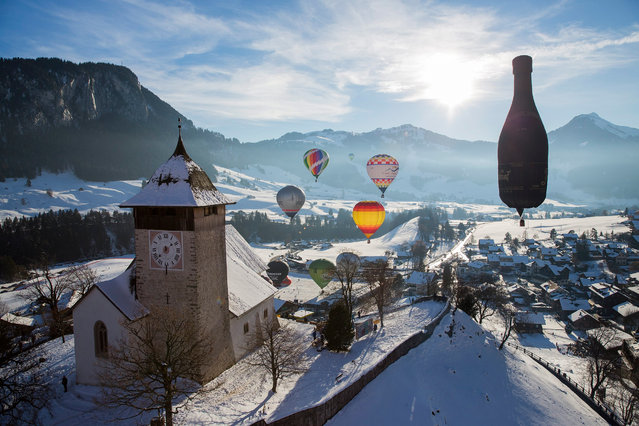
Hot air balloons take part in the 38th International Balloon Festival of Chateau-d'oex, Switzerland, 23 January 2016. The festival takes place from 23 to 31 January. (Photo by Cyril Zingaro/EPA)

Hot air balloons take part in the 38th International Balloon Festival of Chateau-d'oex, Switzerland, 23 January 2016. For nine days balloonists from 15 countries take part in the ballooning event in the Swiss mountain resort famous for ideal flight conditions due to an exceptional microclimate. The festival takes place from 23 to 31 January. (Photo by Cyril Zingaro/EPA)
Details
24 Jan 2016 15:23:00
A reveller reacts during a water fight at Songkran Festival celebrations in Bangkok April 13, 2016. (Photo by Jorge Silva/Reuters)

A reveller reacts during a water fight at Songkran Festival celebrations in Bangkok April 13, 2016. The three-day Songkran Festival starts on 13-15 April annually and is celebrated with splashing water and putting powder on each others faces as a symbolic sign of cleansing and washing away the sins from the old year. (Photo by Jorge Silva/Reuters)
Details
14 Apr 2016 12:18:00