Loading...
Done
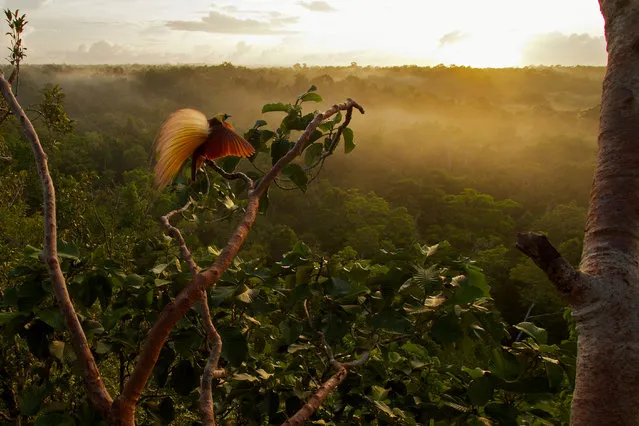
A greater bird of paradise (Paradisaea apoda) displaying in Badigaki Forest, Wokam Island (Aru Islands, Indonesia). Found here in Aru and on adjacent New Guinea, the greater bird of paradise represents about 40 different species of birds of paradise that depend on intact rainforest across the New Guinea region spanning eastern Indonesia and Papua New Guinea. With more than 80% of forest cover still intact, this region represents the largest remaining block of rainforest in the entire Asia-Pacific. (Photo by Tim Laman/naturepl.com/LDY Agency)

A greater bird of paradise (Paradisaea apoda) displaying in Badigaki Forest, Wokam Island (Aru Islands, Indonesia). Found here in Aru and on adjacent New Guinea, the greater bird of paradise represents about 40 different species of birds of paradise that depend on intact rainforest across the New Guinea region spanning eastern Indonesia and Papua New Guinea. With more than 80% of forest cover still intact, this region represents the largest remaining block of rainforest in the entire Asia-Pacific. (Photo by Tim Laman/naturepl.com/LDY Agency)
Details
14 Nov 2021 05:57:00
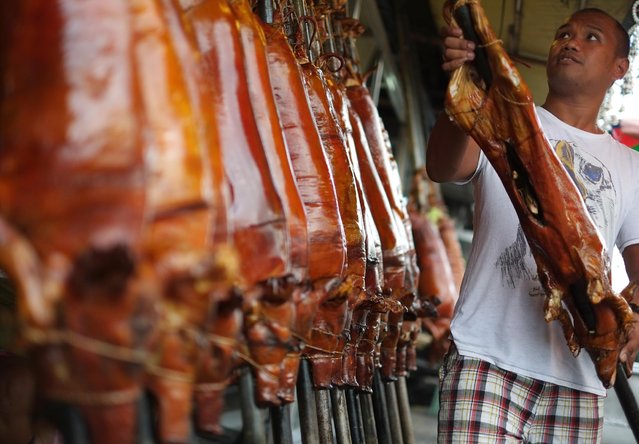
A Filipino worker arranges roasted pigs which they sell in suburban Quezon city, Philippines on Tuesday, December 23, 2014. Roasted pig is popular during Filipino celebrations and traditionally served during a Christmas eve dinner called “Noche Buena” in this predominantly Roman Catholic nation. (Photo by Aaron Favila/AP Photo)

A Filipino worker arranges roasted pigs which they sell in suburban Quezon city, Philippines on Tuesday, December 23, 2014. Roasted pig is popular during Filipino celebrations and traditionally served during a Christmas eve dinner called “Noche Buena” in this predominantly Roman Catholic nation. (Photo by Aaron Favila/AP Photo)
Details
27 Dec 2014 11:49:00
Bloodthirsty by Thomas P Peschak, Germany/South Africa — winner, Behaviour: birds. When rations run short on Wolf Island, in the remote northern Galápagos, the sharp-beaked ground finches become vampires. Their sitting targets are Nazca boobies and other large birds. The finches rely on a scant diet of seeds and insects, which regularly dries up, so they drink blood to survive. ‘I’ve seen more than half a dozen finches drinking from a single Nazca booby,’ says Tom. Rather than leave their nests the boobies tolerate the vampires, and the blood loss doesn’t seem to cause permanent harm. (Photo by Thomas P Peschak/2018 Wildlife Photographer of the Year)

Bloodthirsty by Thomas P. Peschak, Germany/South Africa — winner, Behaviour: birds. When rations run short on Wolf Island, in the remote northern Galápagos, the sharp-beaked ground finches become vampires. Their sitting targets are Nazca boobies and other large birds. The finches rely on a scant diet of seeds and insects, which regularly dries up, so they drink blood to survive. ‘I’ve seen more than half a dozen finches drinking from a single Nazca booby,’ says Tom. Rather than leave their nests the boobies tolerate the vampires, and the blood loss doesn’t seem to cause permanent harm. (Photo by Thomas P. Peschak/2018 Wildlife Photographer of the Year)
Details
19 Oct 2018 00:05:00
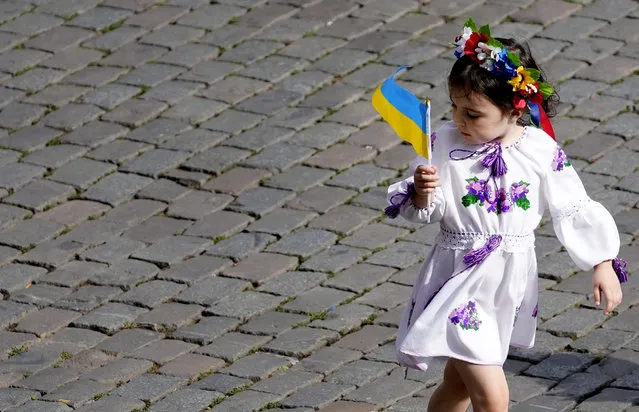
A young girl walks with a Ukrainian flag during an event for Ukrainian Independence Day in the historical Grand Place of Brussels, Wednesday, August 24, 2022. European leaders are pledging unwavering support for Ukraine as the war-torn country marks its Independence Day. The commemorations Wednesday coincide with the six-month milestone of Russia's invasion. (Photo by Virginia Mayo/AP Photo)

A young girl walks with a Ukrainian flag during an event for Ukrainian Independence Day in the historical Grand Place of Brussels, Wednesday, August 24, 2022. European leaders are pledging unwavering support for Ukraine as the war-torn country marks its Independence Day. The commemorations Wednesday coincide with the six-month milestone of Russia's invasion. (Photo by Virginia Mayo/AP Photo)
Details
11 Sep 2022 04:40:00
In this photo taken on August 26, 2017, a contestant of the “fantasy” category prepares to be judged during the Daegu International Bodypainting Festival in Daegu, South Korea. The bodies of dozens of female models turned into living canvases this weekend as they allowed delicate brush strokes and flamboyant illustrations to cover up their bare skin. They are part of the 2017 Daegu International Bodypainting Festival along with top artists from 10 countries that runs until August 27 in South Korea's southeastern city of Daegu. (Photo by Ed Jones/AFP Photo)

In this photo taken on August 26, 2017, a contestant of the “fantasy” category prepares to be judged during the Daegu International Bodypainting Festival in Daegu, South Korea. The bodies of dozens of female models turned into living canvases this weekend as they allowed delicate brush strokes and flamboyant illustrations to cover up their bare skin. They are part of the 2017 Daegu International Bodypainting Festival along with top artists from 10 countries that runs until August 27 in South Korea's southeastern city of Daegu. (Photo by Ed Jones/AFP Photo)
Details
03 Sep 2017 07:32:00
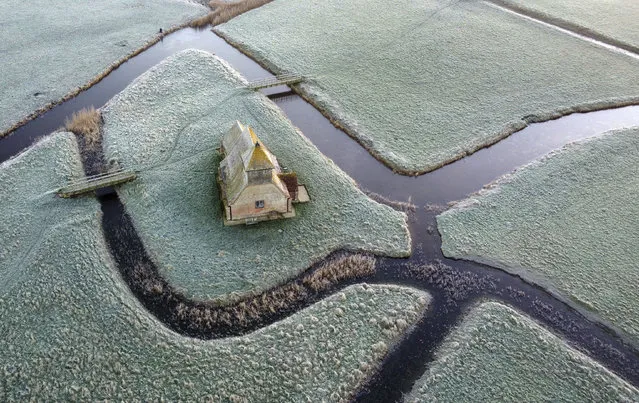
A view of St Thomas Becket church during the morning frost, in Fairfield, Kent, England, Thursday, January 6, 2022, following freezing overnight temperatures. (Photo by Gareth Fuller/PA Wire via AP Photo)

A view of St Thomas Becket church during the morning frost, in Fairfield, Kent, England, Thursday, January 6, 2022, following freezing overnight temperatures. (Photo by Gareth Fuller/PA Wire via AP Photo)
Details
30 Mar 2022 05:47:00
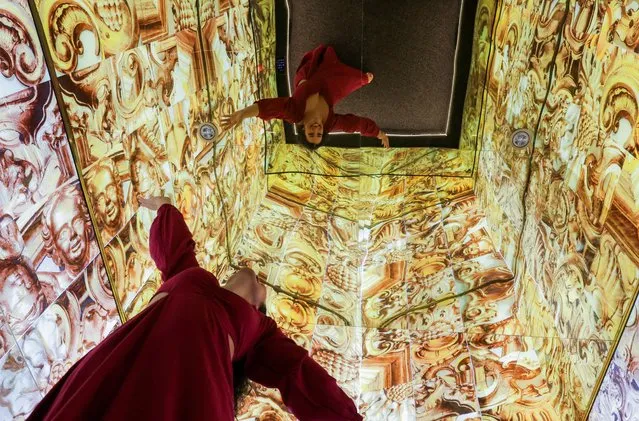
A woman visits the mirror installation “Mar de Espelhos” (Sea of Mirrors) ahead of its opening in Rio de Janeiro, Brazil on June 13, 2023. (Photo by Ricardo Moraes/Reuters)

A woman visits the mirror installation “Mar de Espelhos” (Sea of Mirrors) ahead of its opening in Rio de Janeiro, Brazil on June 13, 2023. (Photo by Ricardo Moraes/Reuters)
Details
21 Jul 2023 03:26:00
A Sri Lankan elephant, accompanied by his mahout, browse through a roadside fruit stall in Colombo on January 19, 2015. The Sri Lankan elephant is listed as endangered by the International Union for Conservation of Nature (IUCN) as the population has declined by at least 50 percent over the last three generations, with the species threatened by habitat loss, degradation and fragmentation. (Photo by Lakruwan Wanniarachchi/AFP Photo)

A Sri Lankan elephant, accompanied by his mahout, browse through a roadside fruit stall in Colombo on January 19, 2015. The Sri Lankan elephant is listed as endangered by the International Union for Conservation of Nature (IUCN) as the population has declined by at least 50 percent over the last three generations, with the species threatened by habitat loss, degradation and fragmentation. (Photo by Lakruwan Wanniarachchi/AFP Photo)
Details
23 Jan 2015 13:21:00