Loading...
Done
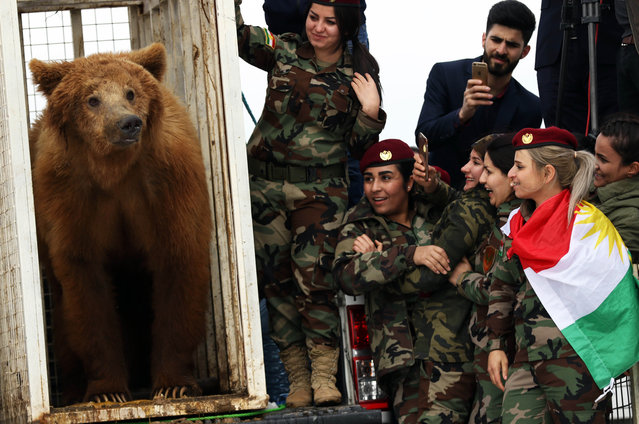
Female Iraqi Kurdish peshmerga fighters watch on as they release a bear into the wild in the Gara Mountains near the northern Iraqi city of Dohuk on March 4, 2018, after Iraqi Kurdish Animal rights activists from a local NGO rescued it from a private home. (Photo by Safin Hamed/AFP Photo)

Female Iraqi Kurdish peshmerga fighters watch on as they release a bear into the wild in the Gara Mountains near the northern Iraqi city of Dohuk on March 4, 2018, after Iraqi Kurdish Animal rights activists from a local NGO rescued it from a private home. (Photo by Safin Hamed/AFP Photo)
Details
06 Mar 2018 09:27:00
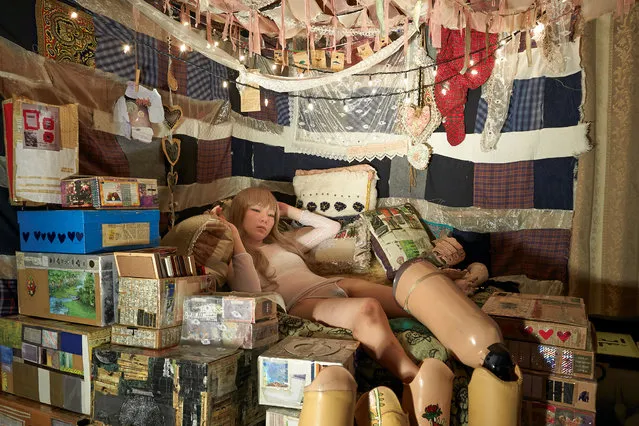
Ophelia (2013). From a series of photos of imagined women exhibited at the 2013 Aichi Triennale. Here, Katayama invokes Hamlet’s tragic heroine, after the painting by British pre-Raphaelite John Everett Millais. (Photo by Mari Katayama/The Guardian)

Born with a rare condition, the artist has chronicled her life in portraits – capturing everything from her tattooed prosthetics to the tentacled creature she stitched together on the shores of Naoshima. Here: Ophelia (2013). From a series of photos of imagined women exhibited at the 2013 Aichi Triennale. Here, Katayama invokes Hamlet’s tragic heroine, after the painting by British pre-Raphaelite John Everett Millais. (Photo by Mari Katayama/The Guardian)
Details
07 Mar 2017 00:04:00
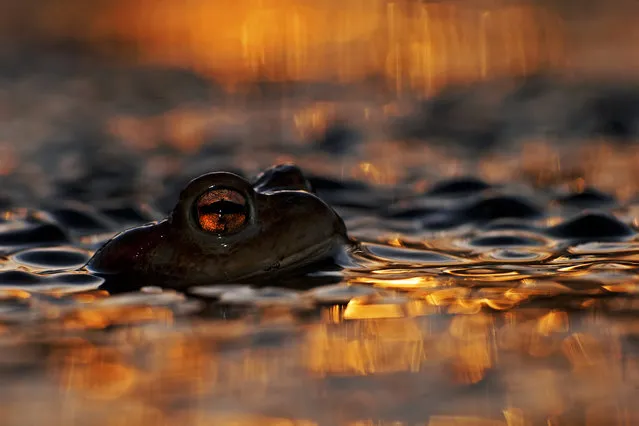
“Eye of a toad”. Animal Portraits, Łukasz Bożycki, Poland.  (Photo by Łukasz Bożycki)

“Eye of a toad”. Animal Portraits, Łukasz Bożycki, Poland. Early spring sees a pond near Łukasz’s home city of Warsaw, Poland, full of mating frogs and a few toads. On this March day, Łukasz shared the pond with them for an evening, sitting in the icy water in his chest-high waders, keeping as still as possible, despite the numbing cold, so that the amphibians could get used to him. “I wanted to find a fresh way of portraying the amphibians”, he says, “at water level”. Using a telephoto lens, he focused on one lone toad and waited for the sun to dip almost below the horizon before pressing the shutter, using flash to bring out the details in the shadow. His prize was “the glorious pool of sunset colour” and fiery glow of the toad’s eye. Nikon D80 + 70-300mm f4.5-5.6 lens + extension tube; 1/125 sec at f9 (-2.3 e/v); ISO 100; built-in flash. (Photo by Łukasz Bożycki)

Details
28 Aug 2013 11:45:00
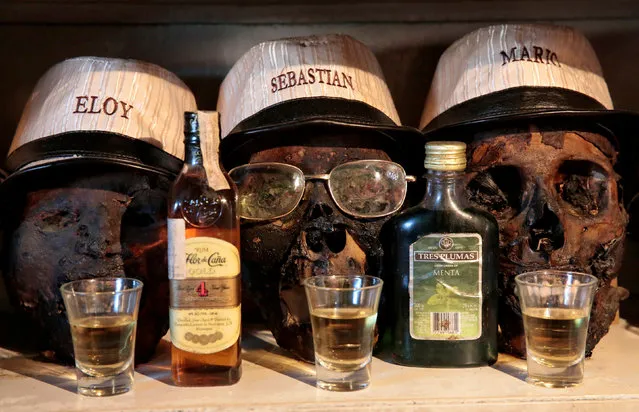
Skulls are seen at the witch doctor kiosk during the day of offerings to the “Pachamama” (Mother Earth) in El Alto, Bolivia, August 1, 2016. (Photo by David Mercado/Reuters)

Skulls are seen at the witch doctor kiosk during the day of offerings to the “Pachamama” (Mother Earth) in El Alto, Bolivia, August 1, 2016. Pachamama is a goddess revered by the indigenous people of the Andes. She is also known as the earth/time mother. In Inca mythology, Pachamama is a fertility goddess who presides over planting and harvesting, embodies the mountains, and causes earthquakes. (Photo by David Mercado/Reuters)
Details
02 Aug 2016 08:11:00
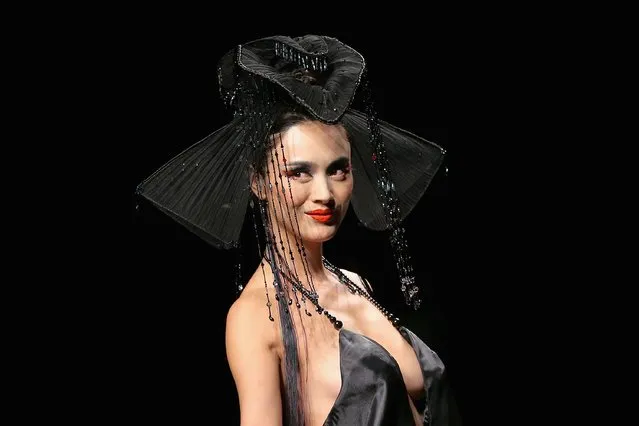
A model showcases designs on the runway at MGPIN 2015 Mao Geping Makeup Trends Launch show during Mercedes-Benz China Fashion Week Spring/Summer 2015 at Beijing Hotel on October 27, 2014 in Beijing, China. (Photo by Feng Li/Getty Images)

A model showcases designs on the runway at MGPIN 2015 Mao Geping Makeup Trends Launch show during Mercedes-Benz China Fashion Week Spring/Summer 2015 at Beijing Hotel on October 27, 2014 in Beijing, China. (Photo by Feng Li/Getty Images)
Details
27 Oct 2014 12:20:00
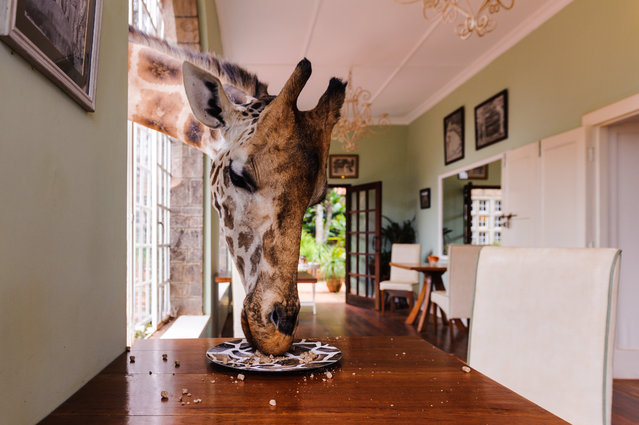
“Don't Leave Any Food On Your Plate”. The giraffes at Nairobi's Giraffe Manor are totally at home with humans. They will eat out of your hand, or even off your plate. Photo location: Giraffe Manor, Nairobi, Kenya. (Photo and caption by Gavin Werbeloff/National Geographic Photo Contest)

“Don't Leave Any Food On Your Plate”. The giraffes at Nairobi's Giraffe Manor are totally at home with humans. They will eat out of your hand, or even off your plate. Photo location: Giraffe Manor, Nairobi, Kenya. (Photo and caption by Gavin Werbeloff/National Geographic Photo Contest)
Details
20 Jun 2014 10:23:00
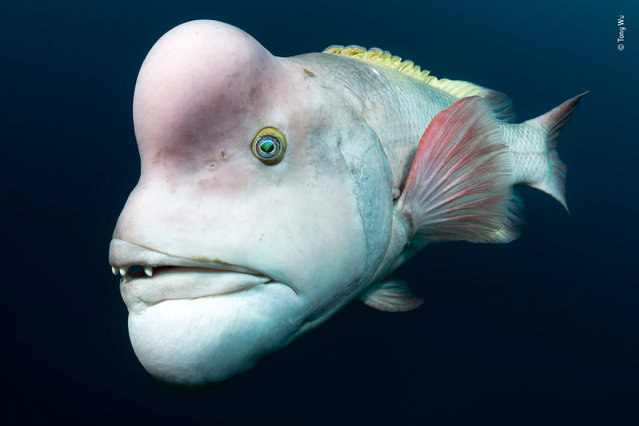
Looking for love by Tony Wu, USA. Highly commended, Animal Portraits. “Accentuating his mature appearance with pastel colours, protruding lips and an outstanding pink forehead, this Asian sheepshead wrasse sets out to impress females and see off rivals, which he will head-butt and bite, near Japan’s remote Sado Island. Individuals start out as females, and when they reach a certain age and size – up to a metre (more than 3 feet) long – can transform into males. Long-lived and slow-growing, the species is intrinsically vulnerable to overfishing”. (Photo by Tony Wu/2018 Wildlife Photographer of the Year)

Looking for love by Tony Wu, USA. Highly commended, Animal Portraits. “Accentuating his mature appearance with pastel colours, protruding lips and an outstanding pink forehead, this Asian sheepshead wrasse sets out to impress females and see off rivals, which he will head-butt and bite, near Japan’s remote Sado Island. Individuals start out as females, and when they reach a certain age and size – up to a metre (more than 3 feet) long – can transform into males. Long-lived and slow-growing, the species is intrinsically vulnerable to overfishing”. (Photo by Tony Wu/2018 Wildlife Photographer of the Year)
Details
03 Sep 2018 08:17:00
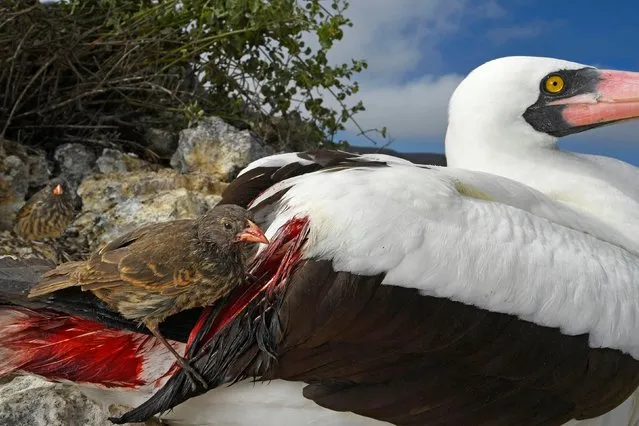
Bloodthirsty by Thomas P Peschak, Germany/South Africa — winner, Behaviour: birds. When rations run short on Wolf Island, in the remote northern Galápagos, the sharp-beaked ground finches become vampires. Their sitting targets are Nazca boobies and other large birds. The finches rely on a scant diet of seeds and insects, which regularly dries up, so they drink blood to survive. ‘I’ve seen more than half a dozen finches drinking from a single Nazca booby,’ says Tom. Rather than leave their nests the boobies tolerate the vampires, and the blood loss doesn’t seem to cause permanent harm. (Photo by Thomas P Peschak/2018 Wildlife Photographer of the Year)

Bloodthirsty by Thomas P. Peschak, Germany/South Africa — winner, Behaviour: birds. When rations run short on Wolf Island, in the remote northern Galápagos, the sharp-beaked ground finches become vampires. Their sitting targets are Nazca boobies and other large birds. The finches rely on a scant diet of seeds and insects, which regularly dries up, so they drink blood to survive. ‘I’ve seen more than half a dozen finches drinking from a single Nazca booby,’ says Tom. Rather than leave their nests the boobies tolerate the vampires, and the blood loss doesn’t seem to cause permanent harm. (Photo by Thomas P. Peschak/2018 Wildlife Photographer of the Year)
Details
19 Oct 2018 00:05:00