A member of security forces takes part in a training session arranged by a security company in Tajoura suburb of Tripoli, Libya on February 10, 2021. (Photo by Hazem Ahmed/Reuters)
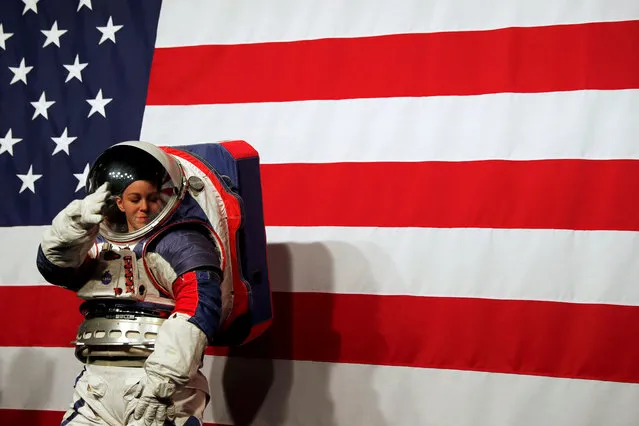
Advanced Space Suit Engineer at NASA Kristine Davis wears the xEMU prototype space suit for the next astronaut to the moon by 2024, during its presentation at NASA headquarters in Washington, U.S., October 15, 2019. (Photo by Carlos Jasso/Reuters)
Labourers work at the installation site of Liquefied Petroleum Gas (LPG) pipeline on May Day or Labour Day in Chandigarh, India, May 1, 2015. (Photo by Ajay Verma/Reuters)
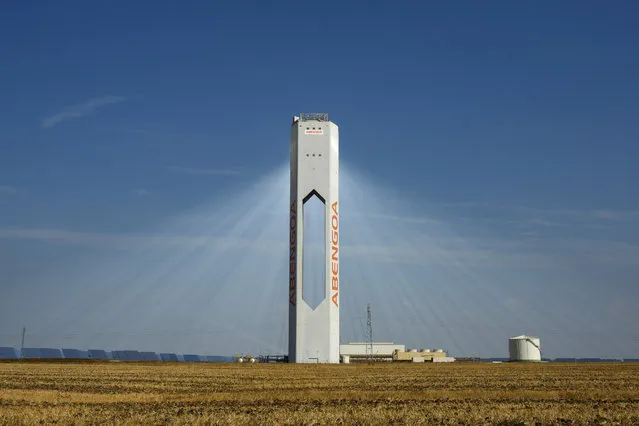
A tower belonging to the Abengoa solar plant at the Solucar solar park is seen in Sanlucar la Mayor, Spain on October 1, 2018. (Photo by Marcelo del Pozo/Reuters)
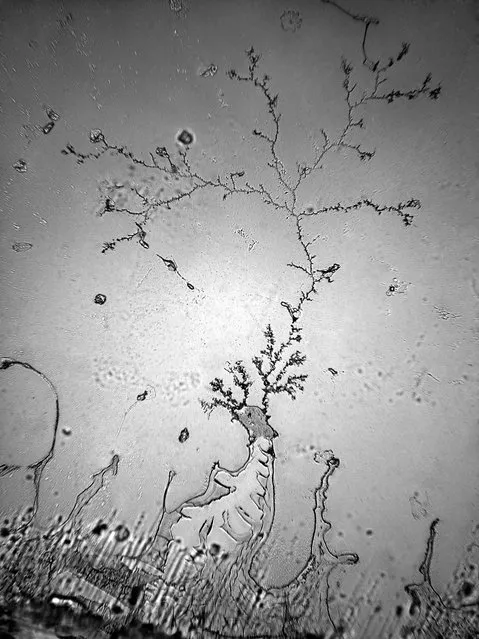
Do tears of joy look the same as ones of woe—or ones from chopping onions? In “The Topography of Tears,” the Los Angeles-based photographer Rose-Lynn Fisher explores the physical terrain of one hundred tears emitted during a range of emotional states and physical reactions. Using a Zeiss microscope with an attached digital camera, she captures the composition of tears enclosed in glass slides, magnified between 10x and 40x. “There are many factors that determine the look of each tear image, including the viscosity of the tear, the chemistry of the weeper, the settings of the microscope, and the way I process the images afterwards,” she says.
A goat begs for food as people have a meal and beer at the Beichelstein-Alpe outdoor restaurant near Seeg, southern Germany, on March 27, 2017. (Photo by Karl-Josef Hildenbrand/AFP Photo/DPA)