Loading...
Done
An Egyptian street vendor carries plastic dishes on a street decorated for the holy month of Ramadan in old Cairo, Egypt June 1, 2016. (Photo by Amr Abdallah Dalsh/Reuters)

An Egyptian street vendor carries plastic dishes on a street decorated for the holy month of Ramadan in old Cairo, Egypt June 1, 2016. (Photo by Amr Abdallah Dalsh/Reuters)
Details
15 Jul 2016 12:20:00
Second place, nature: double trapping. Picture taken in the Brazilian Pantanal ... when I downloaded the CF did not want to believe it ... The nature knows we always give magnificent events but sometimes extraordinary. (Photo by Massimiliano Bencivenni/National Geographic Travel Photographer of the Year Contest)

Second place, Nature: double trapping. Picture taken in the Brazilian Pantanal ... when I downloaded the CF did not want to believe it ... The nature knows we always give magnificent events but sometimes extraordinary. (Photo by Massimiliano Bencivenni/National Geographic Travel Photographer of the Year Contest)
Details
02 Jul 2016 12:53:00
A Geisha girl pouring a drink for a visitor, circa 1955. (Photo by Fox Photos)

A Geisha girl pouring a drink for a visitor, circa 1955. (Photo by Fox Photos). P.S. All pictures are presented in high resolution.
Details
07 Sep 2012 11:24:00
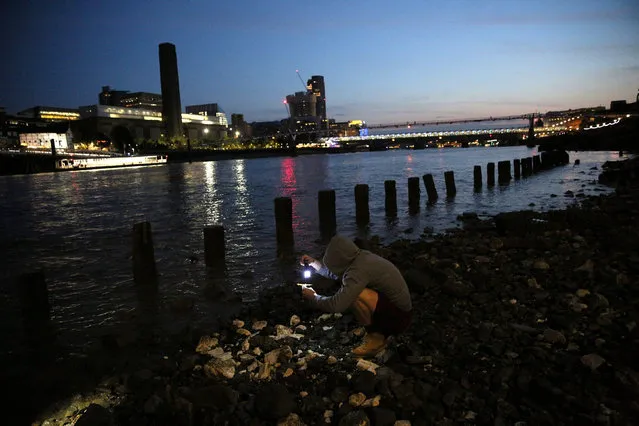
A mudlark uses a torch to look for items on the bank of the River Thames in London, Britain June 06, 2016. Mudlarking is believed to trace its origins to the 18th and 19th century, when scavengers searched the Thames' shores for items to sell. These days, history and archaeology fans are the ones hoping to find old relics such as coins, ceramics, artifacts or everyday items from across centuries. They wait for the low tide and then scour specific areas of exposed shores. "If you're in a field you could be out all day long, with the river you're restricted to about two or three hours," mudlark Nick Stevens said. While many just use the naked eye for their searches, others rely on metal detectors for which a permit from the Port of London Authority is needed. Digging also requires consent. (Photo by Neil Hall/Reuters)

A mudlark uses a torch to look for items on the bank of the River Thames in London, Britain June 06, 2016. Mudlarking is believed to trace its origins to the 18th and 19th century, when scavengers searched the Thames' shores for items to sell. These days, history and archaeology fans are the ones hoping to find old relics such as coins, ceramics, artifacts or everyday items from across centuries. their finds with the Portable Antiquities Scheme. Any item over 300 years old must be recorded. (Photo by Neil Hall/Reuters)

Details
27 Aug 2016 10:43:00
A sculptural artwork creation is displayed as part of the “Fashion in Motion: Daniel Lismore” exhibition by British multidisciplinary artist Daniel Lismore, at the Victoria and Albert Museum in London, Britain on August 5, 2022. (Photo by Toby Melville/Reuters)

A sculptural artwork creation is displayed as part of the “Fashion in Motion: Daniel Lismore” exhibition by British multidisciplinary artist Daniel Lismore, at the Victoria and Albert Museum in London, Britain on August 5, 2022. (Photo by Toby Melville/Reuters)
Details
06 Aug 2022 05:36:00
Tourists play on the “Big” piano inside of the toy store FAO Schwarz on the last day that the store will be open in New York, July 15, 2015. FAO Schwarz will officially close the doors of its flagship Fifth Avenue toy store in New York City on Wednesday night, to the dismay of shoppers charmed by the iconic destination for childhood fun. (Photo by Lucas Jackson/Reuters)

Tourists play on the “Big” piano inside of the toy store FAO Schwarz on the last day that the store will be open in New York, July 15, 2015. FAO Schwarz will officially close the doors of its flagship Fifth Avenue toy store in New York City on Wednesday night, to the dismay of shoppers charmed by the iconic destination for childhood fun. (Photo by Lucas Jackson/Reuters)
Details
16 Jul 2015 10:37:00
Palestinian girl Manar Al-Shinbari (R), 15, who lost her both legs by what medics said was Israeli shelling at a UN-run school where she was taking refuge during the 50-day war last summer, is helped by her sister to put on her headscarf in an apartment in Jabaliya refugee camp in the northern Gaza Strip January 13, 2015. (Photo by Mohammed Salem/Reuters)

Palestinian girl Manar Al-Shinbari (R), 15, who lost her both legs by what medics said was Israeli shelling at a UN-run school where she was taking refuge during the 50-day war last summer, is helped by her sister to put on her headscarf in an apartment in Jabaliya refugee camp in the northern Gaza Strip January 13, 2015. Manar's mother and three of her brothers were killed in the same incident. The girl's family house was destroyed by Israeli shelling during the war. (Photo by Mohammed Salem/Reuters)
Details
14 Jan 2015 12:34:00
In a 200-acre-plus dump 5 kilometers north of Haiti’s capital, Port-au-Prince, hundreds of men, women and children scavenge day and night through the burning wasteland. They earn $12 to $15 a day – on a good day – for recycling plastics as well as clothing, household items and aluminum (for smelting). Some 5,000 tons of waste is created each day in the Port-au-Prince area. (Photo and caption by Giles Clarke/Getty Images Reportage)

In a 200-acre-plus dump 5 kilometers north of Haiti’s capital, Port-au-Prince, hundreds of men, women and children scavenge day and night through the burning wasteland. They earn $12 to $15 a day – on a good day – for recycling plastics as well as clothing, household items and aluminum (for smelting). Some 5,000 tons of waste is created each day in the Port-au-Prince area. (Photo and caption by Giles Clarke/Getty Images Reportage)
Details
02 Feb 2015 11:21:00