Loading...
Done
An Egyptian street vendor carries plastic dishes on a street decorated for the holy month of Ramadan in old Cairo, Egypt June 1, 2016. (Photo by Amr Abdallah Dalsh/Reuters)

An Egyptian street vendor carries plastic dishes on a street decorated for the holy month of Ramadan in old Cairo, Egypt June 1, 2016. (Photo by Amr Abdallah Dalsh/Reuters)
Details
15 Jul 2016 12:20:00
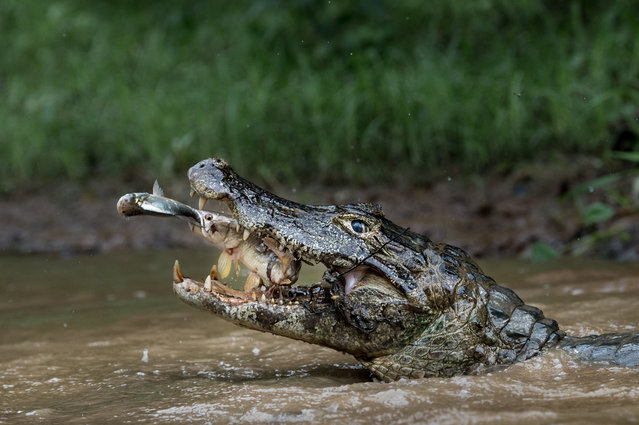
Second place, nature: double trapping. Picture taken in the Brazilian Pantanal ... when I downloaded the CF did not want to believe it ... The nature knows we always give magnificent events but sometimes extraordinary. (Photo by Massimiliano Bencivenni/National Geographic Travel Photographer of the Year Contest)

Second place, Nature: double trapping. Picture taken in the Brazilian Pantanal ... when I downloaded the CF did not want to believe it ... The nature knows we always give magnificent events but sometimes extraordinary. (Photo by Massimiliano Bencivenni/National Geographic Travel Photographer of the Year Contest)
Details
02 Jul 2016 12:53:00
A Geisha girl pouring a drink for a visitor, circa 1955. (Photo by Fox Photos)

A Geisha girl pouring a drink for a visitor, circa 1955. (Photo by Fox Photos). P.S. All pictures are presented in high resolution.
Details
07 Sep 2012 11:24:00
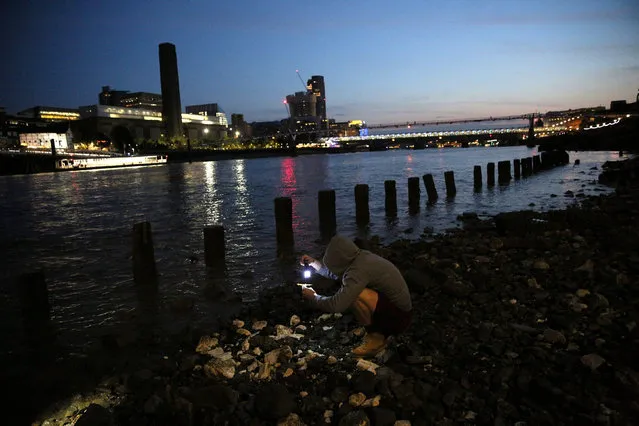
A mudlark uses a torch to look for items on the bank of the River Thames in London, Britain June 06, 2016. Mudlarking is believed to trace its origins to the 18th and 19th century, when scavengers searched the Thames' shores for items to sell. These days, history and archaeology fans are the ones hoping to find old relics such as coins, ceramics, artifacts or everyday items from across centuries. They wait for the low tide and then scour specific areas of exposed shores. "If you're in a field you could be out all day long, with the river you're restricted to about two or three hours," mudlark Nick Stevens said. While many just use the naked eye for their searches, others rely on metal detectors for which a permit from the Port of London Authority is needed. Digging also requires consent. (Photo by Neil Hall/Reuters)

A mudlark uses a torch to look for items on the bank of the River Thames in London, Britain June 06, 2016. Mudlarking is believed to trace its origins to the 18th and 19th century, when scavengers searched the Thames' shores for items to sell. These days, history and archaeology fans are the ones hoping to find old relics such as coins, ceramics, artifacts or everyday items from across centuries. their finds with the Portable Antiquities Scheme. Any item over 300 years old must be recorded. (Photo by Neil Hall/Reuters)
Details
27 Aug 2016 10:43:00
A policeman comforts a man next to the body of Maria Duron, a pregnant fruit vendor caught in the crossfire after gunmen opened fire on a vehicle, killing a sixteen year-old student, her police bodyguard and three other people who were on the street in the city of Tegucigalpa, Honduras, on April 15, 2013. (Photo by Fernando Antonio/Associated Press)

A policeman comforts a man next to the body of Maria Duron, a pregnant fruit vendor caught in the crossfire after gunmen opened fire on a vehicle, killing a sixteen year-old student, her police bodyguard and three other people who were on the street in the city of Tegucigalpa, Honduras, on April 15, 2013. (Photo by Fernando Antonio/Associated Press)

P.S. All pictures are presented in high resolution. To see Hi-Res images – just TWICE click on any picture. In other words, click small picture – opens the BIG picture. Click BIG picture – opens VERY BIG picture (if available; this principle works anywhere on the site AvaxNews)

Details
20 Apr 2013 11:43:00
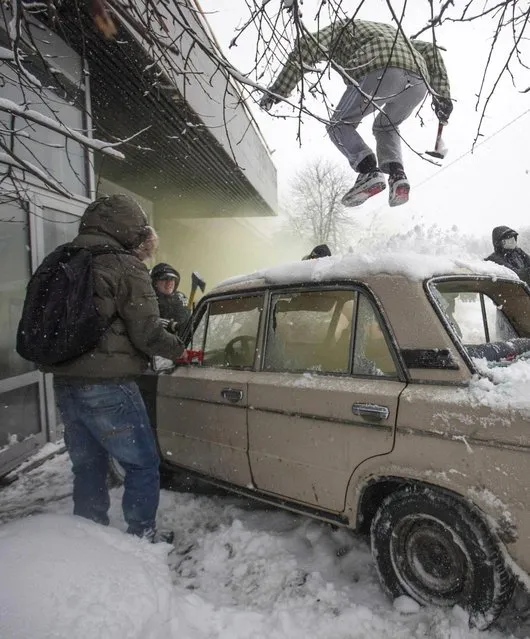
In this photo taken on Friday, March 15, 2013, members of a pro-Kremlin youth group attack pushers of spice, a synthetic drug, in Moscow, Russia. Russian officials and anti-drugs campaigners say that spice has become one of the most dangerous drugs widely available to youngsters and almost impossible to ban because of the constantly changing chemical ingredients. (Photo by Alexander Zemlianichenko Jr/AP Photo)

In this photo taken on Friday, March 15, 2013, members of a pro-Kremlin youth group attack pushers of spice, a synthetic drug, in Moscow, Russia. Russian officials and anti-drugs campaigners say that spice has become one of the most dangerous drugs widely available to youngsters and almost impossible to ban because of the constantly changing chemical ingredients. (Photo by Alexander Zemlianichenko Jr/AP Photo)
Details
26 Apr 2013 08:39:00
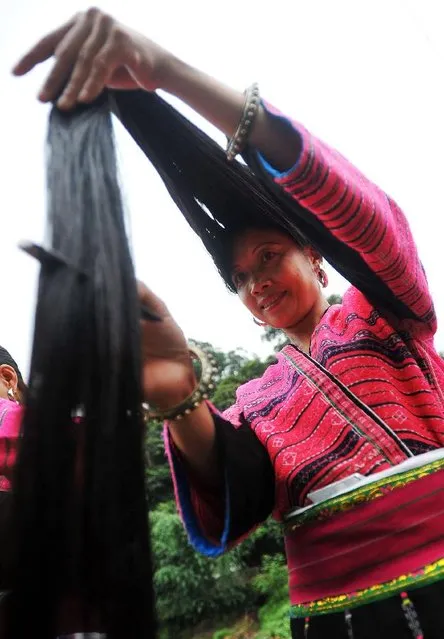
A woman combs her hair at the Huangluo Village of the Yao ethnic group in Guilin, south China's Guangxi Zhuang Autonomous Region, July 15, 2012. (Photo by Lu Boan/Xinhua)

“The Yao nationality is a government classification for various minorities in China. They form one of the 55 ethnic minority groups officially recognized by the People's Republic of China, where they reside in the mountainous terrain of the southwest and south”. – Wikipedia

Photo: A woman combs her hair at the Huangluo Village of the Yao ethnic group in Guilin, south China's Guangxi Zhuang Autonomous Region, July 15, 2012. The Huangluo Village of the Yao ethnic group locates at the Longji Terraces in Heping Town of Longsheng County in Guilin. Women here have the tradition of keeping long hair. They believe that long hair brings good luck and fortune. The average length of hair of 180 women in the village is 1.7 meters. (Photo by Lu Boan/Xinhua)
Details
07 Mar 2015 08:33:00
Andrew Parkinson, animal behaviour category winner: Crepuscular Contentment, Derbyshire. “In 15 years of working with badgers I’ve never seen a badger sit out in the open to have a scratch. I was sat concealed behind a tree and downwind so it was especially nice that the badger had his back to me, demonstrating just how inconspicuous and inconsequential my presence was”. (Photo by Andrew Parkinson/British Wildlife Photography Awards 2017)

Andrew Parkinson, animal behaviour category winner: Crepuscular Contentment, Derbyshire. “In 15 years of working with badgers I’ve never seen a badger sit out in the open to have a scratch. I was sat concealed behind a tree and downwind so it was especially nice that the badger had his back to me, demonstrating just how inconspicuous and inconsequential my presence was”. (Photo by Andrew Parkinson/British Wildlife Photography Awards 2017)
Details
10 Nov 2017 09:01:00