Loading...
Done
Tourists play at a beach covered by a thick layer of green algae on July 3, 2013 in Qingdao, China. A large quantity of non-poisonous green seaweed, enteromorpha prolifera, hit the Qingdao coast in recent days. More than 20,000 tons of such seaweed has been removed from the city's beaches. (Photo by ChinaFotoPress/ChinaFotoPress)

Tourists play at a beach covered by a thick layer of green algae on July 3, 2013 in Qingdao, China. A large quantity of non-poisonous green seaweed, enteromorpha prolifera, hit the Qingdao coast in recent days. More than 20,000 tons of such seaweed has been removed from the city's beaches. (Photo by China Foto Press)
Details
04 Jul 2013 11:01:00
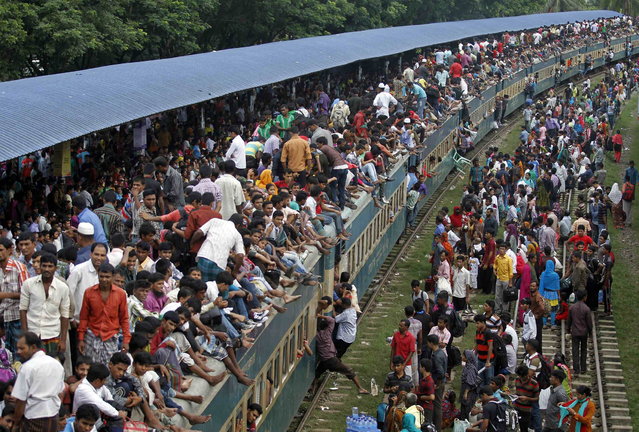
Passengers climb to board an overcrowded train at a railway station in Dhaka August 8, 2013. Millions of residents in Dhaka are travelling home from the capital city to celebrate the Muslim Eid al-Fitr holiday, which marks the end of the Muslim holy fasting month of Ramadan. (Photo by Andrew Biraj/Reuters)

Passengers climb to board an overcrowded train at a railway station in Dhaka August 8, 2013. Millions of residents in Dhaka are travelling home from the capital city to celebrate the Muslim Eid al-Fitr holiday, which marks the end of the Muslim holy fasting month of Ramadan. (Photo by Andrew Biraj/Reuters)
Details
09 Aug 2013 08:48:00
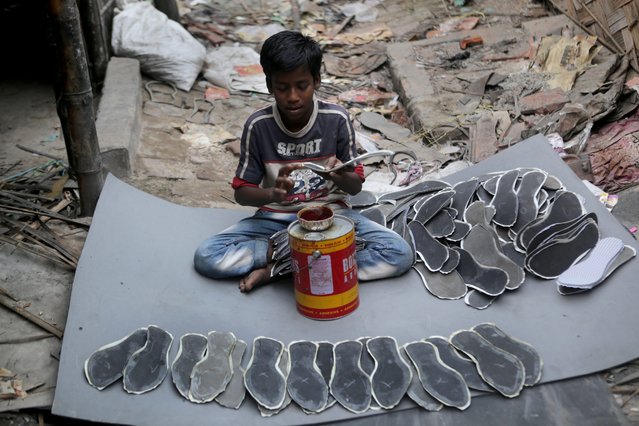
Indian boy Hassan Malik works in a leather shoe factory at Topsia in Calcutta, eastern India, 19 November 2013. (Photo by Piyal Adhikary/EPA)

Indian boy Hassan Malik works in a leather shoe factory at Topsia in Calcutta, eastern India, 19 November 2013. The leather industry occupies an important place in the Indian economy. It is an employment intensive sector with a vast potential for growth and exports but also a pollution intensive industry that relies on cheap labor. One of the major production centers for leather and leather products is located in Calcutta, West Bengal. Hundreds of tanneries are operated in the city’s Tiljala, Topsia and Tangra districts. They are mostly run by local families living and working under poor conditions. (Photo by Piyal Adhikary/EPA)
Details
20 Mar 2014 09:40:00
Greyhounds compete during a race at Santiago city, March 8, 2014. (Photo by Ivan Alvarado/Reuters)

Greyhounds compete during a race at Santiago city, March 8, 2014. With over 100 years of history, greyhound racing attracts people mainly from rural areas of Santiago every weekend. Some dogs come from Argentina, the United States and Ireland and can develop a speed of up to 80 kilometers per hour on a straight running track of about 200 meters, according to organisers. Bets range from $2 to $1,000 per race, offering a livelihood for breeders and gamblers. (Photo by Ivan Alvarado/Reuters)
Details
02 Apr 2014 09:02:00
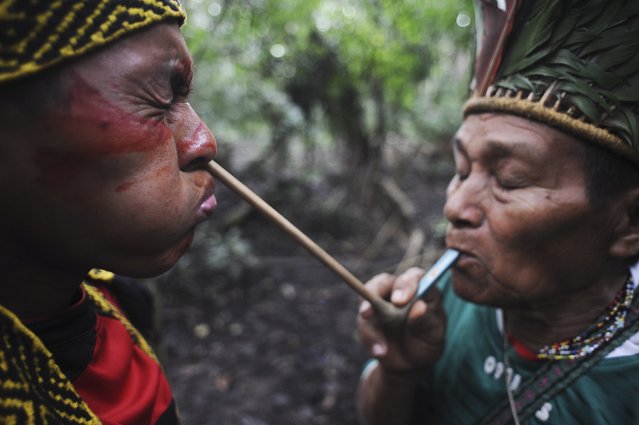
A spiritual leader (R) of the Huni Kui Indian tribe blows an herbal powder into the nose of a tribal member during a ceremony outside the village of Novo Segredo along the Envira river of Brazil's northwestern Acre state, March 9, 2014. (Photo by Lunae Parracho/Reuters)

A spiritual leader (R) of the Huni Kui Indian tribe blows an herbal powder into the nose of a tribal member during a ceremony outside the village of Novo Segredo along the Envira river of Brazil's northwestern Acre state, March 9, 2014. Many indigenous groups, including the Huni Kui, Ashaninka, and Madija, live in villages in the Brazilian rainforest near the border with Peru. (Photo by Lunae Parracho/Reuters)
Details
04 Apr 2014 08:18:00
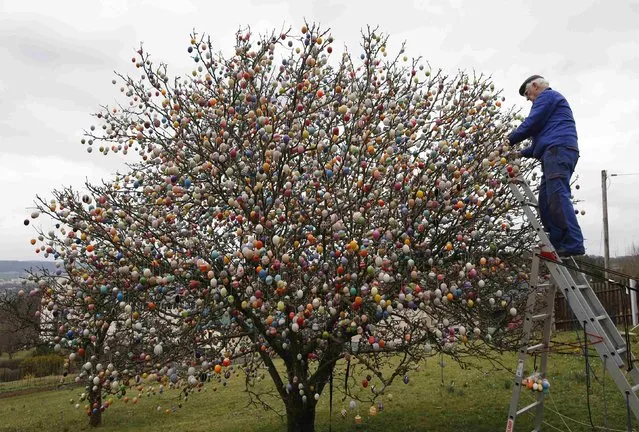
German pensioner Volker Kraft decorates an apple tree with Easter eggs in the garden of his summerhouse, in the eastern German town of Saalfeld, March 19, 2014. (Photo by Fabrizio Bensch/Reuters)

German pensioner Volker Kraft decorates an apple tree with Easter eggs in the garden of his summerhouse, in the eastern German town of Saalfeld, March 19, 2014. Each year since 1965 Volker and his wife Christa spend up to two weeks decorating the tree with their collection of 10,000 colourful hand-painted Easter eggs in time for Easter celebrations. (Photo by Fabrizio Bensch/Reuters)
Details
20 Apr 2014 11:22:00
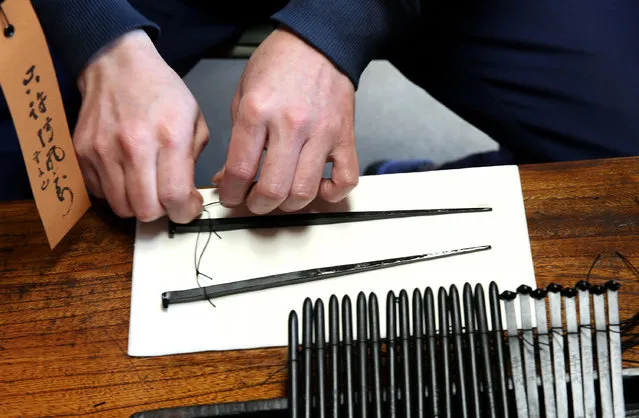
Myouchin Munehisa, 44, as he finishes Hibashi iron bells made of iron on a production line at Myochin Honpo shop on April 25, 2014 in Himeji, Japan. (Photo by Buddhika Weerasinghe/Getty Images)

Myouchin Munehisa, 44, as he finishes Hibashi iron bells made of iron on a production line at Myochin Honpo shop on April 25, 2014 in Himeji, Japan. Myochin family's iron business, started in the Heian period (794-1185) of Japan as an armor and helmet maker, shifted as the needs of people changed in the course of history. (Photo by Buddhika Weerasinghe/Getty Images)
Details
27 Apr 2014 06:29:00
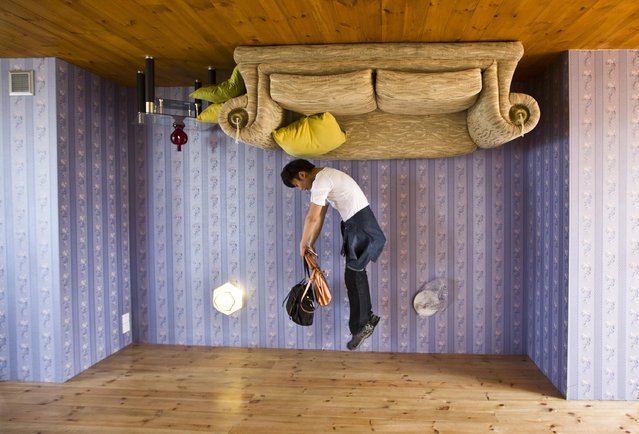
A tourist jumps inside an upside-down house at Fengjing Ancient Town, Jinshan District, south of Shanghai, May 1, 2014. The upside-down house was built as a tourist attraction using everyday household items and furniture. (Photo by Aly Song/Reuters)

A tourist jumps inside an upside-down house at Fengjing Ancient Town, Jinshan District, south of Shanghai, May 1, 2014. The upside-down house was built as a tourist attraction using everyday household items and furniture. (Photo by Aly Song/Reuters)
Details
02 May 2014 11:46:00