France's Romane Miradoli competes during the Women's Downhill event of the FIS Alpine Ski World Championship 2023 in Meribel, French Alps, on February 11, 2023. (Photo by Lionel Bonaventure/AFP Photo)
A Russian Orthodox believers dips in the icy water during a traditional Epiphany celebration in St. Petersburg, Russia, Wednesday, January 19, 2022. Thousands of Russian Orthodox Church followers plunged into icy rivers and ponds across the country to mark Epiphany, cleansing themselves with water deemed holy for the day. The temperature in St. Petersburg is –1C (30F). (Photo by Dmitri Lovetsky/AP Photo)
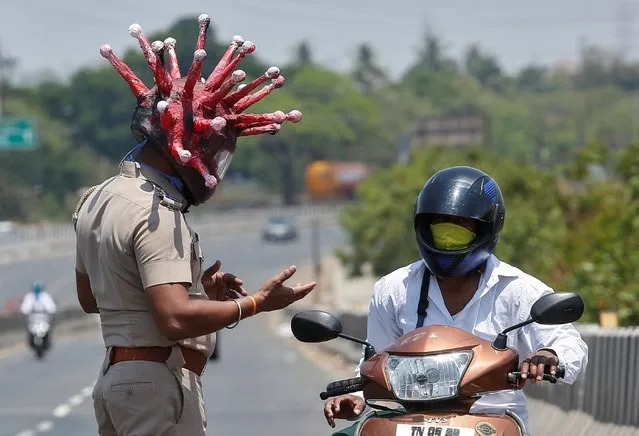
Rajesh Babu, a police officer, wearing a helmet depicting coronavirus, requests a commuter to stay at home during a 21-day nationwide lockdown to limit the spreading of coronavirus disease (COVID-19), in Chennai, India, March 28, 2020. (Photo by P. Ravikumar/Reuters)
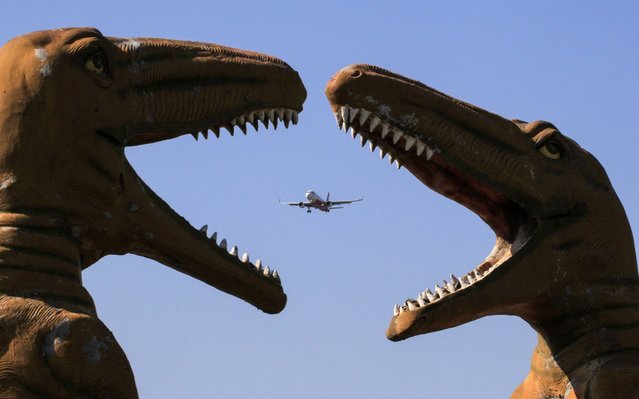
An aircraft flies past sculptures of dinosaurs at the “Valley of Animals” park in Chandigarh, India on November 9, 2019. (Photo by Vijay Mathur/AFP Photo)
Kimono-clad Japanese young women stand in a train after attending a Coming of Age Day ceremony at Yokohama Arena, in Yokohama, Japan, 13 January 2025. Thousands of participants attended the ceremony of the Coming of Age Day in Yokohama, the day celebrating all those who reached 20 years of age, which is considered adulthood in Japan. (Photo by Franck Robichon/EPA/EFE)
Megan McKenna, Amber Turner and Yazmin Oukhellou sightings at Aristocats nightclub Mayfair on March 30, 2017 in London, England. (Photo by Goff Photos)
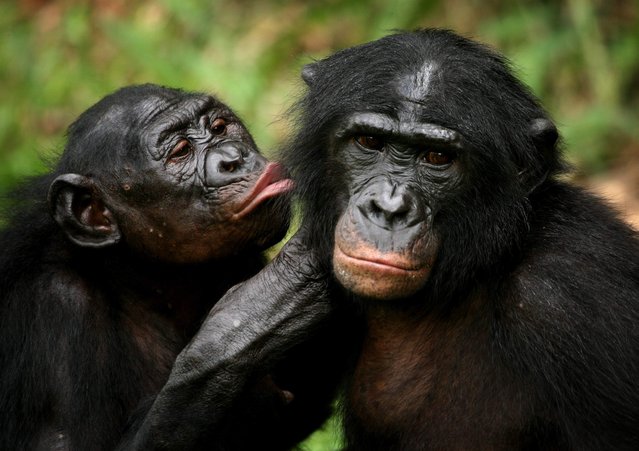
Bonobo apes, primates unique to Congo and humankind's closest relative, groom one another at a sanctuary just outside the capital Kinshasa, Congo on October 31, 2006. (Photo by Finbarr O'Reilly/Reuters)
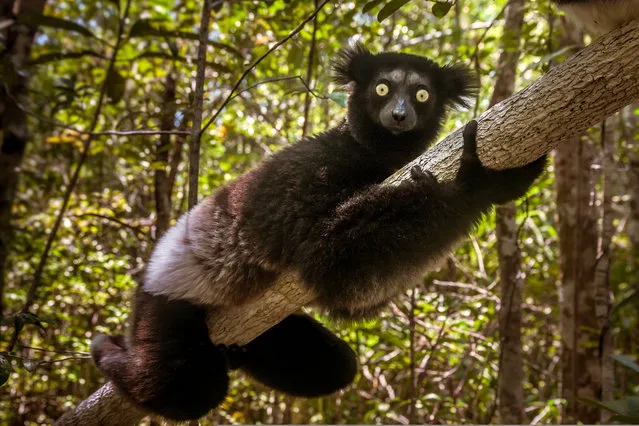
The secretive indri (Indri indri) of Madagascar, the largest living lemur. It is also critically endangered and highly evolutionarily distinct with no close relatives, which makes its branch one of most precarious on the mammal evolutionary tree. In the likely event that the indri goes extinct, we will lose 19m years of unique evolutionary history from the mammal tree of life. (Photo by Pierre-Yves Babelon/Aarhus University)