Loading...
Done
Concept Design Home Reversible Destiny Lofts MITAKA: In Memory Of Helen Keller By Reversible Destiny Foundation and Shusaku Arakawa

“The Reversible Destiny Lofts – Mitaka (In Memory of Helen Keller) is a nine-unit multiple dwelling. It was first completed example of procedural architecture put to residential use. These lofts reflexively articulate the residents’ operative tendencies and coordinating skills essential to and determinative of human thought and behavior; which means to say, the lofts manage, by virtue of how they are constructed, to reveal to their residents the ins and outs of what makes a person, in this case the resident. This is the same set of tendencies and skills to which Arakawa and Madeline Gins gave diagrammatic form in their decades-long research project The Mechanism of Meaning”. – Wikipedia

Photo: The exterior of the concept design home “Reversible Destiny Lofts MITAKA: In Memory of Helen Keller” is seen on October 27, 2005 in Tokyo, Japan. (Photo by Koichi Kamoshida/Getty Images)
Details
30 Nov 2011 11:58:00


“Henri Marie Raymond de Toulouse-Lautrec-Monfa or simply Henri de Toulouse-Lautrec (24 November 1864 – 9 September 1901) was a French painter, printmaker, draughtsman, and illustrator, whose immersion in the colourful and theatrical life of fin de siècle Paris yielded an œuvre of exciting, elegant and provocative images of the modern and sometimes decadent life of those times. Toulouse-Lautrec is known along with Cézanne, Van Gogh, and Gauguin as one of the greatest painters of the Post-Impressionist period. In a 2005 auction at Christie's auction house a new record was set when “La blanchisseuse”, an early painting of a young laundress, sold for $22.4 million U.S” – Wikipedia.

Photo: Full-length portrait of French artist Henri Toulouse-Lautrec wearing an overcoat, a bowler hat, and pince-nez eyeglasses while holding a cane. (Photo by Hulton Archive/Getty Images). Circa 1895
Details
20 Mar 2011 09:28:00


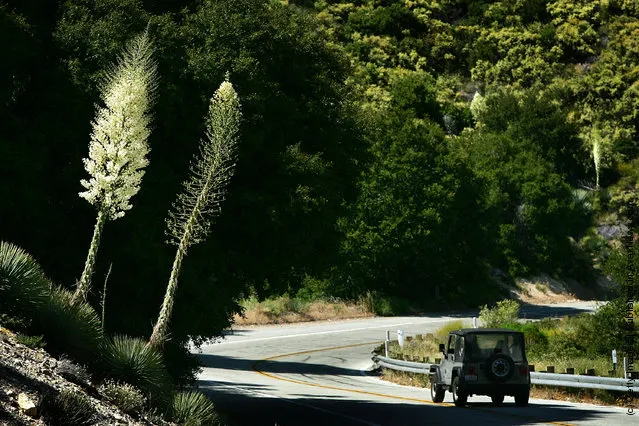
“Yucca is a genus of perennial shrubs and trees in the agave family, Agavaceae. Its 40-50 species are notable for their rosettes of evergreen, tough, sword-shaped leaves and large terminal panicles of white or whitish flowers. They are native to the hot and dry (arid) parts of North America, Central America, South America, and the Caribbean. Early reports of the species were confused with the cassava (Manihot esculenta). Consequently, Linnaeus mistakenly derived the generic name from the Carib word for the latter, yuca. It is also colloquially known in the midwest United States as “Ghosts in the graveyard”, as it is commonly found growing in rural graveyards and when in bloom the flowers appear as an apparition floating.” – Wikipedia

Photo: A yucca standing among flowers bursts forth a very large stalk of flowers as a heavy wildflower bloom on June 21, 2005 in the Angeles National Forest northwest of La Canada, California. (Photo by David McNew/Getty Images)
Details
29 Mar 2011 07:31:00
Thai office workers walk past armed soldiers standing guard outside the Shinawatra Tower Two in Bangkok, Thailand, 20 May 2014. Thai army Chief Prayuth Chan-ocha early on 20 May 2014, declared martial law giving the military full control to prevent further protest-related violence in the country. (Photo by Narong Sangnak/EPA)

Thai office workers walk past armed soldiers standing guard outside the Shinawatra Tower Two in Bangkok, Thailand, 20 May 2014. Thai army Chief Prayuth Chan-ocha early on 20 May 2014, declared martial law giving the military full control to prevent further protest-related violence in the country. The statement was issued about 3 am on 20 May (2000 GMT), according to local media reports. Prayuth has the authority to declare martial law without the consent of the government, which has had caretaker status since 09 December 2013. Thailand has been wracked by six months of non-stop protests seeking to topple the government. At least 25 people have died in political-related violence and more than 700 injured. (Photo by Narong Sangnak/EPA)
Details
21 May 2014 10:09:00


“Sektor gaza” (Russian: Сектор газа) was a Russian rock band formed on 5 December 1987 in the city of Voronezh, Russia. Despite only semi-officially existing (due to obscene lyrics), the group remains popular in Russia today. The group name was taken from an eponymous industrial district of Voronezh (itself named for high levels of environmental contamination). Their music style could be defined as Russian punk, integrated with elements of different musical genres such as rock, rap, and Russian folk. On 4 July 2000, group leader Yuri “Hoy” Klinskih complained of strong pains in his stomach and the left side of his chest. He suffered heart failure shortly thereafter. Klinskikh died in Voronezh (Russia)at the age of 35. He is buried in the Levoberezhniy Cemetery. The group ceased to exist.

About the music video: The First Chechen War, also known as the War in Chechnya, was a conflict between the Russian Federation and the Chechen Republic of Ichkeria, fought from December 1994 to August 1996. After the initial campaign of 1994 – 1995, culminating in the devastating Battle of Grozny, Russian federal forces attempted to seize control of the mountainous area of Chechnya but were set back by Chechen guerrilla warfare and raids on the flatlands in spite of Russia's overwhelming manpower, weaponry, and air support...
Details
24 May 2012 14:38:00
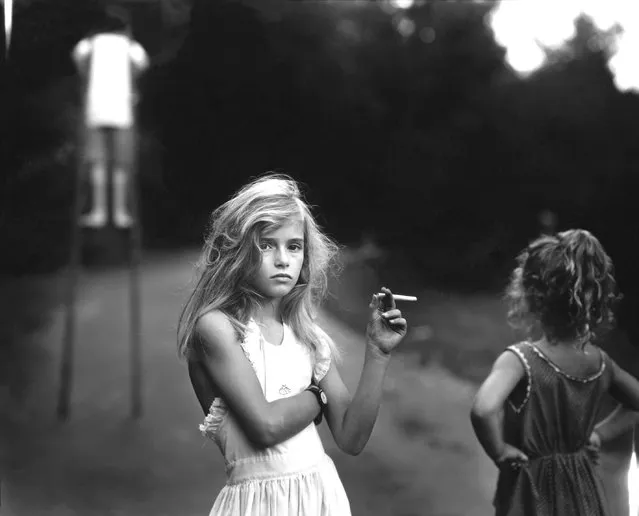
Candy Cigarette, 1989. (Photo by Sally Mann)

“Sally Mann (born in Lexington, Virginia, 1951) is one of America’s most renowned photographers. She has received numerous awards, including NEA, NEH, and Guggenheim Foundation grants, and her work is held by major institutions internationally. Her many books include Second Sight (1983), At Twelve (1988), Immediate Family (1992), Still Time (1994), What Remains (2003), Deep South (2005), Proud Flesh (2009), and The Flesh and the Spirit (2010). A feature film about her work, What Remains, debuted to critical acclaim in 2006. Mann is represented by Gagosian Gallery, New York. She lives in Virginia”.

Photo: Candy Cigarette, 1989. (Photo by Sally Mann)
Details
28 Apr 2012 11:32:00


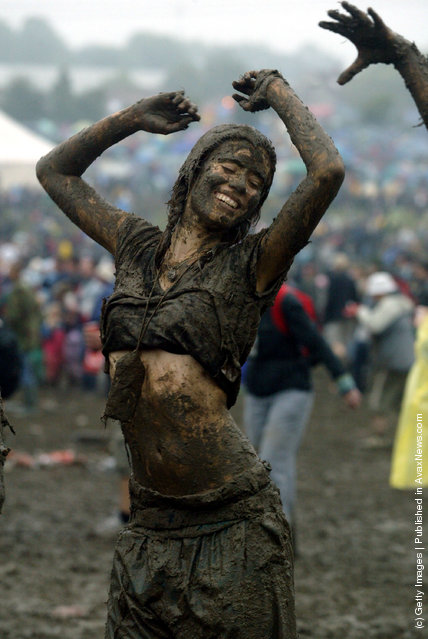
“The Glastonbury Festival of Contemporary Performing Arts, commonly abbreviated to Glastonbury is a British performing arts festival, best known for its contemporary music, but also for dance, comedy, theatre, circus, cabaret and many other arts. For 2005, the enclosed area of the festival was over 900 acres (3.6 km²), had over 385 live performances and was attended by around 150,000 people. In 2007, over 700 acts played on over 80 stages and the capacity expanded by 20,000 to 177,000. In 2011 UK Music published a report stating that Glastonbury Festival contributes over £100 million annually to the UK economy” – Wikipedia

Photo: Festival goers dance in the mud in front of the Pyramid stage at Worthy Farm, Pilton, Somerset, at the 2004 Glastonbury Festival, 26 June 2004. (Photo by Matt Cardy/Getty Images)
Details
21 Jun 2011 11:19:00


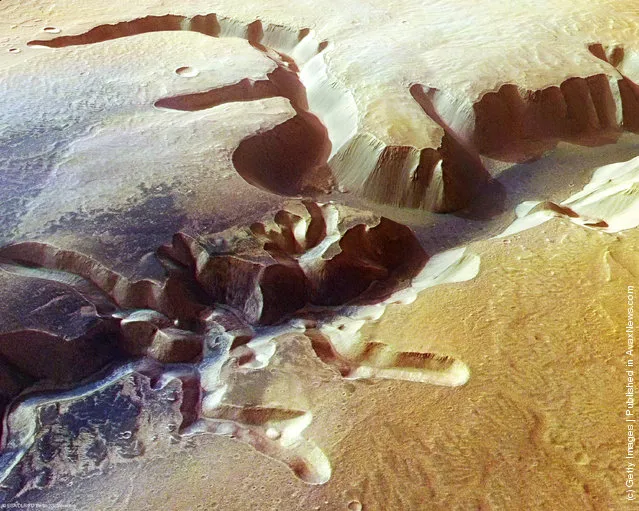
“Echus Chasma is a chasma in the Lunae Planum high plateau north of the Valles Marineris canyon system of Mars. Clay has been found in Echus Chasma that means that water once sat there for a time. Echus Chasma is approximately 100 km long and 10 km wide, with valleys ranging in depth from around 1 km to 4 km”. – Wikipedia

Photo: In this handout image supplied by the European Space Agency (ESA) on July 16, 2008, The Echus Chasma, one of the largest water source regions on Mars, is pictured from ESA's Mars Express. The data was acquired on September 25, 2005. The dark material shows a network of light-coloured, incised valleys that look similar to drainage networks known on Earth. It is still debated whether the valleys originate from precipitation, groundwater springs or liquid or magma flows on the surface. (Photo by ESA via Getty Images)
Details
18 Jul 2011 11:47:00