Loading...
Done
Doctor Dvora Ancona wears a glove bearing writings against violence on women as she arrives to attend La Scala opera house's gala season opener, Giuseppe Verdi's opera “Don Carlo” at the Milan La Scala theater, Italy, Thursday December 7, 2023. The season-opener Thursday, held each year on the Milan feast day St. Ambrose, is considered one of the highlights of the European cultural calendar. (Photo by Luca Bruno/AP Photo)

Doctor Dvora Ancona wears a glove bearing writings against violence on women as she arrives to attend La Scala opera house's gala season opener, Giuseppe Verdi's opera “Don Carlo” at the Milan La Scala theater, Italy, Thursday December 7, 2023. The season-opener Thursday, held each year on the Milan feast day St. Ambrose, is considered one of the highlights of the European cultural calendar. (Photo by Luca Bruno/AP Photo)
Details
18 Feb 2025 04:05:00
“Dropping” – Artist uses high-speed photography to capture the beauty of ink and oil. (Photo by Alberto Seveso)

“Dropping” is the work of Italian graphic artist Alberto Seveso. Seveso captured these amazing images or “fluid sculpture” with the use of high-speed photography while mixing ink with oil, as a tribute to the dripping technique of Jackson Pollock. Seveso works from his home town of Portoscuso, Italy creating cutting edge imagery for ad campaigns for companies such as Adobe, Sony, ESPN, Nikon and more. Sevese says of his work: “I don't consider myself as an artist, I'm just someone playing with software and creativity”... (Photo by Alberto Seveso)
Details
05 Jun 2015 08:17:00
“Little Apple” – a Viral Hit from China

When you think of the People's Liberation Army, you probably don't think of line dancing. But the Chinese military's latest online recruiting video makes a soldier's life look more fun than the macarena. The brief spot, posted last week on the website of the Ministry of National Defense and going viral, features tanks and fighter jets, as well as soldiers dancing in rows to a quirky hit tune by the Chopsticks Brothers called “Little Apple”. Its lyrics include, “You are my little dear little apple/I can never stop loving you”.
Details
09 Aug 2014 13:34:00
“Blow Job”: Gale-force Wind Portraits by Tadao Cern

“In spring of 2010 I wanted to try something new and stopped being an architect. That 'something new' turned out to be photography. Wedding photography – to be exact. Today I travel around the world with my personal projects and commissions knowing that there is a lot more exiting stuff to be tried out. Don't be afraid to change something in your life, because for me that was one of the best decisions”. – Tadao Cern (Photo by Tadao Cern)
Details
19 May 2012 12:48:00
Bob Carey By The Tutu Project

You don't often see a man walking around a field of cows wearing a pink tutu. Needless to say, we were intrigued by Bob Carey and the shirtless photos of him gallivanting around in a costume often worn by little girls. We sensed there was a good story behind this alter-ego ballerina, but we didn't expect it would be this heartwarming.
Details
12 Jun 2013 07:26:00


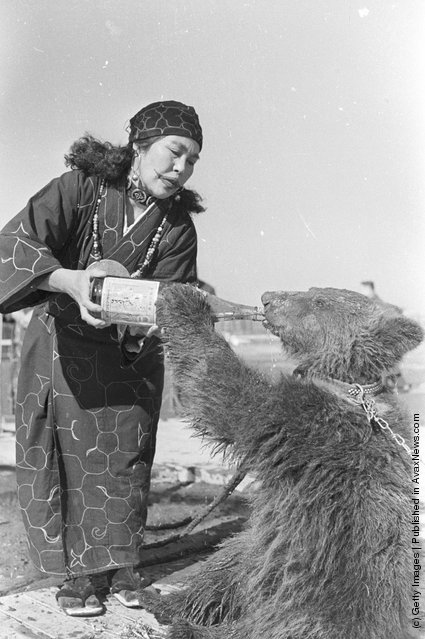
“The Ainu (アイヌ?), also called Aynu, Aino (アイノ), and in historical texts Ezo (蝦夷), are indigenous people or groups in Japan and Russia. Historically they spoke the Ainu language and related varieties and lived in Hokkaidō, the Kuril Islands, and much of Sakhalin. Most of those who identify themselves as Ainu still live in this same region, though the exact number of living Ainu is unknown. This is due to ethnic issues in Japan resulting in those with Ainu backgrounds hiding their identities and confusion over mixed heritages. In Japan, because of intermarriage over many years with Japanese, the concept of a 'pure Ainu' ethnic group is no longer feasible. Official estimates of the population are of around 25,000, while the unofficial number is upwards of 200,000 people”. – Wkipedia

Photo: A captive bear drinking from a large bottle held by an Ainu tribeswoman. (Photo by Evans/Three Lions/Getty Images). Circa 1955
Details
24 Mar 2011 14:01:00
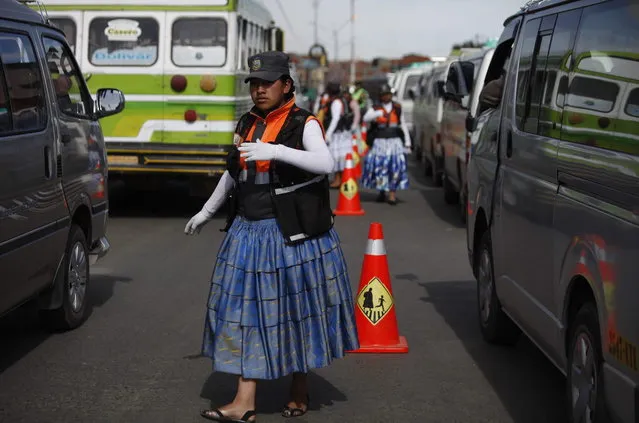
In this December 3, 2013 photo, an Aymara woman cops directs traffic on the streets of El Alto, Bolivia. The women wear the bright petticoats and shawls of indigenous women in the Andes, called cholitas in Bolivian slang, the main difference being that instead of bowler hats they wear khaki green police-style caps. Some don fluorescent traffic vests. (Photo by Juan Karita/AP Photo)

“This city in Bolivia's highlands has hired Aymara women dressed in traditional multilayered Andean skirts and brightly embroidered vests to work as traffic cops and bring order to its road chaos. About 20 of the “traffic cholitas” have been trained to direct cars and buses in El Alto, a teeming, impoverished sister city of La Paz in Bolivia's Andes mountains”. – El Alto via Associated Press. Photo: In this December 3, 2013 photo, an Aymara woman cops directs traffic on the streets of El Alto, Bolivia. The women wear the bright petticoats and shawls of indigenous women in the Andes, called cholitas in Bolivian slang, the main difference being that instead of bowler hats they wear khaki green police-style caps. Some don fluorescent traffic vests. (Photo by Juan Karita/AP Photo)
Details
25 Dec 2013 10:48:00
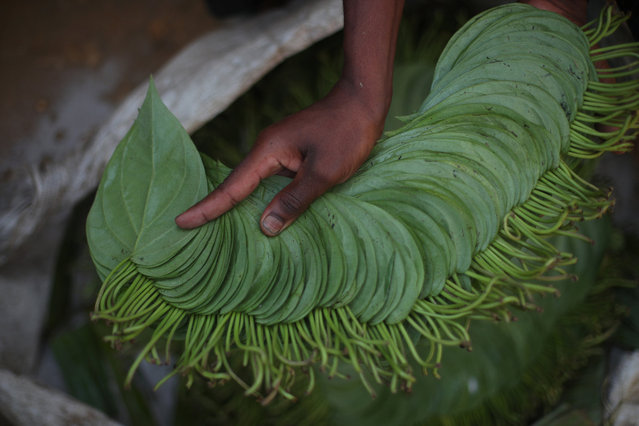
Faruk, 17, a Rohingya refugee trader holds betel leaves which are on sale at a stall in Palong Khali refugee camp near Cox's Bazar, Bangladesh, November 3, 2017. He left his village in Myanmar when the military opened fire towards the Rohingya. “I buy this betel leaf from Palong Khali market, in one bundle there are 160 pieces, I buy it for 80 taka and I sell it for 100 taka. Bangladeshi's and I sell for the same rate in the camp. Outside in the local market it is 80 taka per bundle. My problem is that I don't have money so I can't buy anything to eat, I can't buy fish to eat”, he said. (Photo by Hannah McKay/Reuters)

Faruk, 17, a Rohingya refugee trader holds betel leaves which are on sale at a stall in Palong Khali refugee camp near Cox's Bazar, Bangladesh, November 3, 2017. He left his village in Myanmar when the military opened fire towards the Rohingya. “I buy this betel leaf from Palong Khali market, in one bundle there are 160 pieces, I buy it for 80 taka and I sell it for 100 taka (1 Bangladeshi Taka = 0.012 US Dollar). Bangladeshi's and I sell for the same rate in the camp. Outside in the local market it is 80 taka per bundle. My problem is that I don't have money so I can't buy anything to eat, I can't buy fish to eat”, he said. (Photo by Hannah McKay/Reuters)
Details
27 Nov 2017 08:54:00