Loading...
Done
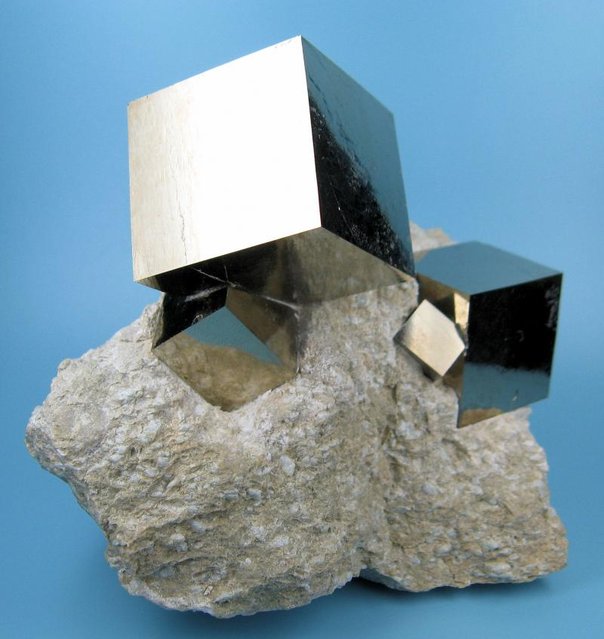
Pyrite Cubic Crystals

The mineral pyrite, or iron pyrite, also known as fool's gold, is an iron sulfide with the formula FeS2. This mineral's metallic luster and pale brass-yellow hue give it a superficial resemblance to gold, hence the well-known nickname of fool's gold. The color has also led to the nicknames brass, brazzle, and Brazil, primarily used to refer to pyrite found in coal.
In crystallography, the cubic (or isometric) crystal system is a crystal system where the unit cell is in the shape of a cube. This is one of the most common and simplest shapes found in crystals and minerals.
Details
23 Nov 2013 13:31:00
Artists called “Le couple en chocolat” take part in the festival “Statues en Marche” in Marche-en-Famenne, Belgium, July 22, 2018. (Photo by Yves Herman/Reuters)

Artists called “Le couple en chocolat” take part in the festival “Statues en Marche” in Marche-en-Famenne, Belgium, July 22, 2018. Living statues are a common sight in many city centres, but it is rare to see such a diverse range of this peculiar form of street art for which performers must keep still for painfully long periods of time to create the desired illusion. (Photo by Yves Herman/Reuters)

Details
25 Jul 2018 00:05:00


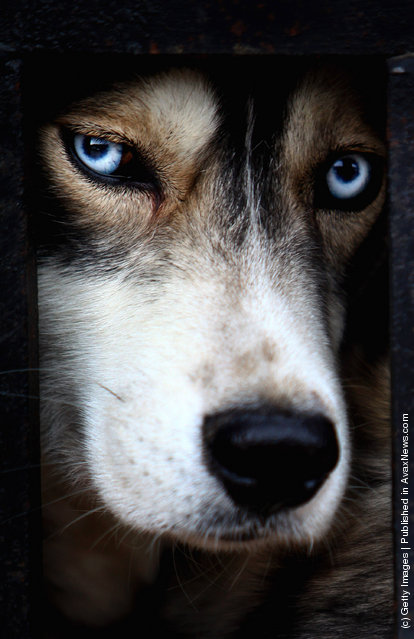
“Husky is a general term for several breeds of dogs used as sled dogs. Huskies were originally used as sled dogs in northern regions but are now also kept as pets. The word “husky” is a corruption of the derogative term “Eskie”, also given to the Esquimaux tribes that came into contact with Europeans who made early expeditions into their lands. The most common huskies are the Siberian Husky and the Alaskan Husky”. – Wikipedia

Photo: A husky looks out from his pen as competitors and teams prepare for the 27th annual Aviemore Husky Sled Dog Rally beside Loch Morlich on January 21, 2010 Aviemore, Scotland. (Photo by Jeff J Mitchell/Getty Images)
Details
21 Jul 2011 14:51:00
Microphones are seen in front of Frida, a female Chihuahua, after the San Francisco Board of Supervisors issued a special commendation naming Frida “Mayor of San Francisco for a Day” in San Francisco, California November 18, 2014. (Photo by Stephen Lam/Reuters)

Microphones are seen in front of Frida, a female Chihuahua, after the San Francisco Board of Supervisors issued a special commendation naming Frida “Mayor of San Francisco for a Day” in San Francisco, California November 18, 2014. Frida, a previously unknown female Chihuahua, has won her first political office, being named Mayor of San Francisco for the day as part of a campaign to support the city's animal shelter. (Photo by Stephen Lam/Reuters)
Details
20 Nov 2014 12:35:00
This property in the French Pyrenees is owned by a German man, who moved with his family here 25 years ago. He has since renovated the shack to be a completely self-sufficient house. There are no electrical appliances, but the solar panel powers small lights in the house. (Photo by Antoine Bruy)

Back in 2010, French photographer Antoine Bruy began hitchhiking around Europe without any fixed route. Along his travels, he met people who had entirely abandoned city life in favour of an isolated country existence they found more fulfilling. Bruy began seeking out people who lived off-the-grid. After three years on the road, staying in makeshift houses and on community farms, he has released Scrublands, a documentation of the lifestyle. While each living situation is different, Bruy found that all the people he met shared a common desire to escape the rat race and achieve a quieter life in harmony with nature. (Photo by Antoine Bruy)
Details
13 Aug 2014 09:45:00


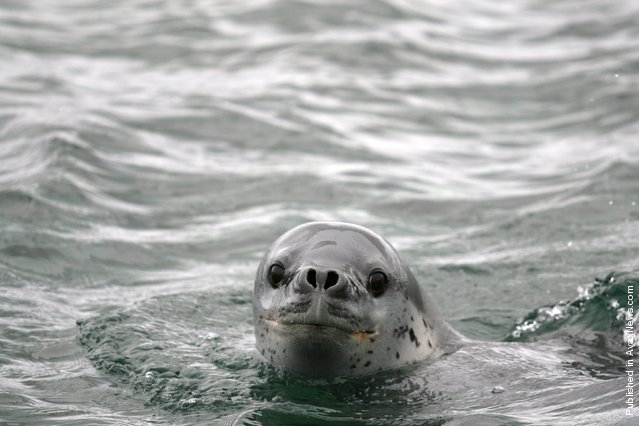
“The leopard seal (Hydrurga leptonyx), also referred to as the sea leopard, is the second largest species of seal in the Antarctic (after the southern elephant seal). It is most common in the southern hemisphere along the coast of Antarctica and on most sub-Antarctic islands, but can also be found on the coasts of southern Australia, Tasmania, South Africa, New Zealand, Lord Howe Island, Tierra del Fuego, the Cook Islands, and the Atlantic coast of South America. It can live twenty-six years, possibly more. Orcas and large sharks are the only natural predators of leopard seals”. – Wikipedia

Photo by: Gilad Rom; Source: Flickr
Details
13 Nov 2011 11:24:00
An artist's impression of a growing supermassive black hole located in the early Universe is seen in this NASA handout illustration released on June 15, 2011. Using the deepest X-ray image ever taken, astronomers found the first direct evidence that massive black holes were common in the early universe. This discovery from NASA's Chandra X-Ray Observatory shows that very young black holes grew more aggressively than previously thought, in tandem with the growth of their host galaxies. (Photo by Reuters/NASA/Chandra X-Ray Observatory/A.Hobart)

An artist's impression of a growing supermassive black hole located in the early Universe is seen in this NASA handout illustration released on June 15, 2011. Using the deepest X-ray image ever taken, astronomers found the first direct evidence that massive black holes were common in the early universe. This discovery from NASA's Chandra X-Ray Observatory shows that very young black holes grew more aggressively than previously thought, in tandem with the growth of their host galaxies. (Photo by Reuters/NASA/Chandra X-Ray Observatory/A.Hobart)
Details
11 Feb 2016 12:57:00
28 year old Rupa has her hair shaven to donate to the Gods at the Thiruthani Murugan Temple November 10, 2016 in Thiruttani, India. Rupa donated her hair with the wish that her daughter's illness is cured. The process of shaving ones hair and donating it to the Gods is known as tonsuring. It is common for Hindu believers to tonsure their hair at a temple as a young child, and also to celebrate a wish coming true, such as the birth of a baby or the curing of an illness. The “temple hair”, as it's known, is then auctioned off to a processing plant and then sold as pricey wigs and weaves in the US, Europe and Africa. (Photo by Allison Joyce/Getty Images)

28 year old Rupa has her hair shaven to donate to the Gods at the Thiruthani Murugan Temple November 10, 2016 in Thiruttani, India. Rupa donated her hair with the wish that her daughter's illness is cured. The process of shaving ones hair and donating it to the Gods is known as tonsuring. It is common for Hindu believers to tonsure their hair at a temple as a young child, and also to celebrate a wish coming true, such as the birth of a baby or the curing of an illness. The “temple hair”, as it's known, is then auctioned off to a processing plant and then sold as pricey wigs and weaves in the US, Europe and Africa. (Photo by Allison Joyce/Getty Images)
Details
21 Nov 2016 10:30:00