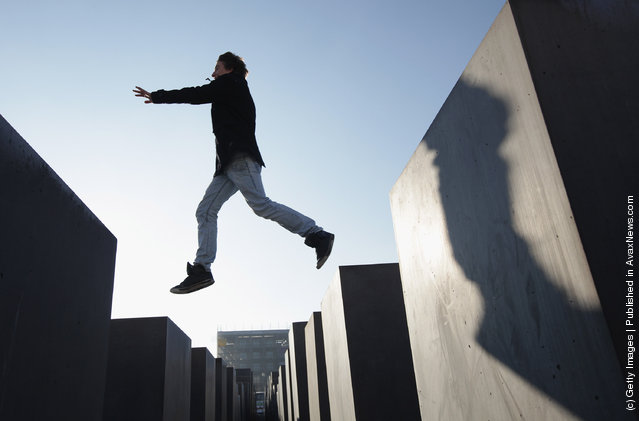
A young man leaps across stellae at the Memorial to the Murdered Jews of Europe, also called the Holocaust Memorial, on January 26, 2012 in Berlin, Germany. (Photo by Sean Gallup/Getty Images)
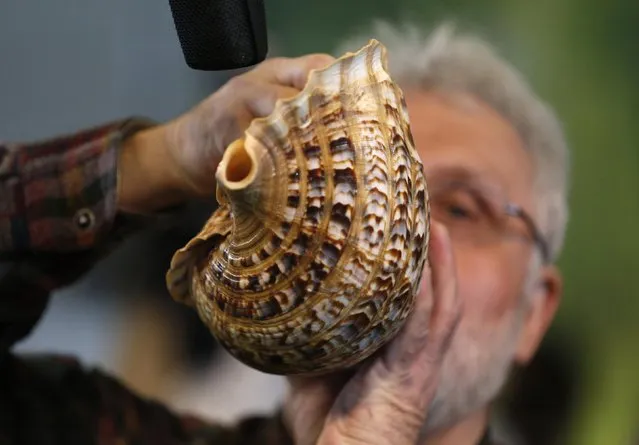
A competitor calls with a shell at the German championships in Deer-Calling at the “Jagd & Hund” (hunting & dog) exhibition in Dortmund February 6, 2015. Competitors use specially designed instruments or ox horns to imitate the mating call of red deers. About 750 exhibitors will present their latest developments at the 34th “Jagd & Hund” exhibition, which runs from February 3 to February 8. (Photo by Ina Fassbender/Reuters)
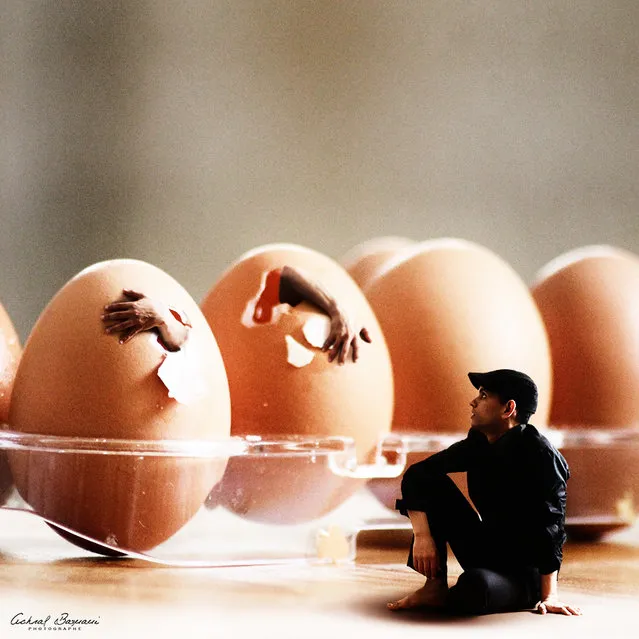
Moroccan photographer and filmmaker Achraf Baznani carries on the traditions of Surrealism with his wild, imaginative, and wholly impractical imagery. Among his inventive scenarios, small human figures—often the artist himself—appear trapped within glass jars or the size of a camera lens; in other works, Baznani more or less dissects his body, as for example, in one, he cleanly removes his brain from his cranium, or in another, twists off his hand, much as if it were a light bulb. Imparted throughout such works are strong senses of humor and wonder, and as such, Baznani’s art offers a Surrealistic take on life experience in the digital age.
J. Schwartz (C) and Marianne Wittelsberger (2nd R) of Consumer Watchdog dress as members of the “Google Track Team” in a hallway of the Dirksen Senate Office Building prior to a hearing on Google September 21, 2011 on Capitol Hill in Washington, DC. Members of Consumer Watchdog attended the antitrust hearing dressed as the “Google Track Team” in white tracksuits emblazoned with Google's motto, “Don't be evil”, wearing “Wi-Spy” glasses and pretending to track unsuspecting people during the event. (Photo by Alex Wong/Getty Images)
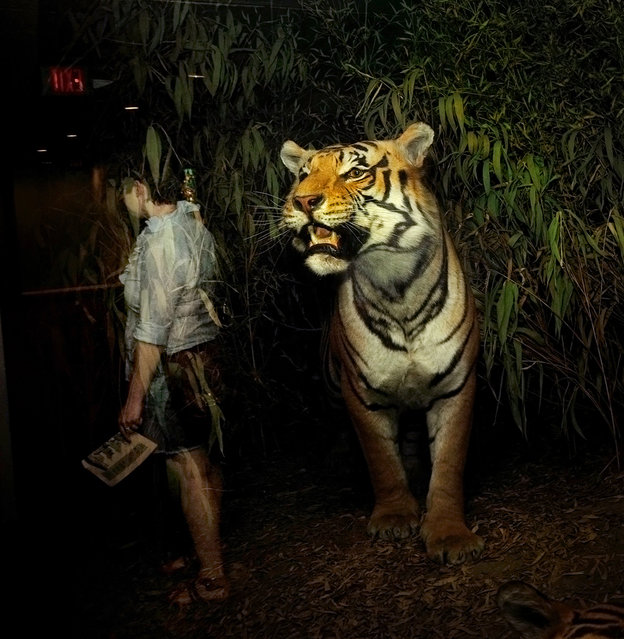
“Natural History” is a series of completely candid single exposure images that merge the living and the dead to create allegorical narratives of our troubled co-existence with nature. Ghost-like reflections of modern visitors viewing wildlife dioramas are juxtaposed against the antique taxidermied subjects housed behind thick glass, their faces molded into permanent expressions of fear, aggression or fleeting passivity. After decades of over-hunting, climate change, poaching and destruction of habitat, many of these long dead diorama specimens now represent endangered or completely extinct species”. – Traer Scott. (Photo by Traer Scott)
A Saudi police officer receives emergency calls at a call center, ahead of the Hajj pilgrimage in the Muslim holy city of Mecca, Saudi Arabia, Tuesday, August 6, 2019. The hajj occurs once a year during the Islamic lunar month of Dhul-Hijja, the 12th and final month of the Islamic calendar year. (Photo by Amr Nabil/AP Photo)
Breath at sunset, captures a sea turtle at a dive site called Black Rock. Kāʻanapali, Hawaiʻi, August 2013. (Photo by Christopher Doherty/Smithsonian.com)