Loading...
Done
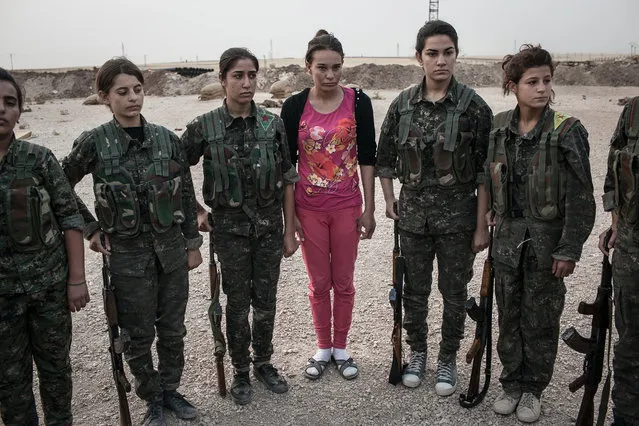
A young YPJ recruit (in pink) arrives to the training base for her first day in training near Derek City, Syria. The YPJ schedule is demanding and requires discipline – new soldiers in training get about 6 hours of sleep a night and wake up at 4 AM to begin exercising; afterwards, their day consists of a full schedule of drills and classroom lessons. Before joining the YPJ many of the girls had never participated in physical activity or sports before. (Photo by Erin Trieb/NBC News)

A young YPJ recruit (in pink) arrives to the training base for her first day in training near Derek City, Syria. The YPJ schedule is demanding and requires discipline – new soldiers in training get about 6 hours of sleep a night and wake up at 4 AM to begin exercising; afterwards, their day consists of a full schedule of drills and classroom lessons. Before joining the YPJ many of the girls had never participated in physical activity or sports before. (Photo by Erin Trieb/NBC News)
Details
10 Sep 2014 12:01:00
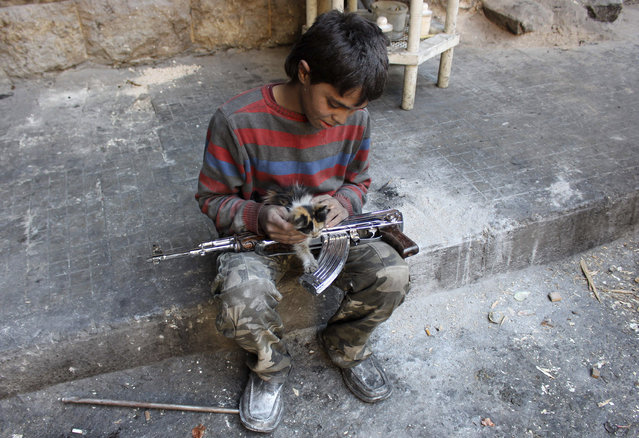
Mohammad, a 13-year-old fighter from the “Free Syrian Army”, plays with a cat in Aleppo's Bustan al-Basha district, Syria October 28, 2013. Mohammad joined the Free Syrian Army after his father died during clashes with the Syrian regime. The gun he is using was his father's. (Photo by Molhem Barakat/Reuters)

Mohammad, a 13-year-old fighter from the “Free Syrian Army”, plays with a cat in Aleppo's Bustan al-Basha district, Syria October 28, 2013. Mohammad joined the Free Syrian Army after his father died during clashes with the Syrian regime. The gun he is using was his father's. (Photo by Molhem Barakat/Reuters)
Details
13 May 2015 10:44:00
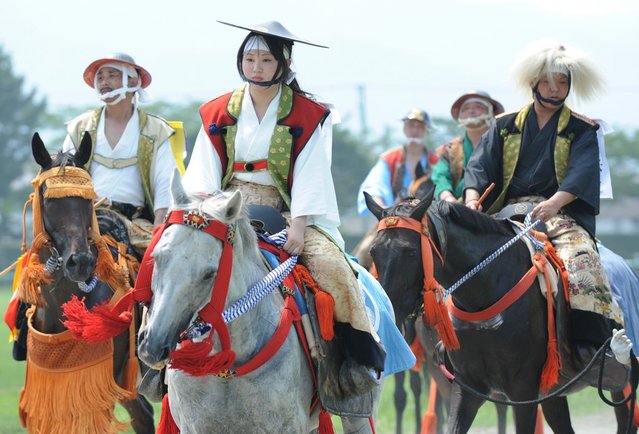
A young woman (C) clad in samurai costume leads other local poeple as she rides her horse during a parade at the annual Soma Nomaoi festival in Minamisoma, Fukushima Prefecture, on July 28, 2012.  The traditional full-scale festival kicked off for the first time after the accident of the Fukushima Dai-ichi Nuclear Power Plant following the massive earthquake and the tsunami on March 11, 2011. (Photo by Toru Yamanaka/AFP Photo)

Soma-Nomaoi is a festival that recreates a battle scene from more than 1,000 years ago. It is annually held for 4 days from July 22 to 25 in Haramachi City, Fukushima Prefecture, in the eastern part of Japan. In this historical event, 600 mounted samurai in traditional Japanese armor, with long swords at their side and ancestral flagstaffs streaming from their backs, ride across open fields. Soma-Nomaoi has been designated an Important Intangible Folk Cultural Property.

Photo: A young woman (C) clad in samurai costume leads other local poeple as she rides her horse during a parade at the annual Soma Nomaoi festival in Minamisoma, Fukushima Prefecture, on July 28, 2012. The traditional full-scale festival kicked off for the first time after the accident of the Fukushima Dai-ichi Nuclear Power Plant following the massive earthquake and the tsunami on March 11, 2011. (Photo by Toru Yamanaka/AFP Photo)
Details
02 Aug 2012 12:59:00
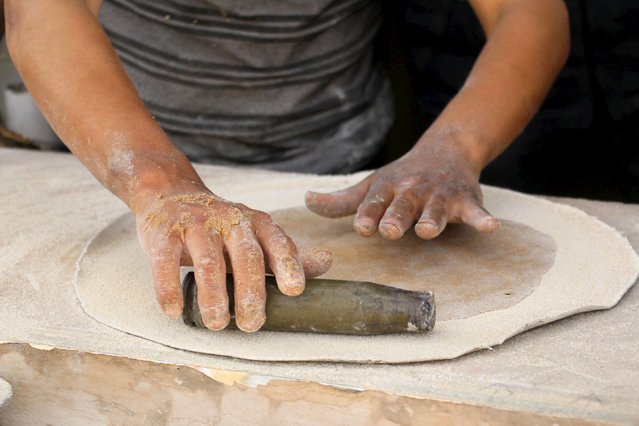
A boy uses remnants of ordnance as he prepares dough inside Abu Khaled's shop in the Douma neighborhood of Damascus April 28, 2015. Abu Khaled opened a shop for making “barley bread” using remnants of weapons including rockets, tank shells and other ordnance fired by forces loyal to Syria's President Bashar al-Assad. (Photo by Amer Almohibany/Reuters)

A boy uses remnants of ordnance as he prepares dough inside Abu Khaled's shop in the Douma neighborhood of Damascus April 28, 2015. Abu Khaled opened a shop for making “barley bread” using remnants of weapons including rockets, tank shells and other ordnance fired by forces loyal to Syria's President Bashar al-Assad. (Photo by Amer Almohibany/Reuters)
Details
09 Aug 2015 11:13:00
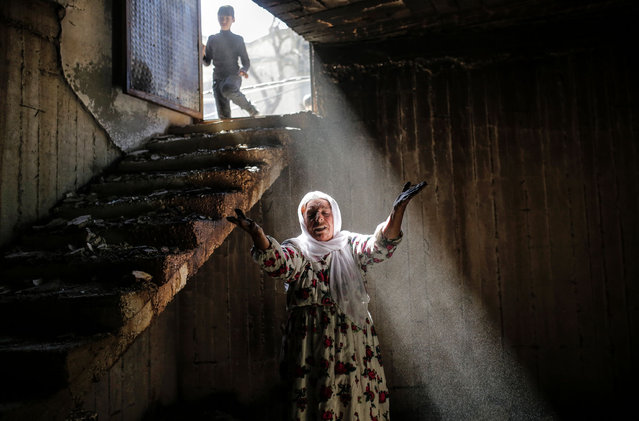
A woman reacts while walking among the ruins of damaged buildings following heavy fighting between government troops and Kurdish fighters, on March 2, 2016 in the southeastern Turkey Kurdish town of Cizre, near the border with Syria and Iraq. Thousands in Turkey's Kurdish-majority town of Cizre started returning to their homes today after authorities partially lifted a curfew in place since December for a controversial military operation to root out separatist rebels. (Photo by Yasin Akgül/AFP Photo)

A woman reacts while walking among the ruins of damaged buildings following heavy fighting between government troops and Kurdish fighters, on March 2, 2016 in the southeastern Turkey Kurdish town of Cizre, near the border with Syria and Iraq. Thousands in Turkey's Kurdish-majority town of Cizre started returning to their homes today after authorities partially lifted a curfew in place since December for a controversial military operation to root out separatist rebels. (Photo by Yasin Akgül/AFP Photo)
Details
03 Mar 2016 11:29:00
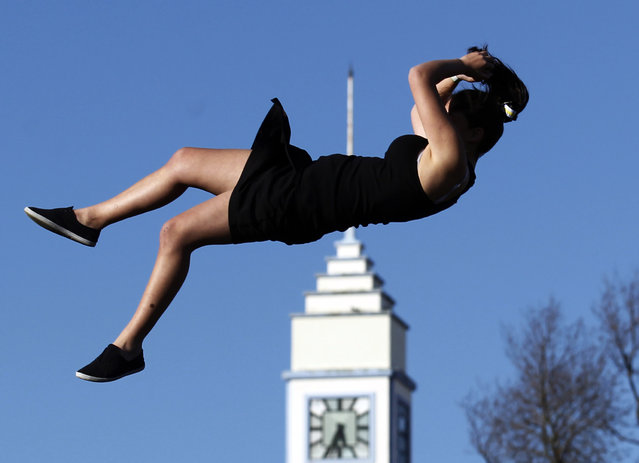
8. NEW ZEALAND: A woman dives from a platform into a giant air bed at a park in Palmerston North September 29, 2011. (Photo by Marcos Brindicci/Reuters)

The report, prepared by the Sustainable Development Solutions Network (SDSN) and the Earth Institute at Columbia University, showed Syria, Afghanistan and eight sub-Saharan countries as the 10 least happy places on earth to live. The top 10 this year were Denmark, Switzerland, Iceland, Norway, Finland, Canada, Netherlands, New Zealand, Australia, and Sweden. Denmark was in third place last year, behind Switzerland and Iceland. The bottom 10 were Madagascar, Tanzania, Liberia, Guinea, Rwanda, Benin, Afghanistan, Togo, Syria and Burundi. The United States came in at 13, the United Kingdom at 23, France at 32, and Italy at 50. Here: #8. NEW ZEALAND: A woman dives from a platform into a giant air bed at a park in Palmerston North September 29, 2011. (Photo by Marcos Brindicci/Reuters)
Details
26 Mar 2016 13:19:00
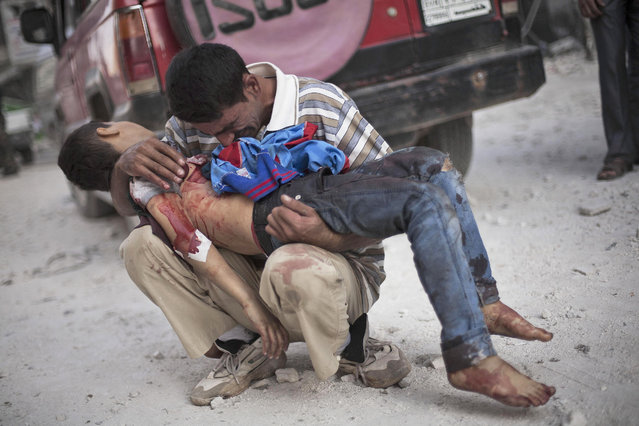
A Syrian man cries while holding the body of his son, killed by the Syrian Army, near Dar El Shifa hospital in Aleppo, Syria, Wednesday, October 3, 2012. (Photo by Manu Brabo/AP Photo)

Manu Brabo was born in Spain in 1981. After studying Photography in The School of Arts and Crafts in Oviedo, he moved to Madrid where he started Journalism in Carlos III University while he was working as a photographer for several humble newspapers and agencies. In 2011, Manu was held captive and then released by by Libyan forces. Brabo, along with fellow AP photographers were awarded the 2013 Pulitzer Prize for Breaking News Photography. Here: a Syrian man cries while holding the body of his son, killed by the Syrian Army, near Dar El Shifa hospital in Aleppo, Syria, Wednesday, October 3, 2012. (Photo by Manu Brabo/AP Photo)
Details
27 Oct 2015 08:04:00
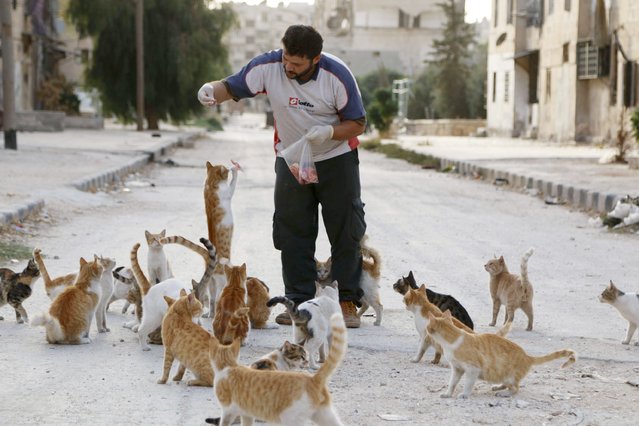
Alaa, an ambulance driver, feeds cats in Masaken Hanano in Aleppo, September 24, 2014. Alaa buys about $4 of meat everyday to feed about 150 abandoned cats in Masaken Hanano, a neigbourhood in Aleppo that has been abandoned because of shelling from forces loyal to Syria's president Bashar Al-Assad on it. Alaa said that he has been feeding and taking care of the cats for over 2 months. (Photo by Hosam Katan/Reuters)

Alaa, an ambulance driver, feeds cats in Masaken Hanano in Aleppo, September 24, 2014. Alaa buys about $4 of meat everyday to feed about 150 abandoned cats in Masaken Hanano, a neigbourhood in Aleppo that has been abandoned because of shelling from forces loyal to Syria's president Bashar Al-Assad on it. Alaa said that he has been feeding and taking care of the cats for over 2 months. (Photo by Hosam Katan/Reuters)
Details
25 Sep 2014 13:29:00