Loading...
Done
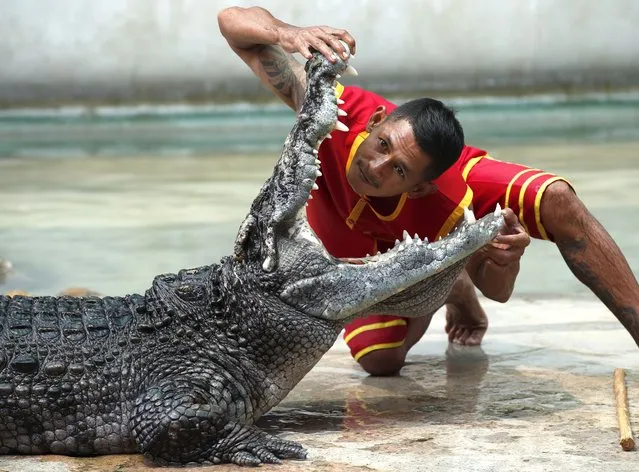
A Thai performer puts his head inside a crocodile's mouth during a media preview performance as part of preparation to reopen Samutprakarn Crocodile Farm and Zoo in Samut Prakan province, Thailand, 19 March 2024. Thailand's famous tourist attraction Samutprakan Crocodile Farm and Zoo is scheduled to reopen to welcome tourists on 01 April 2024 after a temporary closure in 2020 due to the loss of visitors caused by the COVID-19 pandemic which resulted in the zoo suffering financial loss and going into liquidation. The Samutprakan Crocodile Farm and Zoo established in 1950 claims to be Thailand's first and the world's largest crocodile farm with more than 60,000 freshwater and marine crocodiles offering crocodile shows to attract tourists as well as housing various other animal showcases including tigers, chimpanzees, elephants. (Photo by Rungroj Yongrit/EPA)

A Thai performer puts his head inside a crocodile's mouth during a media preview performance as part of preparation to reopen Samutprakarn Crocodile Farm and Zoo in Samut Prakan province, Thailand, 19 March 2024. (Photo by Rungroj Yongrit/EPA)
Details
06 Apr 2024 04:17:00
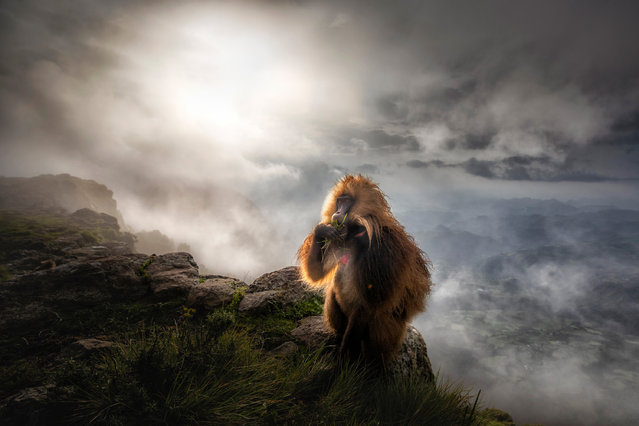
Highly commended, mammals: Gelada after the storm – Marco Gaiotti (Italy). “Gelada baboons are the only monkey species in the world that feed on grasses. They are native to the tableland of Ethiopia. Every morning large family groups wander from their sleeping places in the steep rock face, up to 1,000 metres high, to the feeding grounds at the tablelands. This image clearly depicts their feeding strategy: they pull out bunches of grass, sort the stalks and then lift them to their mouth. This shot was taken towards the end of the rainy season after a heavy storm”. (Photo by Marco Gaiotti/2019 GDT European Wildlife Photographer of the Year)

Highly commended, mammals: Gelada after the storm – Marco Gaiotti (Italy). “Gelada baboons are the only monkey species in the world that feed on grasses. They are native to the tableland of Ethiopia. Every morning large family groups wander from their sleeping places in the steep rock face, up to 1,000 metres high, to the feeding grounds at the tablelands. This image clearly depicts their feeding strategy: they pull out bunches of grass, sort the stalks and then lift them to their mouth. This shot was taken towards the end of the rainy season after a heavy storm”. (Photo by Marco Gaiotti/2019 GDT European Wildlife Photographer of the Year)
Details
31 Oct 2019 00:03:00
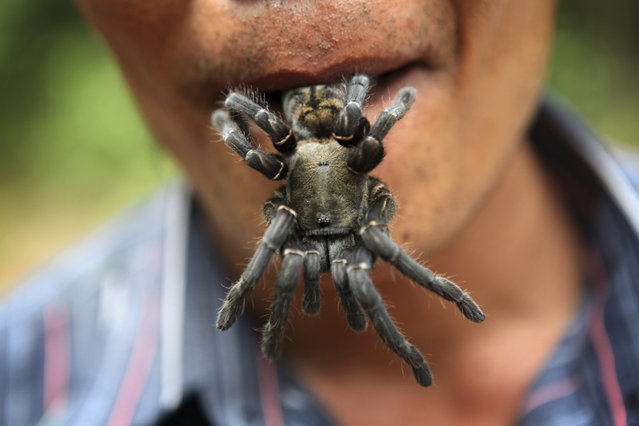
A Cambodian tuk tuk driver and guide with a tarantula in his mouth shortly after is was dug from the ground on June 7, 2010 in Skuon, Kampong Cham Province, Cambodia. The trade for spiders and other insects as food and for medicinal purposes has been in effect since the 1970's in Cambodia but only very recently have tourists been finding a way to see where the spiders are hunted in the nearby countryside. One guide, who can be found in Kampong Cham Town has started offering tours to tourists who can find him. (Photo by Tim Whitby/Getty Images)

A Cambodian tuk tuk driver and guide with a tarantula in his mouth shortly after is was dug from the ground on June 7, 2010 in Skuon, Kampong Cham Province, Cambodia. The trade for spiders and other insects as food and for medicinal purposes has been in effect since the 1970's in Cambodia but only very recently have tourists been finding a way to see where the spiders are hunted in the nearby countryside. One guide, who can be found in Kampong Cham Town has started offering tours to tourists who can find him. (Photo by Tim Whitby/Getty Images)
Details
04 Sep 2016 09:27:00
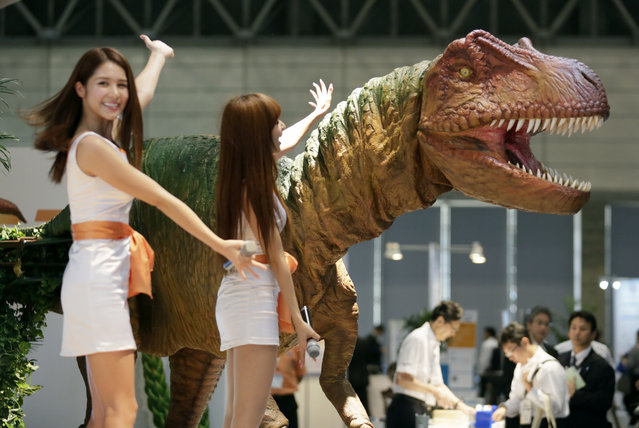
A dinosaur robot produced by Tyco Electronics Japan G.K. is controlled by a smartphone at CEATEC (Combined Exhibition of Advanced Technologies) Japan 2014 held at at Makuhari Messe in Chiba, east of Tokyo, Japan, 07 October 2014. The CEATEC opened on 07 October for a five-day exhibition. (Photo by Kimimasa Mayama/EPA)

A dinosaur robot produced by Tyco Electronics Japan G.K. is controlled by a smartphone at CEATEC (Combined Exhibition of Advanced Technologies) Japan 2014 held at at Makuhari Messe in Chiba, east of Tokyo, Japan, 07 October 2014.With a Sharp Aquos ZETA mobile phone model, users can make the 6.5-meter (21 feet, 4 inches) long, 2.1-meter (6 feet, 11 inches) tall dinosaur robot to walk forward and backward, jump, move its head, hands and legs up and down, left and right, open and close its mouth by touching the screen panel and make it bark by shaking the handheld. (Photo by Kimimasa Mayama/EPA)
Details
08 Oct 2014 11:54:00
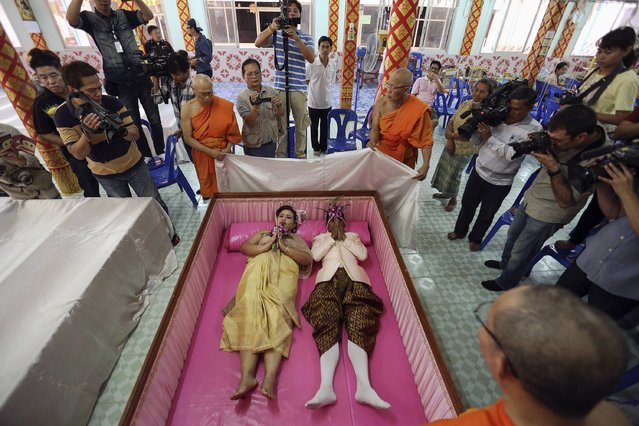
People take pictures and Buddhist monk chants as a groom and a bride lay inside a pink coffin during their wedding ceremony at Wat Takien temple in Nonthaburi province, on the outskirts of Bangkok February 14, 2015. (Photo by Damir Sagolj/Reuters)

People take pictures and Buddhist monk chants as a groom and a bride lay inside a pink coffin during their wedding ceremony at Wat Takien temple in Nonthaburi province, on the outskirts of Bangkok February 14, 2015. Ten Thai couples laid in the pink coffin starting 9:09 AM on Saturday during the wedding ceremony organised by the Buddhist temple on Valentine's Day. Couples believe laying briefly in the coffin will get rid of bad luck and usher happiness into their lives. (Photo by Damir Sagolj/Reuters)
Details
16 Feb 2015 13:36:00
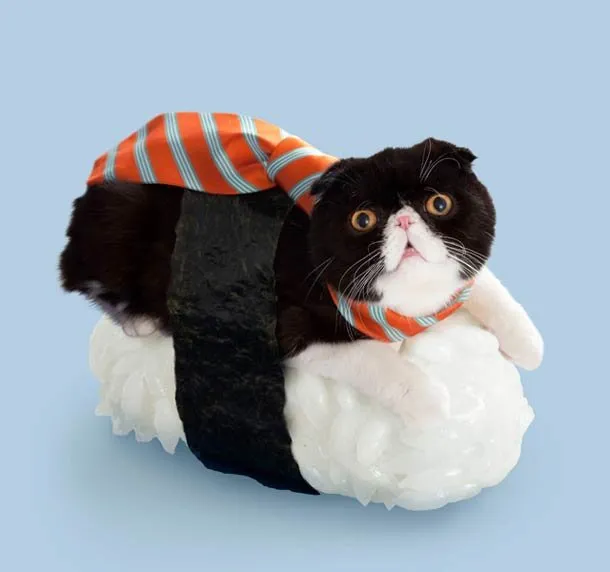
Sushi Cats By Tange & Nakimushi Peanuts

Sushi Cats (originally branded as Neko-Sushi) is a series of photographs created by the Japan-based company Tange & Nakimushi Peanuts. In this series the creators have dressed up a number of cats and placed them on top of oversized balls of sushi rice. The kitties don’t look too happy with what is going on, though they do look adorable in their little outfits. Tange & Nakimushi Peanuts didn’t think that making a set of photos was enough, so they’ve also created an Android and iPhone apps featuring Sushi Cats. Moreover, people living in Japan can visit their website, if they wish to order photo prints, postcards, and other items. (Photo by Tange & Nakimushi Peanuts)
Details
08 Jan 2015 14:14:00
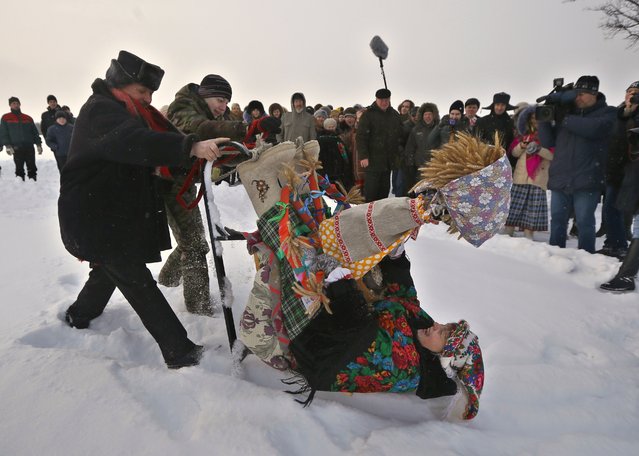
Belarusians wearing national costumes celebrate a Pull the Kolyada Up the Oak rite in the village of Martsiyanauka, some 77 km (48 miles) east of capital Minsk, Belarus, Thursday, January 21, 2016. (Photo by Sergei Grits/AP Photo)

Belarusians wearing national costumes celebrate a Pull the Kolyada Up the Oak rite in the village of Martsiyanauka, some 77 km (48 miles) east of capital Minsk, Belarus, Thursday, January 21, 2016. The merry ancient rite Pull the Kolyada Up the Oak marks the end of Orthodox Christmas celebrations in Belarus. On Jan. 21 a wheel, the so-called Kolyada, would be pulled up an oak or any old tree. The Belarusians believed that the ritual heralds a good harvest, luck and happiness for the entire year. (Photo by Sergei Grits/AP Photo)
Details
22 Jan 2016 10:13:00
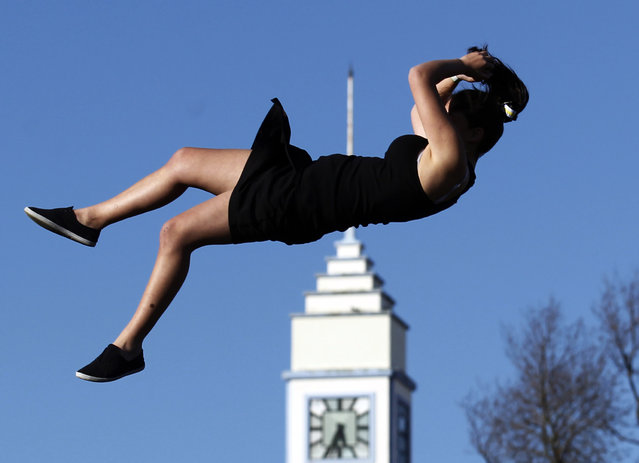
8. NEW ZEALAND: A woman dives from a platform into a giant air bed at a park in Palmerston North September 29, 2011. (Photo by Marcos Brindicci/Reuters)

The report, prepared by the Sustainable Development Solutions Network (SDSN) and the Earth Institute at Columbia University, showed Syria, Afghanistan and eight sub-Saharan countries as the 10 least happy places on earth to live. The top 10 this year were Denmark, Switzerland, Iceland, Norway, Finland, Canada, Netherlands, New Zealand, Australia, and Sweden. Denmark was in third place last year, behind Switzerland and Iceland. The bottom 10 were Madagascar, Tanzania, Liberia, Guinea, Rwanda, Benin, Afghanistan, Togo, Syria and Burundi. The United States came in at 13, the United Kingdom at 23, France at 32, and Italy at 50. Here: #8. NEW ZEALAND: A woman dives from a platform into a giant air bed at a park in Palmerston North September 29, 2011. (Photo by Marcos Brindicci/Reuters)
Details
26 Mar 2016 13:19:00