Loading...
Done
A member of the Air Force's Wings of Blue Parachute Demonstration Team salutes as he jumps out of an aircraft, during the opening ceremony of Aviation Nation 2017 Nellis Air and Space Expo at Nellis Air Force Base, Nev., November 10, 2017. (Photo by Senior Airman Kevin Tanenbaum/Reuters/U.S. Air Force)

A member of the Air Force's Wings of Blue Parachute Demonstration Team salutes as he jumps out of an aircraft, during the opening ceremony of Aviation Nation 2017 Nellis Air and Space Expo at Nellis Air Force Base, Nev., November 10, 2017. (Photo by Senior Airman Kevin Tanenbaum/Reuters/U.S. Air Force)
Details
15 Nov 2017 03:35:00
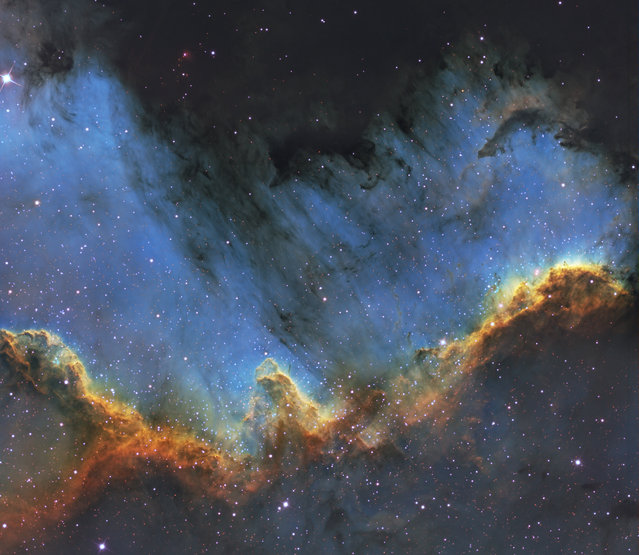
The Cygnus Wall is in the southern  area of NGC7000 also known as the North America Nebula. It is approximately 1800 light years from Earth, and is in the constellation Cygnus. The Wall is an energized shock front and contains the most concentrated star formations in the nebula. The size of the North America Nebula is about 4 full moons. (Bill Snyder)

Amateur astronomer Bill Snyder has been involved with astrophotography since 2007. Photo: The Cygnus Wall is in the southern area of NGC7000 also known as the North America Nebula. It is approximately 1800 light years from Earth, and is in the constellation Cygnus. The Wall is an energized shock front and contains the most concentrated star formations in the nebula. The size of the North America Nebula is about 4 full moons. (Photo and caption by Bill Snyder)
Details
30 Oct 2013 09:15:00
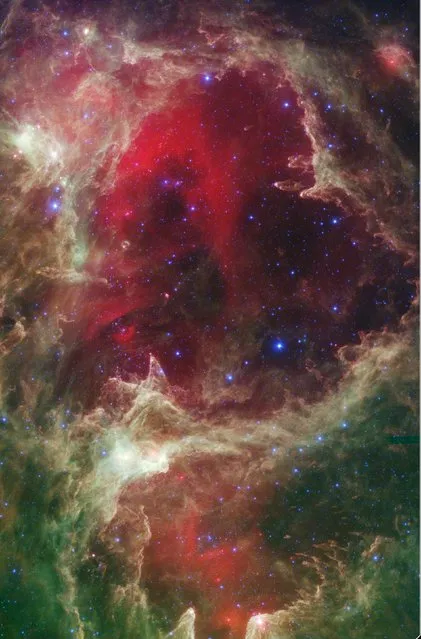
An infrared portrait from NASA's Spitzer Space Telescope which shows generations of stars is seen in this undated NASA handout image released February 14, 2013. In this wispy star-forming region, called W5, the oldest stars can be seen as blue dots in the centers of the two hollow cavities (other blue dots are background and foreground stars not associated with the region). Red shows heated dust that pervades the region's cavities, while green highlights dense clouds. (Photo by NASA/Reuters/JPL-Caltech/Harvard-Smithsonian/Handout)

An infrared portrait from NASA's Spitzer Space Telescope which shows generations of stars is seen in this undated NASA handout image released February 14, 2013. In this wispy star-forming region, called W5, the oldest stars can be seen as blue dots in the centers of the two hollow cavities (other blue dots are background and foreground stars not associated with the region). Red shows heated dust that pervades the region's cavities, while green highlights dense clouds. (Photo by NASA/Reuters/JPL-Caltech/Harvard-Smithsonian/Handout)
Details
03 Mar 2013 08:44:00
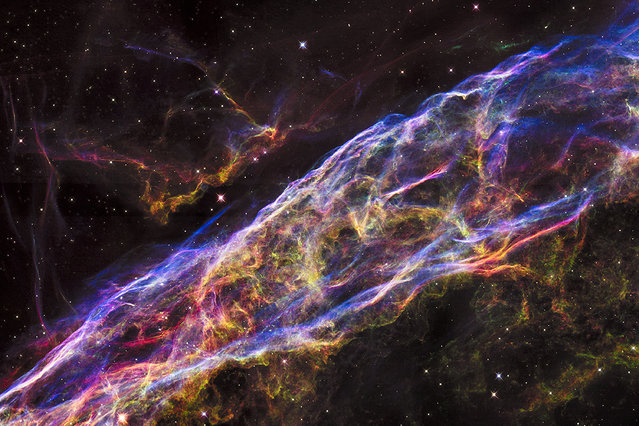
A small section of the expanding remains of the Veil Nebula, a massive star that exploded about 8,000 years ago. The entire nebula is 110 light-years across, covering six full moons on the sky as seen from Earth, and resides about 2,100 light-years away in the constellation Cygnus, the Swan. Image taken by NASA's Hubble Space Telescope. Released September 24, 2015. (Photo by Reuters/NASA/ESA/Hubble Heritage Team)

A small section of the expanding remains of the Veil Nebula, a massive star that exploded about 8,000 years ago. The entire nebula is 110 light-years across, covering six full moons on the sky as seen from Earth, and resides about 2,100 light-years away in the constellation Cygnus, the Swan. Image taken by NASA's Hubble Space Telescope. Released September 24, 2015. (Photo by Reuters/NASA/ESA/Hubble Heritage Team)
Details
10 Dec 2015 08:01:00
People attend the 49th annual New York City Gay Pride Parade in New York, New York, USA on 24 June 2018. (Photo by Erik Pendzich/Rex Features/Shutterstock)

People attend the 49th annual New York City Gay Pride Parade in New York, New York, USA on 24 June 2018. (Photo by Erik Pendzich/Rex Features/Shutterstock)
Details
26 Jun 2018 00:01:00
“Woman with Umbrella in Rain” by Raimund von Stillfried. Artist: Kusakabe Kimbei (Japanese, 1841–1934), 1870s. (Photo courtesy of The Metropolitan Museum of Art)

“Woman with Umbrella in Rain” by Raimund von Stillfried. Artist: Kusakabe Kimbei (Japanese, 1841–1934), 1870s. Commercial photography studios in Meiji-era Japan were renowned for the subtlety and refinement of their coloring techniques. This hand-tinted image of a young woman caught in a heavy rainstorm achieved its naturalistic effect by knitting together multiple strands of artifice: the greenery in the foreground was a studio prop; the flaps of the kimono were suspended by thin wires to create the impression of a strong wind; and long, diagonal marks were made on the negative to suggest streaks of rain. (Photo courtesy of The Metropolitan Museum of Art)
Details
12 May 2013 10:13:00
Woman taunts naked man. (Photo by riskms/Getty Images)

Woman taunts naked man. (Photo by riskms/Getty Images)
Details
05 Aug 2018 00:01:00
Internationally acclaimed German three-dimensional artist Manfred Stader adds finishing touches to his artwork  in Cape Town, South Africa on 21 November 2010. Stader created this masterpiece to celebrate the opening of Speedo's first dedicated concept store in Africa. (Photo by Foto24/Gallo Images/Getty Images)

Internationally acclaimed German three-dimensional artist Manfred Stader adds finishing touches to his artwork in Cape Town, South Africa on 21 November 2010. Stader created this masterpiece to celebrate the opening of Speedo's first dedicated concept store in Africa. (Photo by Foto24/Gallo Images/Getty Images)
Details
29 Aug 2018 00:03:00