Loading...
Done
Labourers pour molten iron into a container at a foundry in Xiangfan, Hubei province in this July 2, 2010 file photo. Iron ore is enjoying its biggest rally in years, outpacing copper and oil so far in 2016, but still weak forward prices show it may be tough to stretch the bullish outlook. Improving steel prices in top market China are helping fuel iron ore's climb as producers gear up for a seasonal uptick in demand. (Photo by Reuters/Stringer)

Labourers pour molten iron into a container at a foundry in Xiangfan, Hubei province in this July 2, 2010 file photo. Iron ore is enjoying its biggest rally in years, outpacing copper and oil so far in 2016, but still weak forward prices show it may be tough to stretch the bullish outlook. Improving steel prices in top market China are helping fuel iron ore's climb as producers gear up for a seasonal uptick in demand. Yet there is no shortage of doubters who see gains in the bulk commodity as fleeting given a large glut and challenges for China's economy. (Photo by Reuters/Stringer)
Details
24 Feb 2016 12:41:00
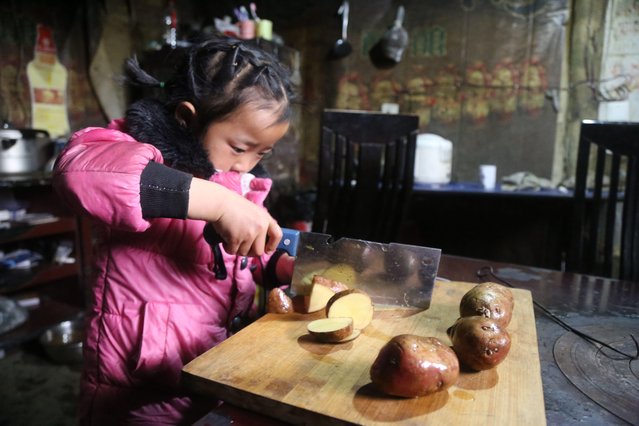
5-year-old Chinese girl Wang Anna prepares meals for her grandmother and great-grandmother at home in Zhuyuan village, Guizhou province, China on March 3, 2017. (Photo by Imaginechina/Rex Features/Shutterstock)

5-year-old Chinese girl Wang Anna prepares meals for her grandmother and great-grandmother at home in Zhuyuan village, Guizhou province, China on March 3, 2017. Chinese girl called Wang Anna, 5, takes care of her ill grandmother and 92-year-old great-grandmother on her own every day in a mountainous village in Zhima town, Zunyi city, southwest China's Guizhou province. Her father went to jail before she was born and her mother remarried after gave birth to her. Although she is just five years old, she started to shoulder the responsibility to look after ill grandmother and elderly great-grandmother. (Photo by Imaginechina/Rex Features/Shutterstock)
Details
09 Mar 2017 00:05:00
This picture taken on September 3, 2014 shows a man taking pictures of floodwater released from the Three Gorges Dam, a gigantic hydropower project on the Yangtze river, in Yichang, central China's Hubei province, after heavy downpours in the upper reaches of the dam caused the highest flood peak of the year. (Photo by AFP Photo/Stringer)

This picture taken on September 3, 2014 shows a man taking pictures of floodwater released from the Three Gorges Dam, a gigantic hydropower project on the Yangtze river, in Yichang, central China's Hubei province, after heavy downpours in the upper reaches of the dam caused the highest flood peak of the year. Eleven people died and 27 others are missing after torrential rains battered southwest China's Chongqing, a municipality in the upper reaches of the Three Gorges Dam, causing thousands of houses to collapse, state media said. (Photo by AFP Photo/Stringer)
Details
06 Sep 2014 12:02:00
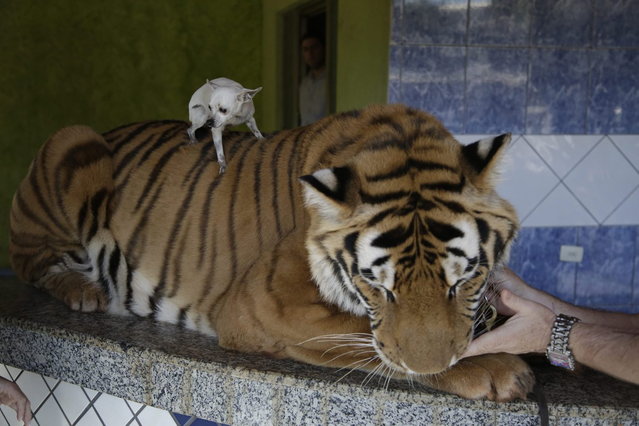
The Borges' family pet dog, Little, is placed on the back of Tom, their tiger, for a photo to be taken, in Maringa, Brazil, Friday, September 27, 2013. The Brazilian family is now locked in a legal dispute for the big cats, they have eight tigers and two lions, with federal wildlife officials working to take them away. While Borges does have a license to raise the animals, Brazilian wildlife officials say he illegally bred the cats, creating a public danger. (Photo by Renata Brito/AP Photo)

“Ary Borges and his family live in southern Brazil like most families the Borges' love animals and have an array of cats living in their home. The only difference between the cats owned by the Borges family and the cat that is cuddled up on your lap as you read this is the Borges' cats weigh over 700 pounds and could kill you just as soon as look at you. The Borges family shares their home with nine tigers, two lionesses, a chimp and a Chihuahua”. – Amanda Schiavo via Latin Times. Photo: The Borges' family pet dog, Little, is placed on the back of Tom, their tiger, for a photo to be taken, in Maringa, Brazil, Friday, September 27, 2013. (Photo by Renata Brito/AP Photo)
Details
04 Oct 2013 11:51:00
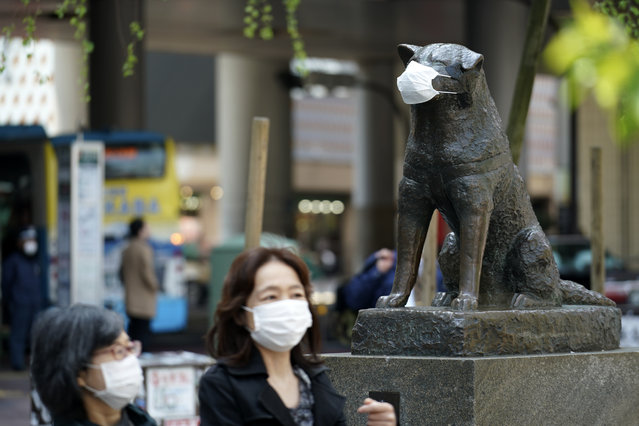
A statue of a Japanese Akita dog named “Hachiko” wearing a face mask is seen near Shibuya Station Wednesday, April 8, 2020, in Tokyo. Japanese Prime Minister Shinzo Abe declared a state of emergency on Tuesday for Tokyo and six other prefectures to ramp up defenses against the spread of the new coronavirus. Hachiko has waited for his owner University of Tokyo Prof. Eizaburo Ueno at the same place by the station every afternoon, expecting him to return home for nearly 11 years even after Ueno's death at work. (Photo by Eugene Hoshiko/AP Photo)

A statue of a Japanese Akita dog named “Hachiko” wearing a face mask is seen near Shibuya Station Wednesday, April 8, 2020, in Tokyo. Japanese Prime Minister Shinzo Abe declared a state of emergency on Tuesday for Tokyo and six other prefectures to ramp up defenses against the spread of the new coronavirus. Hachiko has waited for his owner University of Tokyo Prof. Eizaburo Ueno at the same place by the station every afternoon, expecting him to return home for nearly 11 years even after Ueno's death at work. (Photo by Eugene Hoshiko/AP Photo)
Details
15 Apr 2020 00:05:00
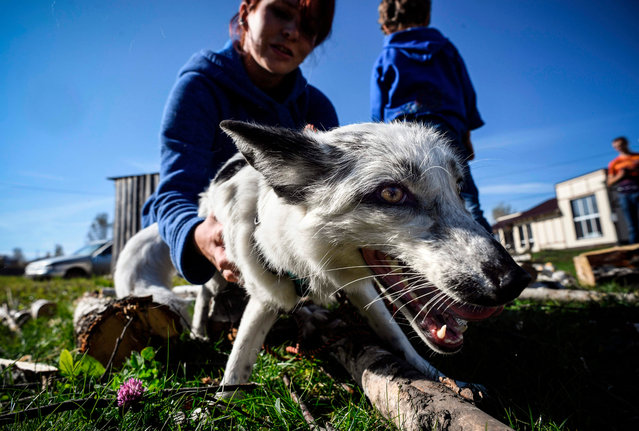
Tatyana Abramova, 33, plays with her home fox Plombir at her countryside house outside Siberian city of Novosibirsk on September 12, 2020. The official start of the Soviet experiment to better understand the domestication of animals by humans began in 1959, and was initiated by geneticists Dmitri Beliaiev and Lioudmila Trout on a farm in Akademgorodok, the scientific center of excellence in Siberia. Their primary objective was to domesticate foxes, to understand how the ancestor of wolves, another canine, evolved into a loyal and loving dog. And understand what this domestication tells us about the genetic evolution of species. (Photo by Alexander Nemenov/AFP Photo)

Tatyana Abramova, 33, plays with her home fox Plombir at her countryside house outside Siberian city of Novosibirsk on September 12, 2020. The official start of the Soviet experiment to better understand the domestication of animals by humans began in 1959, and was initiated by geneticists Dmitri Beliaiev and Lioudmila Trout on a farm in Akademgorodok, the scientific center of excellence in Siberia. Their primary objective was to domesticate foxes, to understand how the ancestor of wolves, another canine, evolved into a loyal and loving dog. And understand what this domestication tells us about the genetic evolution of species. (Photo by Alexander Nemenov/AFP Photo)
Details
25 Oct 2020 00:05:00
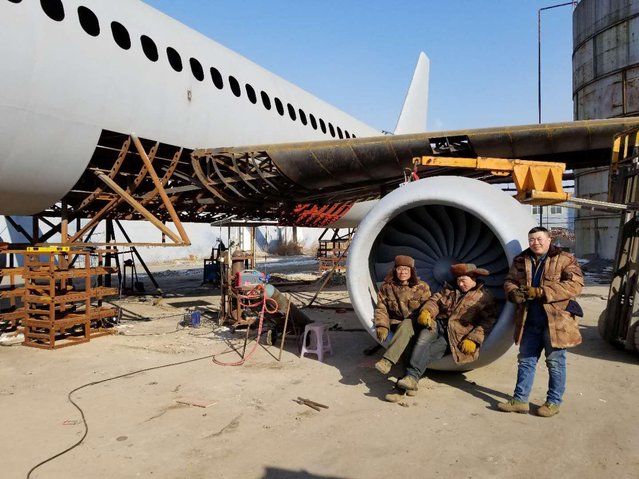
The homemade Airbus A320 jet plane made by Chinese farmer Zhu Yue is being built at an open space in Kaiyuan city, northeast China's Liaoning province on February 4, 2018. (Photo by Imaginechina/Rex Features/Shutterstock)

The homemade Airbus A320 jet plane made by Chinese farmer Zhu Yue is being built at an open space in Kaiyuan city, northeast China's Liaoning province on February 4, 2018. (Photo by Imaginechina/Rex Features/Shutterstock)
Details
06 Feb 2018 08:39:00
Chinese women run with a ball on a snow covered field in Shenyang in China's northeastern Liaoning province during International Women's Day on March 8, 2018. International Women's Day is celebrated on March 8 every year and commemorates the movement for women's rights. (Photo by AFP Photo/Stringer)

Chinese women run with a ball on a snow covered field in Shenyang in China's northeastern Liaoning province during International Women's Day on March 8, 2018. International Women's Day is celebrated on March 8 every year and commemorates the movement for women's rights. (Photo by AFP Photo/Stringer)
Details
10 Mar 2018 08:12:00