A woman reacts during the annual “Tomatina” tomato fight fiesta, in the village of Bunol near Valencia, Spain, Wednesday, August 27, 2025. (Photo by Alberto Saiz/AP Photo)
A protester is sprayed by a Department of Homeland Security officer outside a U.S. Immigration and Customs Enforcement facility on Thursday, October 2, 2025, in Portland, Ore. (Photo by Jenny Kane/AP Photo)
Drag king Riss Obolensky performs as drag king Norman Creebs during the Opening Cabaret at The London Clown Festival in London, Britain, on July 8, 2024. (Photo by Hollie Adams/Reuters)
American actress Sydney Sweeney and a pal have a “little london getaway” while doing facemasks in a hot tub on December 10, 2025. (Photo by sydneysweeney/instagram)
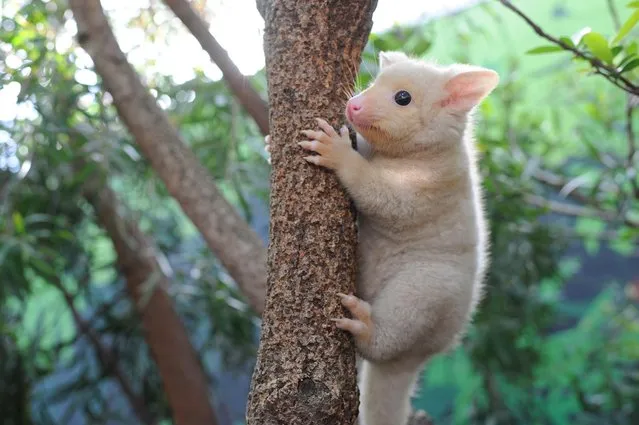
The common brushtail possum (Trichosurus vulpecula, from the Greek for "furry tailed" and the Latin for "little fox", previously in the genus Phalangista) is a nocturnal, semi-arboreal marsupial of the family Phalangeridae, it is native to Australia, and the second largest of the possums.
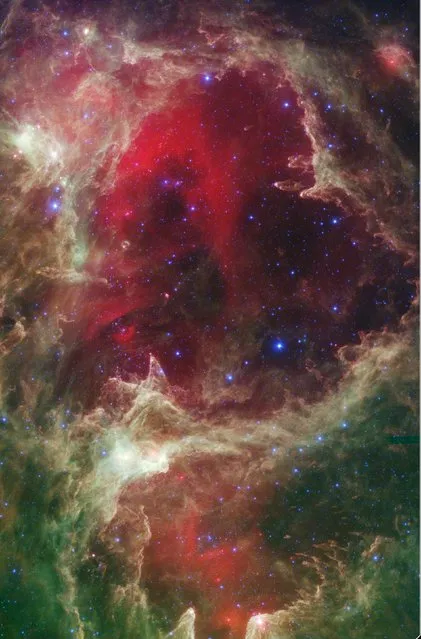
An infrared portrait from NASA's Spitzer Space Telescope which shows generations of stars is seen in this undated NASA handout image released February 14, 2013. In this wispy star-forming region, called W5, the oldest stars can be seen as blue dots in the centers of the two hollow cavities (other blue dots are background and foreground stars not associated with the region). Red shows heated dust that pervades the region's cavities, while green highlights dense clouds. (Photo by NASA/Reuters/JPL-Caltech/Harvard-Smithsonian/Handout)
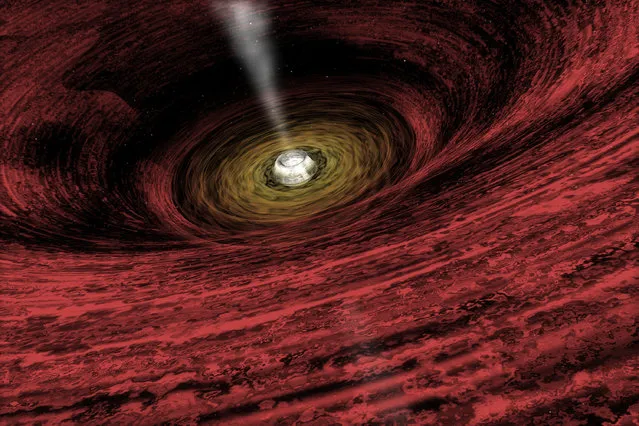
An artist's impression of a growing supermassive black hole located in the early Universe is seen in this NASA handout illustration released on June 15, 2011. Using the deepest X-ray image ever taken, astronomers found the first direct evidence that massive black holes were common in the early universe. This discovery from NASA's Chandra X-Ray Observatory shows that very young black holes grew more aggressively than previously thought, in tandem with the growth of their host galaxies. (Photo by Reuters/NASA/Chandra X-Ray Observatory/A.Hobart)
File photo taken on July 24, 2011 shows the scenery of karst landform in Dacai Township under Maonan Autonomous County of Huaijiang, south China's Guangxi Zhuang Autonomous Region. The World Heritage Committee on Monday inscribed an extension of South China Karst, a natural World Heritage Site since 2007, into the UNESCO's World Heritage List. (Photo by Wang Xiufa/Xinhua)