Loading...
Done
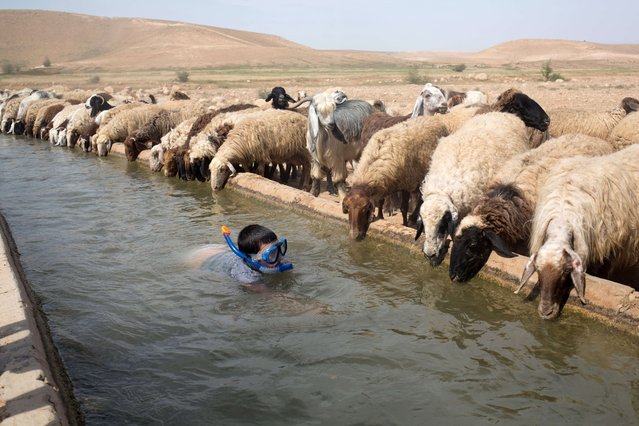
An Israeli boy swims next to sheep belonging to a Palestinian farmer in the West Bank village of Al-Auja in the Jordan Valley on April 8, 2015 during the Jewish Passover holiday. Thousands of Israelis spent the day outdoors, picnicking and touring the country during the eight-day Passover holiday, which commemorates the Israelites' exodus from Egypt some 3,500 years ago. (Photo by Menahem Kahana/AFP Photo)

An Israeli boy swims next to sheep belonging to a Palestinian farmer in the West Bank village of Al-Auja in the Jordan Valley on April 8, 2015 during the Jewish Passover holiday. Thousands of Israelis spent the day outdoors, picnicking and touring the country during the eight-day Passover holiday, which commemorates the Israelites' exodus from Egypt some 3,500 years ago. (Photo by Menahem Kahana/AFP Photo)
Details
11 Apr 2015 10:59:00
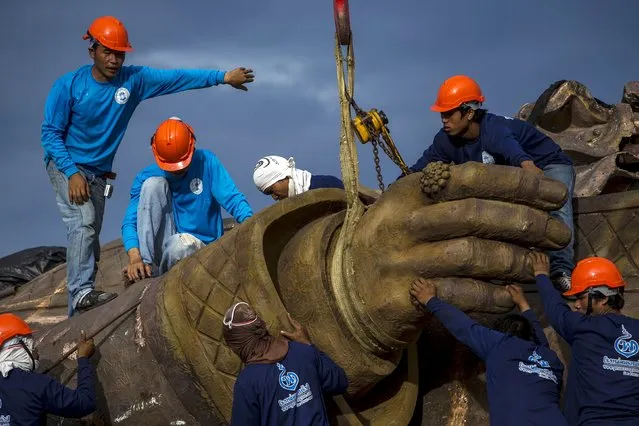
Labourers use a crane to lift the hand of a giant bronze statue of former King Rama I at Ratchapakdi Park in Hua Hin, Prachuap Khiri Khan province, Thailand, August 4, 2015. (Photo by Athit Perawongmetha/Reuters)

Labourers use a crane to lift the hand of a giant bronze statue of former King Rama I at Ratchapakdi Park in Hua Hin, Prachuap Khiri Khan province, Thailand, August 4, 2015. The park is being constructed by the Thai army to honor past Thai monarchs and is situated on an army compound near the Klai Kangwon Palace. The project is estimated to cost about 700 million baht ($20,000,000), according to local media. (Photo by Athit Perawongmetha/Reuters)
Details
05 Aug 2015 14:05:00


Are online casino games all fixed

Short answer: no.

I know, this answer was a little too short, so let me explain in a little more detail.

Imagine tossing a coin. Normally, any normal coin toss has two possible outcomes - heads or tails - with each one having a 50% chance of happening. Ideally, that is, because factors like the force of your finger tossing the coin, gravity, the wind, the moon phase and a passing TARDIS can all influence the outcome of the toss - but I have deviated from the subject.
Details
14 May 2014 07:28:00
A reveller reacts amid a “flour war” during the “Ash Monday” celebrations, a traditional festivity marking the end of the carnival season and the start of the 40-day Lent period until the Orthodox Easter, in the port town of Galaxidi, Greece, on March 11, 2019. (Photo by Aris Messinis/AFP Photo)

A reveller reacts amid a “flour war” during the “Ash Monday” celebrations, a traditional festivity marking the end of the carnival season and the start of the 40-day Lent period until the Orthodox Easter, in the port town of Galaxidi, Greece, on March 11, 2019. (Photo by Aris Messinis/AFP Photo)
Details
13 Mar 2019 00:07:00
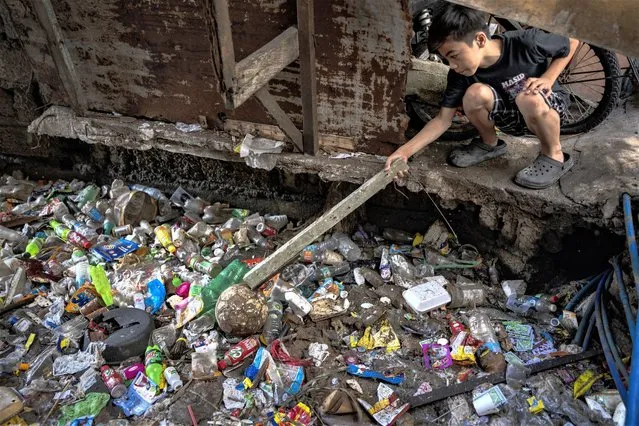
A boy reaches for a ball on a creek clogged with plastic waste on April 15, 2023 in Caloocan, Metro Manila, Philippines. (Photo by Ezra Acayan/Getty Images)

A boy reaches for a ball on a creek clogged with plastic waste on April 15, 2023 in Caloocan, Metro Manila, Philippines. (Photo by Ezra Acayan/Getty Images)
Details
06 May 2023 03:12:00
Henry Frayne of Australia shows his ability to triple jump the lenghth of more than two Formula 1 cars during a press conference at Albert Park

Henry Frayne of Australia shows his ability to triple jump the lenghth of more than two Formula 1 cars during a press conference at Albert Park on February 29, 2012 in Melbourne, Australia. (Photo by Robert Prezioso/Getty Images)
Details
01 Mar 2012 10:43:00
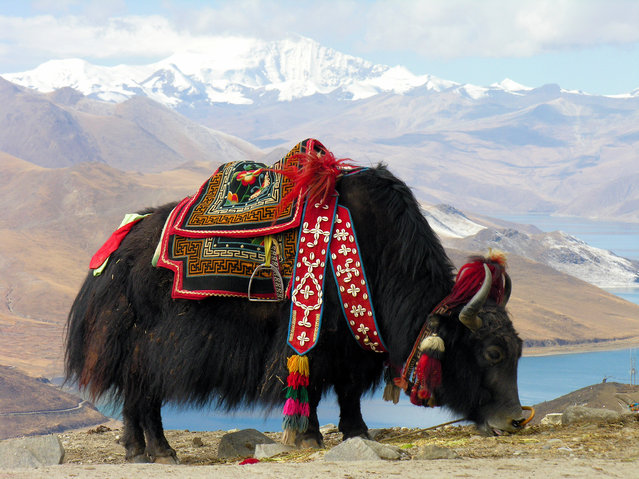
Yak near Yamdrok lake, Tibet. It is a long-haired bovinae found throughout the Himalayan region of south Central Asia, the Tibetan Plateau and as far north as Mongolia and Russia. The Tibetan economy is dominated by subsistence agriculture. Due to limited arable land, the primary occupation of the Tibetan Plateau is raising livestock, such as sheep, cattle, goats, camels, yaks, dzo, and horses. The Tibetan yak is an integral part of Tibetan life. (Photo by Dennis Jarvis)

Yak near Yamdrok lake, Tibet. It is a long-haired bovinae found throughout the Himalayan region of south Central Asia, the Tibetan Plateau and as far north as Mongolia and Russia. The Tibetan economy is dominated by subsistence agriculture. Due to limited arable land, the primary occupation of the Tibetan Plateau is raising livestock, such as sheep, cattle, goats, camels, yaks, dzo, and horses. The Tibetan yak is an integral part of Tibetan life. (Photo by Dennis Jarvis)
Details
10 Jun 2015 10:48:00
The Bridge “Rakotzbrücke” is pictured against trees in autumn colours in the the eastern German town of Kromlau November 4, 2014. (Photo by Hannibal Hanschke/Reuters)

The Bridge “Rakotzbrücke” is pictured against trees in autumn colours in the the eastern German town of Kromlau November 4, 2014. (Photo by Hannibal Hanschke/Reuters)
Details
10 Nov 2016 12:25:00