Loading...
Done
A view of traditional bolinhos de bacalhau (fried codfish balls) in Rio de Janeiro, Brazil, May 7, 2016. (Photo by Sergio Moraes/Reuters)

If the most popular foods of Rio de Janeiro have one thing in common, it is their informality. You can find fine restaurants in the city, but they do not set Rio apart from other places. What does set it apart, and what invariably brings its residents, known as "Cariocas," together is the unpretentious food they eat in bright, loud, crowded bars and restaurants, on busy street corners, or after a day at the beach. Here: A view of traditional bolinhos de bacalhau (fried codfish balls) in Rio de Janeiro, Brazil, May 7, 2016. (Photo by Sergio Moraes/Reuters)
Details
05 Aug 2016 13:20:00
In this Sept. 29, 2013 photo, nine-year-old twin sisters Camila, left, and Carla Rodriguez pose for a portrait along their street in Havana, Cuba. 12 sets of twins live along two consecutive blocks in western Havana, ranging in age from newborns to senior citizens. “We love living on this block because we have twin friends”, said Carla. (Photo by Ramon Espinosa/AP Photo)

A street in the Cuban capital, Havana, is home to 12 sets of twins, ranging from toddlers to senior citizens. Some say it could be something in the water. Others point to a tree with mystical significance for locals. And maybe it's just chance. Photo: In this September 29, 2013 photo, nine-year-old twin sisters Camila, left, and Carla Rodriguez pose for a portrait along their street in Havana, Cuba. 12 sets of twins live along two consecutive blocks in western Havana, ranging in age from newborns to senior citizens. “We love living on this block because we have twin friends”, said Carla. (Photo by Ramon Espinosa/AP Photo)
Details
07 Oct 2013 06:44:00
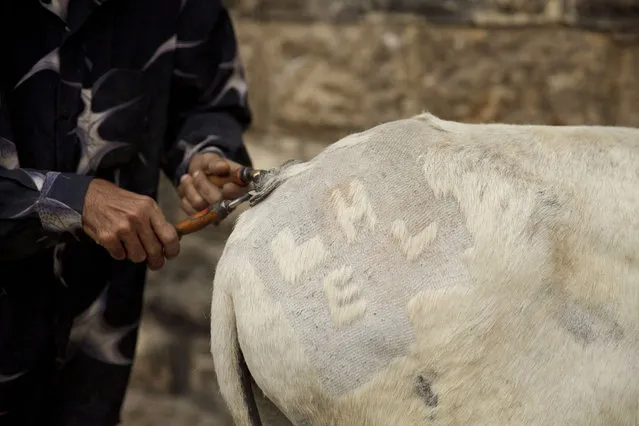
In this Sunday, March 2, 2014 photo, animal barber Mohamed Mahmoud shaves a customer's initials onto the rump of a donkey in Cairo, Egypt. Clients typically request for regular trims to keep animals cool in the summer, initials in English letters, and patterns – but sometimes they give Mahmoud full creative license. (Photo by Maya Alleruzzo/AP Photo)

In this Sunday, March 2, 2014 photo, animal barber Mohamed Mahmoud shaves a customer's initials onto the rump of a donkey in Cairo, Egypt. Clients typically request for regular trims to keep animals cool in the summer, initials in English letters, and patterns – but sometimes they give Mahmoud full creative license. (Photo by Maya Alleruzzo/AP Photo)
Details
03 Nov 2014 12:53:00
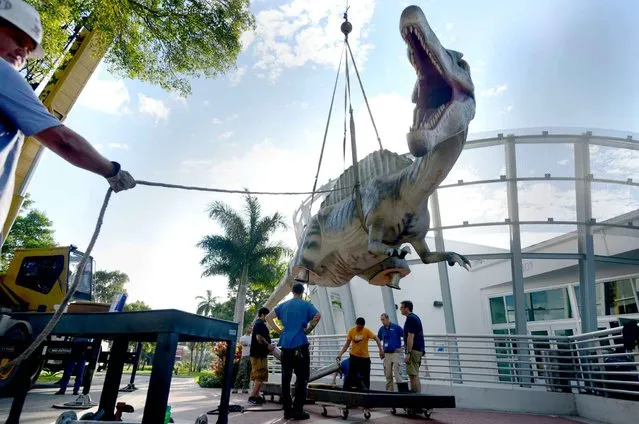
Workers from the South Florida Science Center and Aquarium and Imagine Exhibitions put together an animatronic spinosaurus outside the science center in West Palm Beach, Fla., Tuesday, October 27, 2015. The giant spinosaurus is part of the Dinosaurs Around the World exhibit, set to open on Nov. 1. (Photo by Maria Lorenzino/South Florida Sun-Sentinel via AP Photo)

Workers from the South Florida Science Center and Aquarium and Imagine Exhibitions put together an animatronic spinosaurus outside the science center in West Palm Beach, Fla., Tuesday, October 27, 2015. The giant spinosaurus is part of the Dinosaurs Around the World exhibit, set to open on November 1. (Photo by Maria Lorenzino/South Florida Sun-Sentinel via AP Photo)
Details
29 Oct 2015 08:07:00
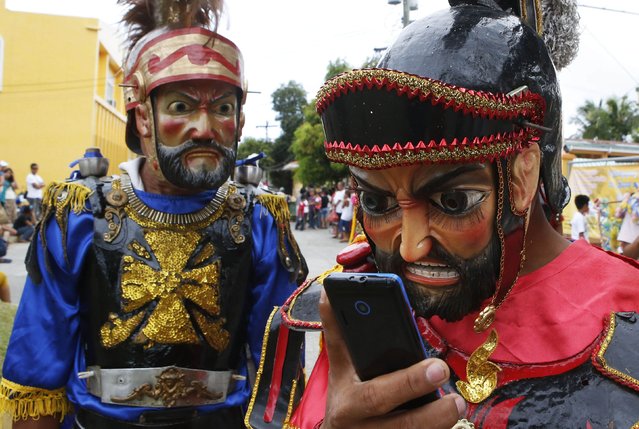
A penitent called “Morion” checks his mobile phone in Mogpog town on Marinduque island in central Philippines April 14, 2014. During the annual festival, masked and costumed penitents called “Moriones” dress in attire that is the local interpretation of what Roman soldiers wore during biblical times. Holy Week is celebrated in many Christian traditions during the week before Easter. (Photo by Erik De Castro/Reuters)

A penitent called “Morion” checks his mobile phone in Mogpog town on Marinduque island in central Philippines April 14, 2014. During the annual festival, masked and costumed penitents called “Moriones” dress in attire that is the local interpretation of what Roman soldiers wore during biblical times. Holy Week is celebrated in many Christian traditions during the week before Easter. (Photo by Erik De Castro/Reuters)
Details
19 Apr 2014 11:52:00
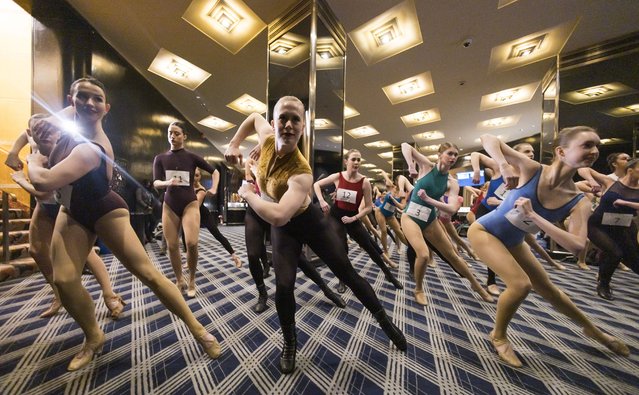
Dancers learn choreography they will need to perform as part of an open audition for the 2022 Radio City Rockettes at Radio City Music Hall in New York, New York, USA, 18 April 2022. The open auditions, the first being held since the start of the coronavirus pandemic, were expected to draw nearly 900 dancers competing for one of the few open spots in the 2022 Christmas Spectacular Starring the Radio City Rockettes, a long running holiday show. (Photo by Justin Lane/EPA/EFE)

Dancers learn choreography they will need to perform as part of an open audition for the 2022 Radio City Rockettes at Radio City Music Hall in New York, New York, USA, 18 April 2022. The open auditions, the first being held since the start of the coronavirus pandemic, were expected to draw nearly 900 dancers competing for one of the few open spots in the 2022 Christmas Spectacular Starring the Radio City Rockettes, a long running holiday show. (Photo by Justin Lane/EPA/EFE)
Details
20 Apr 2022 05:43:00
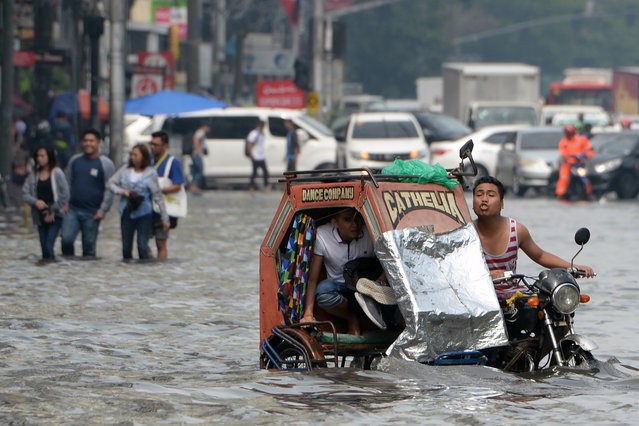
A commuter holding his shoes rides on a tricyle through a flooded street, caused by a heavy downpour brought about by the southwest moonson, in Manila on August 2, 2019. (Photo by Ted Aljibe/AFP Photo)

A commuter holding his shoes rides on a tricyle through a flooded street, caused by a heavy downpour brought about by the southwest moonson, in Manila, Philippines on August 2, 2019. (Photo by Ted Aljibe/AFP Photo)
Details
27 Aug 2019 00:03:00
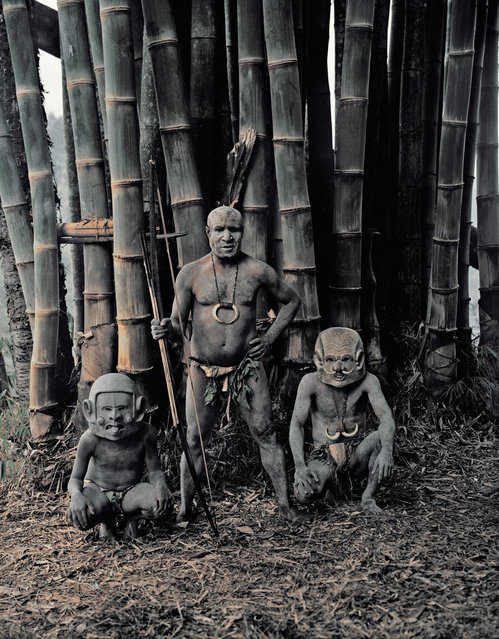
“Asaro from the Eastern Highlands”. The mudmen could not cover their faces with mud because the people of Papua New Guinea thought that the mud from the Asaro river was poisonous. So instead of covering their faces with this alleged poison, they made masks from pebbles that they heated and water from the waterfall, with unusual designs such as long or very short ears either going down to the chin or sticking up at the top, long joined eyebrows attached to the top of the ears, horns and sideways mouths. (Jimmy Nelson)

“Asaro from the Eastern Highlands”. The mudmen could not cover their faces with mud because the people of Papua New Guinea thought that the mud from the Asaro river was poisonous. So instead of covering their faces with this alleged poison, they made masks from pebbles that they heated and water from the waterfall, with unusual designs such as long or very short ears either going down to the chin or sticking up at the top, long joined eyebrows attached to the top of the ears, horns and sideways mouths. (Photo and caption by Jimmy Nelson)
Details
20 Oct 2013 08:54:00