Loading...
Done
Hong Kong Shop Cats #17. Marcel Heijnen returned to Hong Kong in 2015 and found himself living without a cat for the first time in decades. Soon, though, he was indulging in what he calls “re-tail therapy” and found himself on a first-name basis with a number of cats in his neighbourhood, Sai Ying Pun. (Photo by Marcel Heijnen/Blue Lotus)

When Dutch photographer Marcel Heijnen moved to Hong Kong, the territory’s shop cats instantly caught his eye. While the “feline emperors” are the stars, his shots also offer insights into Hong Kong’s wares, from dried fish to paper. Here: Hong Kong Shop Cats #17. (Photo by Marcel Heijnen/Blue Lotus)
Details
03 Jan 2017 11:04:00
Geometric Animals By Allison Kunath

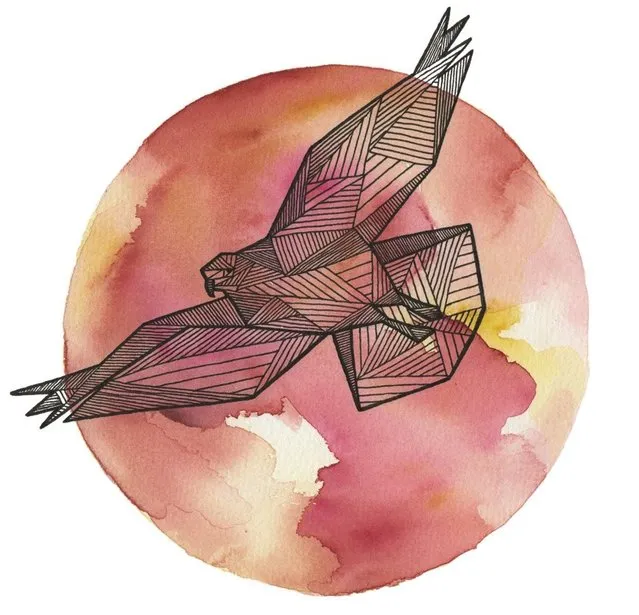
The combination of two different drawing styles in one picture never ceases to amaze us. The works of Allison Kunath are a vivid example of this technique. The background of her pictures is drawn using watercolors, while the actual image is broken down into rough geometrical shapes. This creates a very striking contrast, thanks to black, bold lines of the image on the forefront drawn over soft, cloudy shades of color. The skill of Allison is clearly seen in the way she manages to draw something as amorphous as a squid without making any curved lines. (Photo by Allison Kunath)
Details
22 Dec 2014 12:01:00
3D Models By Rebeca Puebla

One glance at the 3D models created by Rebeca Puebla is enough to realize that this artist has a soft spot for BDSM. The finely detailed model of a nun with heavily tattooed hands and a ball gag in her mouth or an Asian woman in a latex suit of a horse leave no doubt about it. At first, Rebeca Puebla has started out as a traditional illustrator. However, in later years she became a 3D character artist for films, TV, and video games. Though she has many regular-looking 3D models and illustrations, many of her works are quite controversial featuring 3D models of ladies in latex suits or wearing Nazi uniforms. (Photo by Rebeca Puebla)
Details
26 Oct 2014 12:09:00
People carry drinks at 80s Bar in Damascus, Syria, March 11, 2016. (Photo by Omar Sanadiki/Reuters)

People carry drinks at 80s Bar in Damascus, Syria, March 11, 2016. In Damascus's Old City, just a mile from the battered frontline between government and rebel-held territory, young Syrians smoke, drink beer or soft drinks, and talk about anything but the war. The revival of activity in this once-vibrant quarter is part of efforts to project an air of normality in the Syrian capital, even as the five-year-old war that has killed more than 250,000 people and created 5 million refugees continues to rage nearby. (Photo by Omar Sanadiki/Reuters)
Details
28 Apr 2016 12:07:00
Kamchatka

Kamchatka

Oleg Valeriyevich Kotov was born October 27, 1965, in Simferopol, Crimean oblast in Ukrainian SSR. After a career as a physican assigned to space program, he joined the Russian cosmonaut corps. He has flown two long duration spaceflight on the International Space Station logging just short of a year in space. Kotov is currently assigned to the Soyuz TMA-10M/Expedition 37/Expedition 38 long duration spaceflight scheduled for 2013-2014.
Details
03 Apr 2015 09:25:00
Mary, 8-months-old female orphan elephant, drinks milk at Winga Baw Elephant Conservation Camp during the ceremony to mark World Elephant Day at Bago Region, Myanmar, 12 August 2017. (Photo by Lynn Bo Bo/EPA/EFE)

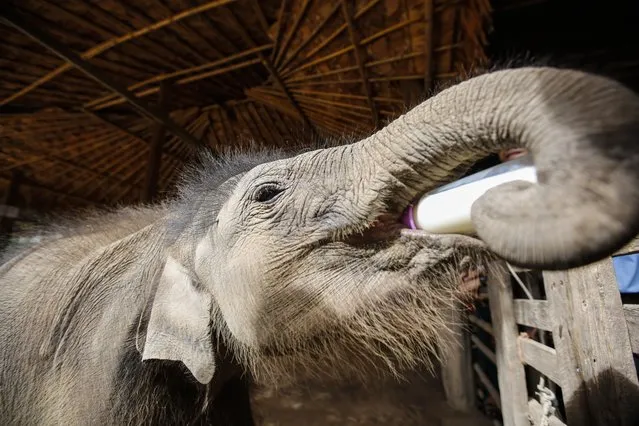
Mary, 8-months-old female orphan elephant, drinks milk at Winga Baw Elephant Conservation Camp during the ceremony to mark World Elephant Day at Bago Region, Myanmar, 12 August 2017. Winga Baw Elephant Conservation Camp, 34-hectare former timber camp for logs located in Bago Region, currently has 14 elephants and was opened for recreation for locals as well as for tourists. World Elephant Day is marked annually on 12 August. (Photo by Lynn Bo Bo/EPA/EFE)
Details
15 Aug 2017 07:47:00
A participant in the “Cats Who Look Like Cows” competition wears a cowboy outfit back stage before judging on March 05, 2023 in Bangkok, Thailand. Thailand's Cat Fanciers' Club hosted a “Cats Who Look Like Cows” competition during a Cat Expo in Bangkok's Ladphro neighborhood. Over 100 cats were judged on how similarly their pattern resembled a cow, color, fur softness and personality. A relaxed, fluffy cat named Arpo took home first prize. (Photo by Lauren DeCicca/Getty Images)

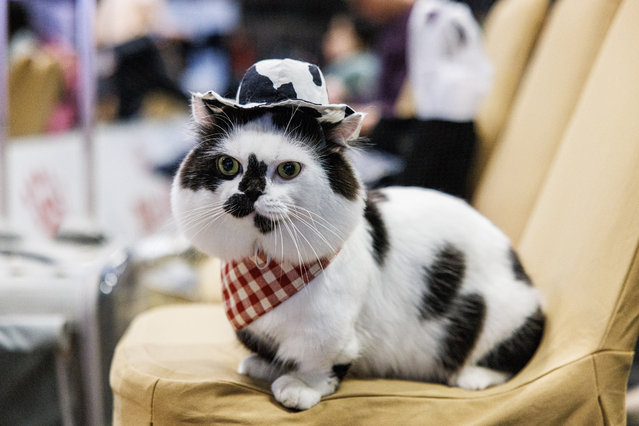
A participant in the “Cats Who Look Like Cows” competition wears a cowboy outfit back stage before judging on March 05, 2023 in Bangkok, Thailand. Thailand's Cat Fanciers' Club hosted a “Cats Who Look Like Cows” competition during a Cat Expo in Bangkok's Ladphro neighborhood. Over 100 cats were judged on how similarly their pattern resembled a cow, color, fur softness and personality. A relaxed, fluffy cat named Arpo took home first prize. (Photo by Lauren DeCicca/Getty Images)
Details
18 Jul 2024 05:04:00
Trucks loaded with tree trunks are burned by agents of the Brazilian Institute for the Environment and Renewable Natural Resources, or Ibama, during an operation to combat illegal mining and logging, in the municipality of Novo Progresso, Para State, northern Brazil, November 11, 2016. When able to do their job, agents of the Brazilian Institute for the Environment and Renewable Natural Resources, or Ibama, are decisive, punishing illegal loggers on the spot. Nearly twice the size of India, the Amazon absorbs an estimated 2 billion tonnes of carbon dioxide per year, making its preservation vital in the fight to halt global warming. Ibama, responsible for preserving Brazil's 65 percent share of the world's largest rainforest, is one of the most important groups in that fight. But after years of surprising success, the rate of deforestation is on the rise again. Over the past four years it has risen 35 percent, as Ibama suffered from a lack of funding amid Brazil's worst recession in a century. (Photo by Ueslei Marcelino/Reuters)

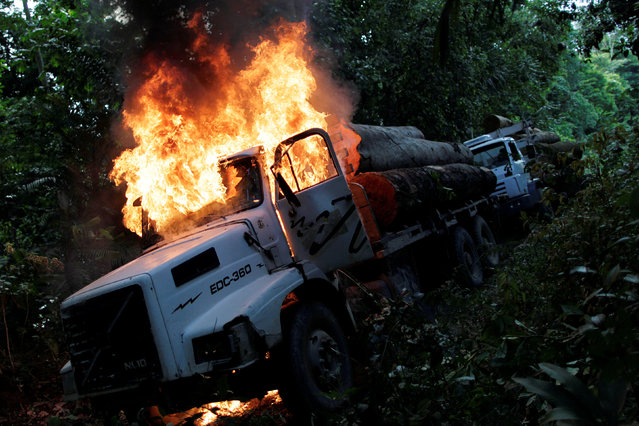
Trucks loaded with tree trunks are burned by agents of the Brazilian Institute for the Environment and Renewable Natural Resources, or Ibama, during an operation to combat illegal mining and logging, in the municipality of Novo Progresso, Para State, northern Brazil, November 11, 2016. When able to do their job, agents of the Brazilian Institute for the Environment and Renewable Natural Resources, or Ibama, are decisive, punishing illegal loggers on the spot. Nearly twice the size of India, the Amazon absorbs an estimated 2 billion tonnes of carbon dioxide per year, making its preservation vital in the fight to halt global warming. (Photo by Ueslei Marcelino/Reuters)
Details
30 Nov 2016 12:36:00