Loading...
Done
Indian women dressed in traditional attire drive motorcycles as they take part in a procession celebrating “Gudhi Padwa” or the Maharashtrian New Year in Mumbai on March 28, 2017. Gudhi Padwa is the Hindu New Year for people in India's Maharashtra state and marks the end of a harvest and the beginning of a new one. (Photo by Punit Paranjpe/AFP Photo)

Indian women dressed in traditional attire drive motorcycles as they take part in a procession celebrating “Gudhi Padwa” or the Maharashtrian New Year in Mumbai on March 28, 2017. Gudhi Padwa is the Hindu New Year for people in India's Maharashtra state and marks the end of a harvest and the beginning of a new one. (Photo by Punit Paranjpe/AFP Photo)
Details
29 Mar 2017 09:39:00
A red squirrel leaps over a gray squirrel after the larger squirrel became annoyed with its territory being encroached upon, Saturday, May 28, 2022, in Freeport, Maine. (Photo by Robert F. Bukaty/AP Photo)

A red squirrel leaps over a gray squirrel after the larger squirrel became annoyed with its territory being encroached upon, Saturday, May 28, 2022, in Freeport, Maine. (Photo by Robert F. Bukaty/AP Photo)
Details
12 Jun 2022 04:01:00
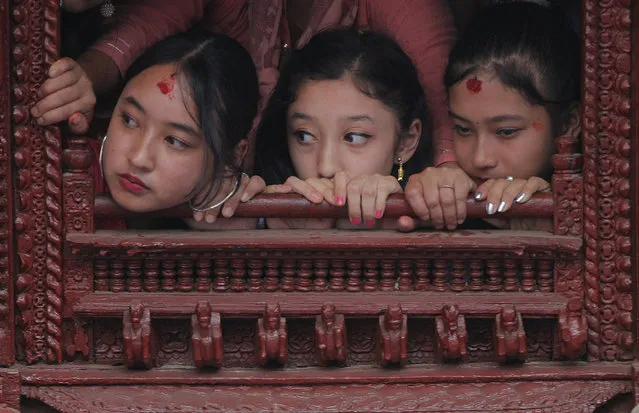
A former living goddess Kumari, middle, watches the Indra Jatra festival, an eight-day festival that honors Indra, the Hindu god of rain, in Kathmandu, Nepal, Friday, September 13, 2019. (Photo by Niranjan Shrestha/AP Photo)

A former living goddess Kumari, middle, watches the Indra Jatra festival, an eight-day festival that honors Indra, the Hindu god of rain, in Kathmandu, Nepal, Friday, September 13, 2019. (Photo by Niranjan Shrestha/AP Photo)
Details
18 Sep 2019 00:03:00
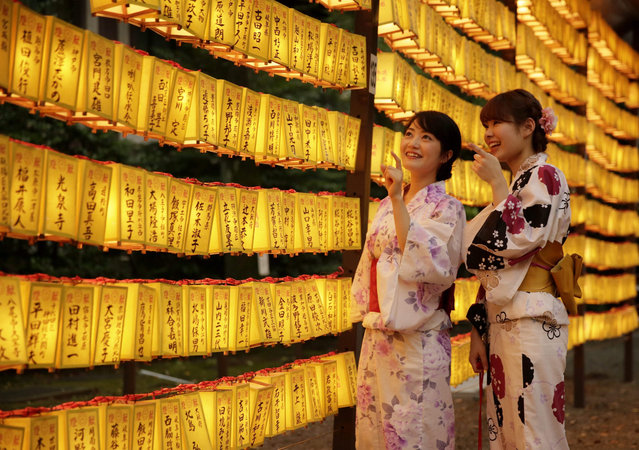
Two office workers wearing summer kimonos Yukata look at paper lanterns as they visit on the eve of Mitama Matsuri, a summer festival at Yasukuni Shrine in Tokyo, Japan, 13 July 2015. About 300,000 people visit the shrine decorated with about 30,000 lanterns during the three-day summer festival aiming at comforting souls of dead, especially for the war dead. The festival is after Japan's Buddhist custom to honor and comfort souls of family's ancestors. (Photo by Kimimasa Mayama/EPA)

Two office workers wearing summer kimonos Yukata look at paper lanterns as they visit on the eve of Mitama Matsuri, a summer festival at Yasukuni Shrine in Tokyo, Japan, 13 July 2015. About 300,000 people visit the shrine decorated with about 30,000 lanterns during the three-day summer festival aiming at comforting souls of dead, especially for the war dead. The festival is after Japan's Buddhist custom to honor and comfort souls of family's ancestors. (Photo by Kimimasa Mayama/EPA)
Details
14 Jul 2015 13:59:00
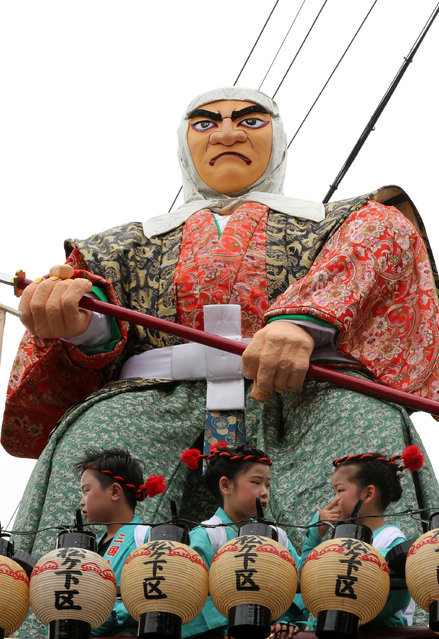
Children dressed in festival costume sit on the huge paper doll of historical Japanese figure named Hashi-Benkeii on the carts during the Mikuini annual festival on May 20, 2014 in Sakai, Japan. The annual festival takes place from May 19-21 and is attended by thousands of visitors. During the festival people dressed in traditional Japanese costumes pull carts carrying 6 meter high dolls of Japanese historical figures through the narrow streets. The origins of the festival are unclear but its history can be traced back more than 250 years. (Photo by Buddhika Weerasinghe/Getty Images)

Children dressed in festival costume sit on the huge paper doll of historical Japanese figure named Hashi-Benkeii on the carts during the Mikuini annual festival on May 20, 2014 in Sakai, Japan. The annual festival takes place from May 19-21 and is attended by thousands of visitors. During the festival people dressed in traditional Japanese costumes pull carts carrying 6 meter high dolls of Japanese historical figures through the narrow streets. The origins of the festival are unclear but its history can be traced back more than 250 years. (Photo by Buddhika Weerasinghe/Getty Images)
Details
21 May 2014 08:49:00
In this August 17, 2016, photo, from left to right, Chhering Chodom, 60, Tashi Yangzom, 50, Lobsang Chhering, 27, and Dorje Tandup, 58, drink milk tea on the side of the road. For centuries, the sleepy valley nestled in the Indian Himalayas remained a hidden Buddhist enclave forbidden to outsiders. Enduring the harsh year-round conditions of the high mountain desert, the people of Spiti Valley lived by a simple communal code – share the Earth's bounty, be hospitable to neighbors, and eschew greed and temptation at all turns. That's all starting to change, for better or worse. Since India began allowing its own citizens as well as outsiders to visit the valley in the early 1990s, tourism and trade have boomed. And the marks of modernization, such as solar panels, asphalt roads and concrete buildings, have begun to appear around some of the villages that dot the remote landscape at altitudes above 4,000 meters (13,000 feet). (Photo by Thomas Cytrynowicz/AP Photo)

In this August 17, 2016, photo, from left to right, Chhering Chodom, 60, Tashi Yangzom, 50, Lobsang Chhering, 27, and Dorje Tandup, 58, drink milk tea on the side of the road. For centuries, the sleepy valley nestled in the Indian Himalayas remained a hidden Buddhist enclave forbidden to outsiders. Enduring the harsh year-round conditions of the high mountain desert, the people of Spiti Valley lived by a simple communal code – share the Earth's bounty, be hospitable to neighbors, and eschew greed and temptation at all turns. That's all starting to change, for better or worse. (Photo by Thomas Cytrynowicz/AP Photo)
Details
15 Sep 2016 09:22:00
In this August 24, 2019 photo, a tractor pulls a trailer that was converted into a swimming pool as it drives along the roads of El Infernal neighborhood in San Andres in the province of Pinar del Río, Cuba. The idea for the mobile tractor-pool was hatched by local parents, to make their kids happy and fight the harsh Caribbean heat. (Photo by Ramon Espinosa/AP Photo)

In this August 24, 2019 photo, a tractor pulls a trailer that was converted into a swimming pool as it drives along the roads of El Infernal neighborhood in San Andres in the province of Pinar del Río, Cuba. The idea for the mobile tractor-pool was hatched by local parents, to make their kids happy and fight the harsh Caribbean heat. (Photo by Ramon Espinosa/AP Photo)
Details
10 Sep 2019 00:01:00
A dog poses in traditional Chinese dress on Yaowarat Road in Chinatown on the eve of Lunar New Year on January 20, 2023 in Bangkok, Thailand. The Chinese diaspora of Southeast Asia is celebrating a lively Lunar New Year as COVID-19 restrictions have been removed. It is traditionally a time for people to meet their relatives and take part in celebrations with families. In Thailand, which has a sizeable population of Chinese lineage, people gather with family and celebrate with feasts and visits to temples. (Photo by Lauren DeCicca/Getty Images)

A dog poses in traditional Chinese dress on Yaowarat Road in Chinatown on the eve of Lunar New Year on January 20, 2023 in Bangkok, Thailand. The Chinese diaspora of Southeast Asia is celebrating a lively Lunar New Year as COVID-19 restrictions have been removed. It is traditionally a time for people to meet their relatives and take part in celebrations with families. In Thailand, which has a sizeable population of Chinese lineage, people gather with family and celebrate with feasts and visits to temples. (Photo by Lauren DeCicca/Getty Images)
Details
09 Feb 2023 05:04:00