Ivan, a tourist from Russia, takes a selfie at Mai Khao Beach as a plane takes off from Phuket International Airport in Phuket, Thailand, January 17, 2022. (Photo by Jorge Silva/Reuters)
Staff prepare for Halloween at the Forbidden Corner tourist attraction, a labyrinth in the heart of Tupgill Park, in the Yorkshire Dales on October 19, 2022. (Photo by James Glossop/The Times)
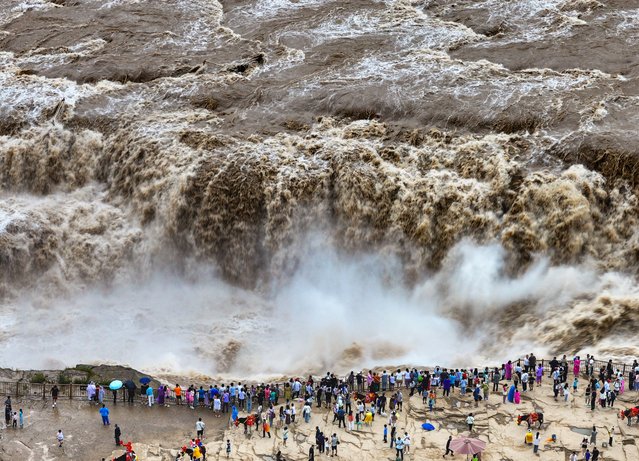
Tourists watch roaring torrent carrying a large amount of yellow sediment at the Hukou Waterfall on the Yellow River on August 15, 2024 in Yan'an, Shaanxi Province of China. (Photo by VCG/VCG via Getty Images)
Tourists take photographs as a wild sika deer eats a bag on June 6, 2019 in Nara, Japan. Nara's free-roaming deer have become a huge attraction for tourists. However, an autopsy on a deer that was recently found dead near one of the city's famous temples discovered 3.2kg of plastic in its stomach and caused concern at the effect of tourism as Japan struggles to cope with a huge increase in domestic and international tourists. (Photo by Carl Court/Getty Images)
Tourists use a selfie stick on the Trocadero Square, with the Eiffel Tower in background, in Paris, Tuesday, January 6, 2015. Selfie sticks have become popular among tourists because you don't have to ask strangers to take your picture, and you can capture a wide view in a selfie without showing your arm. But some people find selfie sticks obnoxious, arguing that they detract from the travel experience. (Photo by Remy de la Mauviniere/AP Photo)
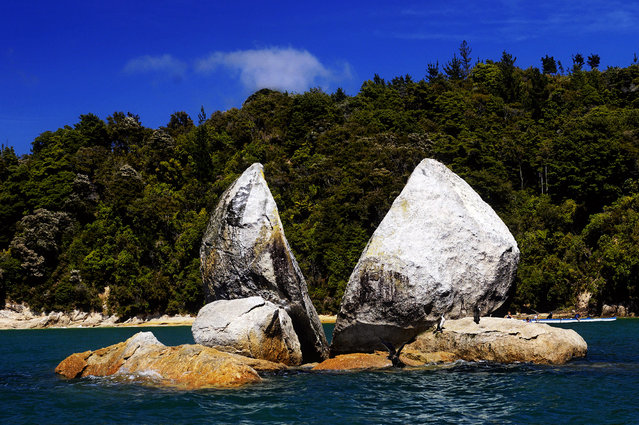
Split Apple Rock is a geological rock formation in The Tasman Bay off the northern coast of the South Island of New Zealand. Made of granite, it is in the shape of an apple which has been cut in half. It is a popular tourist attraction in the waters of the Tasman Sea approximately 50 metres off the coast between Kaiteriteri and Marahau. The rock sits in shallow water at low tide and is accessible by wading. It is also a point of interest for the many tourist boats and pleasure craft which operate along the shores of the Abel Tasman National Park. The cleft to produce two sides of the 'apple' was a natural occurrence. It is unknown when this happened and therefore the cleaving of the rock has attracted mythological explanations.
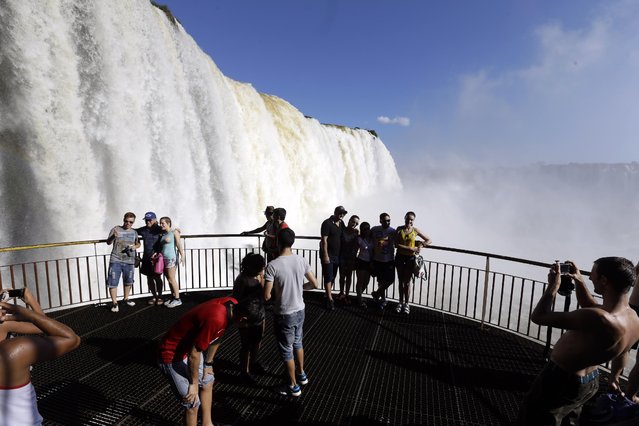
In this March 14, 2015 photo, tourists take pictures from a viewing area at Iguazu Falls in Brazil. From walkways and bridges, viewers can count 270 water falls almost 100 meters (330 feet) high. (Photo by Jorge Saenz/AP Photo)
Aerial view of tourists cooling off at a water park in summer on June 27, 2023 in Zhengzhou, Henan Province of China. Zhengzhou Meteorological Observatory on June 27 issued an orange alert for high temperatures. (Photo by VCG/VCG via Getty Images)