Loading...
Done
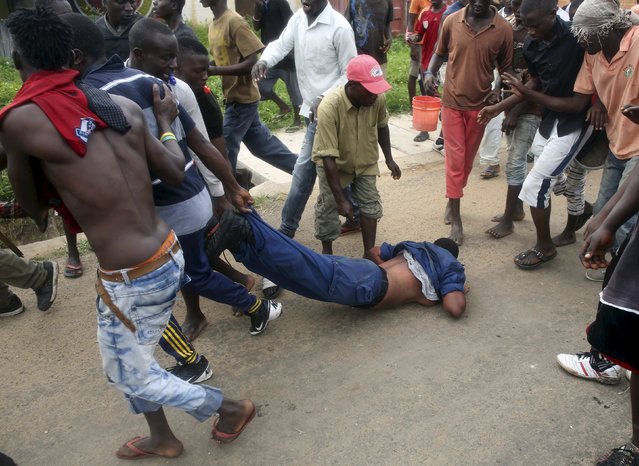
Protesters drag a female police officer accused of shooting a protester in the Buterere neighbourhood of Bujumbura, Burundi, May 12, 2015. (Photo by Goran Tomasevic/Reuters)

From house breaking in Johannesburg to hippos on the loose in Tbilisi to rioters attacking a policewoman in Burundi, Reuters photographers tell the story behind some of the most iconic pictures of the year. Here: Protesters drag a female police officer accused of shooting a protester in the Buterere neighbourhood of Bujumbura, Burundi, May 12, 2015. Goran Tomasevic: Protesters started throwing stones at a group of police, who then started to run away. The policewoman in the photo, Medikintos Inabeza, 33, got left behind and then some protesters started to push her, saying that she had shot a female protestor in the stomach with an AK47 rifle. I didn't see anything of that. There were 5 or 10 protesters pushing the policewoman at first, then others came and joined in. Up to 20 or 30 protesters were surrounding her at one point. The protesters kicked and beat her very badly; I also saw a couple of knives. I thought they were going to kill her... (Photo by Goran Tomasevic/Reuters)
Details
11 Dec 2015 08:06:00
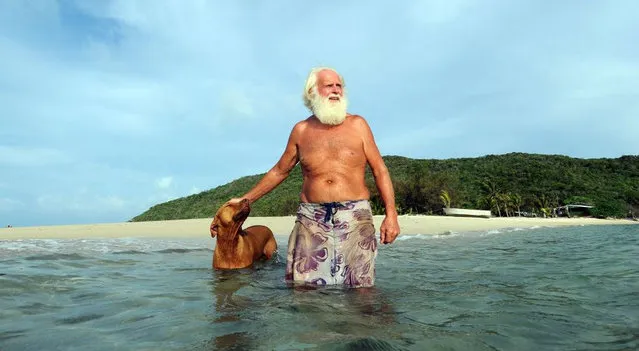
A real life Robinson Crusoe – David Glasheen

David Glasheen faces eviction from his remote tropical paradise after losing a Supreme Court legal case.
Details
08 Nov 2012 17:42:00


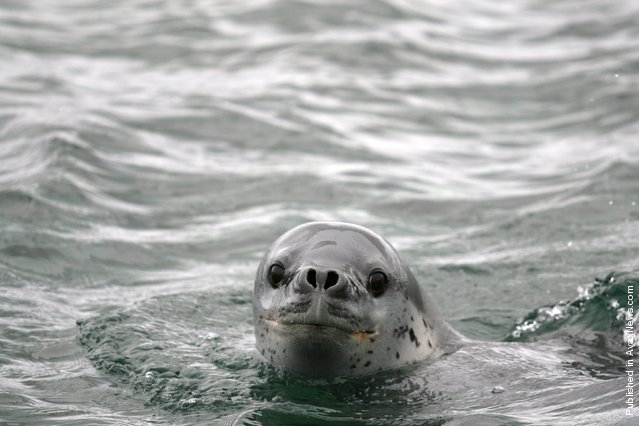
“The leopard seal (Hydrurga leptonyx), also referred to as the sea leopard, is the second largest species of seal in the Antarctic (after the southern elephant seal). It is most common in the southern hemisphere along the coast of Antarctica and on most sub-Antarctic islands, but can also be found on the coasts of southern Australia, Tasmania, South Africa, New Zealand, Lord Howe Island, Tierra del Fuego, the Cook Islands, and the Atlantic coast of South America. It can live twenty-six years, possibly more. Orcas and large sharks are the only natural predators of leopard seals”. – Wikipedia

Photo by: Gilad Rom; Source: Flickr
Details
13 Nov 2011 11:24:00
“Whether that means getting up way before the sun, like I do most days, going out somewhere that I’m not comfortable or just trying to get different angles or styles of photos, I am trying to display the crazy beauty of the ocean, and usually moments that literally last less than a split second”. (Photo by Ryan Pernoski/Caters News Agency)

These kaleidoscopic images are the work of one persistent photographer’s efforts to capture vibrant hues at the exact moment a wave breaks. Ryan Pernofski‘s stunning shots feature brilliant yellows, reds, blues and purples as an array of sunlight hits the water at the perfect time. What’s even more impressive: Ryan, a 27-year-old Australian, began shooting his popular masterpieces without using a professional camera, taking his iPhone out into the water instead. Ryan began experimenting with this method in 2012, using an underwater housing to protect his phone, as he could not afford a professional camera. (Photo by Ryan Pernoski/Caters News Agency)
Details
09 Jun 2018 00:05:00
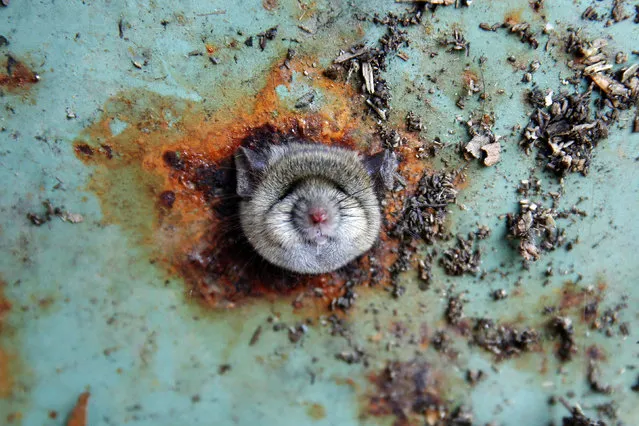
A rat's head rests as it is constricted in an opening in the bottom of a garbage can in the Brooklyn borough of New York, U.S., October 18, 2016. (Photo by Lucas Jackson/Reuters)

A rat's head rests as it is constricted in an opening in the bottom of a garbage can in the Brooklyn borough of New York, U.S., October 18, 2016. The Brooklyn rat was saved on Tuesday after getting its head stuck in the dumpster while scavenging for food, according to the New York Daily News. As the rat was scurrying around the bottom of the trash can, it came across a few ventilation holes. The hungry creature poked his head into one of them, but to its dismay couldn't get back out,Reuters photographer Lucas Jackson told the Daily News. Jackson was able to take some adorable photos of the rat's unfortunate situation before it was rescued. (Photo by Lucas Jackson/Reuters)
Details
19 Oct 2016 12:26:00
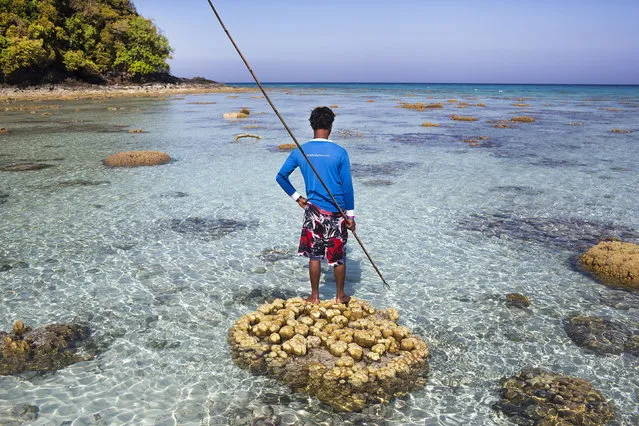
Hook, an indigenous Moken man, holds a three-pronged throwing spear and searches for fish in the waters of Ko Surin National Park. March 1, 2013 – Ko Surin, Thailand. (Photo by Taylor Weidman/zReportage via ZUMA Press)

“For centuries, the Moken sea nomads have traveled the islands between Thailand and Myanmar fishing and foraging for food on the sea floor. Throughout the Mergui Archipelago, Moken migrate in flotillas of Kabangs (traditional boat of the Moken people), stopping at different islands and beaches. Expert freedivers, the Moken have adapted physically to an aquatic life, developing unique characteristics that let them see better and hold their breath longer while underwater”. – Taylor Weidman. Photo: Hook, an indigenous Moken man, holds a three-pronged throwing spear and searches for fish in the waters of Ko Surin National Park. March 1, 2013 – Ko Surin, Thailand. (Photo by Taylor Weidman/zReportage via ZUMA Press)
Details
24 Mar 2014 06:45:00
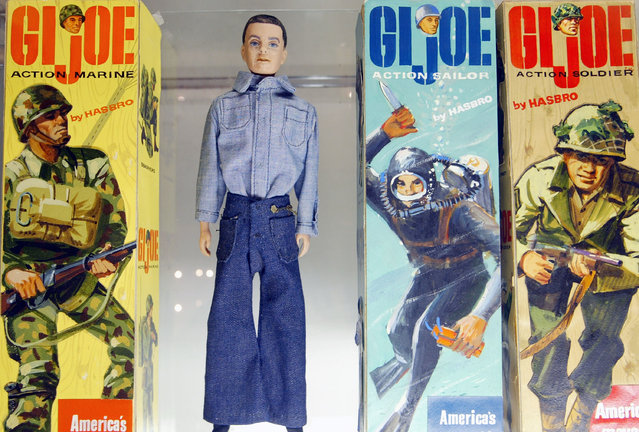
Vintage G.I. Joe figurers are on display at the 2003 Hasbro International G.I. Joe Collectors' Convention June 27, 2003 in Burlingame, California. Hundreds of G.I. Joe fans from around the country are attending the convention to buy, sell and trade G.I. Joe and military action figures. (Photo by Justin Sullivan/Getty Images)

“G.I. Joe is a line of action figures produced by the toy company Hasbro. The term G.I. stands, in popular usage, for Government Issued and after the First World War became a generic term for U.S. soldiers. The origin of the term dates to World War I, when much of the equipment issued to U.S. soldiers was stamped “G.I.”, meaning that it was made from galvanized iron. The development of G.I. Joe led to the coining of the term “action figure”. G.I. Joe's appeal to children has made it an American icon among toys”. – Wikipedia. Photo: Vintage G.I. Joe figurers are on display at the 2003 Hasbro International G.I. Joe Collectors' Convention June 27, 2003 in Burlingame, California. (Photo by Justin Sullivan/Getty Images)
Details
27 Mar 2014 07:46:00
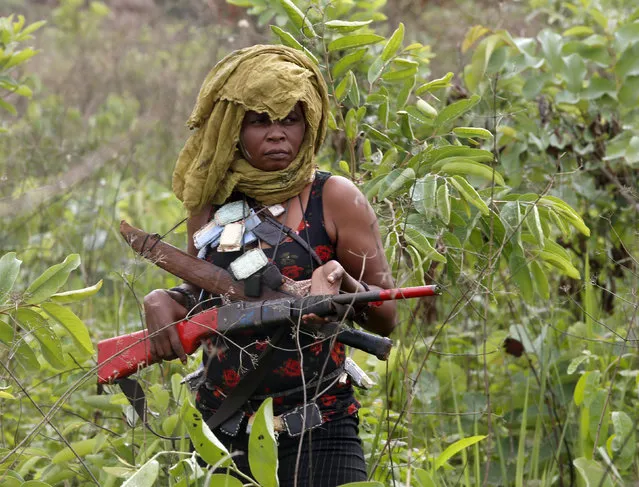
A female member of the anti-balaka, a Christian militia, patrols with other militiamen outside village of Zawa April 8, 2014. (Photo by Goran Tomasevic/Reuters)

Anti-balaka militia originally sprang up to protect the Christian population of the Central African Republic, but now stand accused of human rights abuses themselves. Last month, the African Union branded militia targeting Muslims in Central African Republic as “terrorists” and said they would be treated as enemy combatants, a day after killing a Congolese peacekeeper and amid deepening international frustration at continuing violence in the impoverished and landlocked country. Photo: A female member of the anti-balaka, a Christian militia, patrols with other militiamen outside village of Zawa April 8, 2014. (Photo by Goran Tomasevic/Reuters)
Details
10 Apr 2014 10:26:00