Loading...
Done
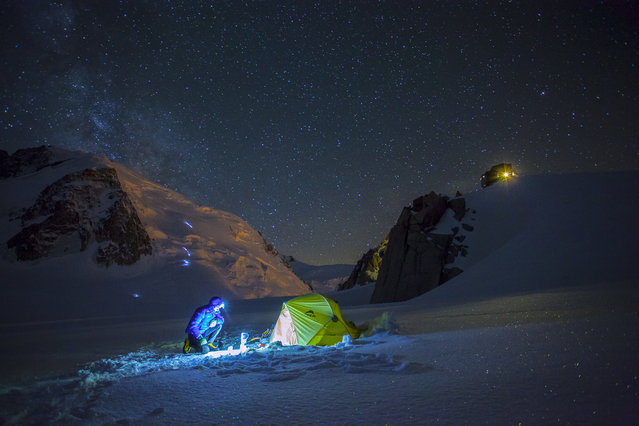
“A snapshot from mountaineer's life”. Have you ever wondered how does a mountaineer's day start? (Photo and caption by Kamil Tamiola/National Geographic Traveler Photo Contest)

“A snapshot from mountaineer's life”. Have you ever wondered how does a mountaineer's day start? I will give you a hint: you wake up at 3 am, set the stove, wake up your partner, pretend it is warm, quickly consume a high-calorie breakfast, watch your friends slowly ascending the icy slopes of your dream summit with their tiny head torches glimmering against perfectly blue ice, and hope for the good weather. One would ask: why all this trouble? The answer is easy: for the love of the adventure and the unknown. Location: Chamonix, Haute Savoye, France. (Photo and caption by Kamil Tamiola/National Geographic Traveler Photo Contest)

ATTENTION! All pictures are presented in high resolution. To see Hi-Res images – just TWICE click on any picture. In other words, click small picture – opens the BIG picture. Click BIG picture – opens VERY BIG picture.
Details
27 Jun 2013 12:47:00
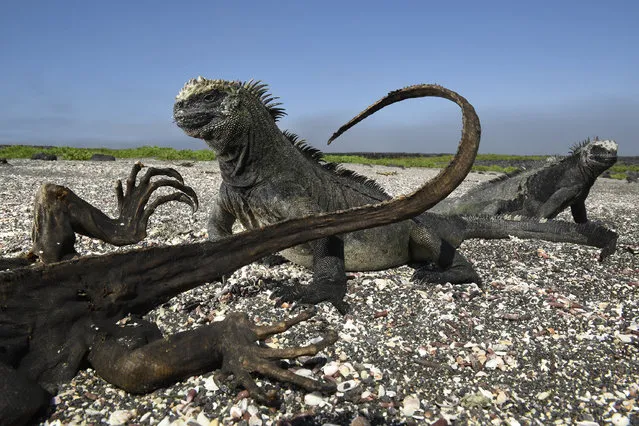
Galapagos – Rocking the Cradle: Four major ocean currents converge along the Galapagos archipelago, creating the conditions for an extraordinary diversity of animal life, April 25, 2016. The islands are home to at least 7,000 flora and fauna species, of which 97 percent of the reptiles, 80 percent of the land birds, 50 percent of the insects and 30 percent of the plants are endemic. The local ecosystem is highly sensitive to the changes in temperature, rainfall and ocean currents that characterize the climatic events known as El Niño and La Niña. These changes cause marked fluctuations in weather and food availability. Many scientists expect the frequency of El Niño and La Niña to increase as a result of climate change, making the Galapagos a possible early-warning location for its effects. (Photo by Thomas P. Peschak for National Geographic/World Press Photo)

Galapagos – Rocking the Cradle: Four major ocean currents converge along the Galapagos archipelago, creating the conditions for an extraordinary diversity of animal life, April 25, 2016. The islands are home to at least 7,000 flora and fauna species, of which 97 percent of the reptiles, 80 percent of the land birds, 50 percent of the insects and 30 percent of the plants are endemic. (Photo by Thomas P. Peschak for National Geographic/World Press Photo)
Details
16 Apr 2018 00:01:00
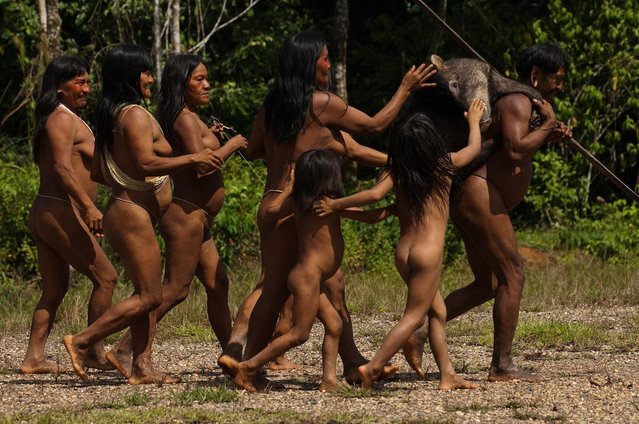
Spectacular images offering insight into the lives of the Huaorani people in the Ecuadorian Amazon have been revealed showing how they use traditional methods to hunt monkeys for food. The stunning pictures were taken by conservation photographer Pete Oxford from Torquay, Devon in the Ecuadorian Amazon. “The Huaorani Indians are a forest people highly in tune with their environment. Many are now totally acculturated since the 1950s by missionaries”, said Pete. “Today they face radical change to their culture to the proximity of oil exploration within their territory and the Yasuni National Park and Biosphere Reserve, they are vastly changed. Some still live very traditionally and for this shoot, through my Huaorani friend, a direct relative of those photographed he wanted to depict them as close to their original culture as possible. They still largely hunt with blow pipes and spears eating a lot of monkeys and peccaries”. The Huaorani are also known as the Waorani, Waodani or the Waos and are native Amerindians. Their lands are located between the Curaray and Napo rivers and speak the Huaorani language. Pete says that during his visit he was welcomed into the group and hopes that ancient cultures can be saved. Here: The tribe were seen celebrating after a hunter returned to camp with a wild pig. (Photo by Pete Oxford/Mediadrumworld.com)

Spectacular images offering insight into the lives of the Huaorani people in the Ecuadorian Amazon have been revealed showing how they use traditional methods to hunt monkeys for food. The stunning pictures were taken by conservation photographer Pete Oxford from Torquay, Devon in the Ecuadorian Amazon. Here: The tribe were seen celebrating after a hunter returned to camp with a wild pig. (Photo by Pete Oxford/Mediadrumworld.com)
Details
20 Jan 2017 07:58:00
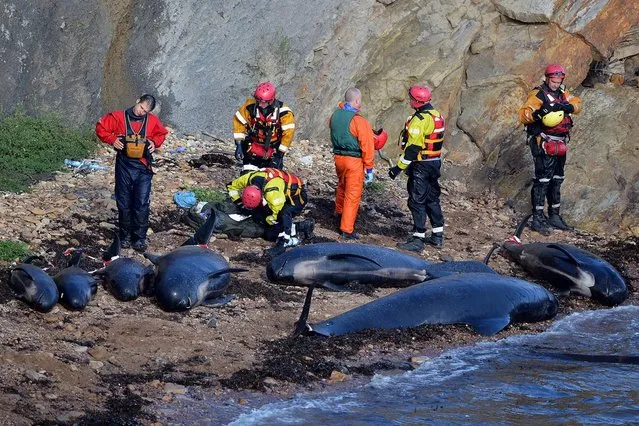
Mass Stranding of Pilot Whales

“Sixteen pilot whales died when they became stranded at Pittenweem, near St Andrews, on Sunday morning, Forth Coastguard said.

The mammals were part of a group of 26, of which 10 were refloated and returned to sea by vets and more than 50 volunteers from the emergency services and British Divers Marine Life Rescue. The whales were kept cool and hydrated with wet blankets and sheets on the shore”. – WalesOnline

Photo: Emergency service personnel walk near beached whales as they continue in their rescue attempt to save a large number of pilot whales who have beached on September 1, 2012 in Pittenweem, Scotland. A number of whales have died after being stranded on the east coast of Scotland between Anstruther and Pittenweem. (Photo by Jeff J. Mitchell)
Details
03 Sep 2012 08:59:00
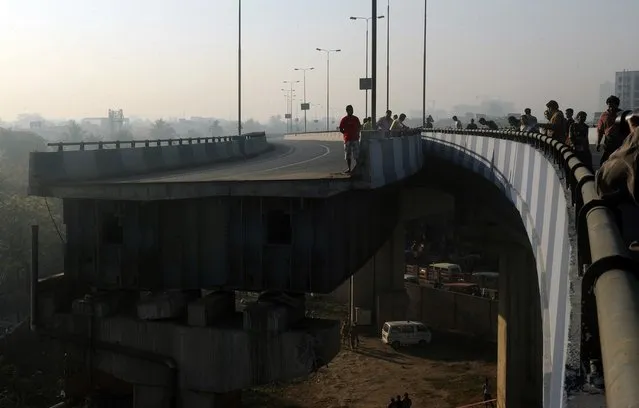
Indian onlookers stand near the collapsed portion of the flyover in Kolkata on March 3, 2013. A huge portion of a flyover on the eastern side of the Indian metropolis collapsed leaving three persons injured, the flyover connects the airport with Eastern Metropolitan Bypass and the eastern and southern suburbs.   As the debris fell into a canal running below the flyover, it took down a truck the driver and two others were rescued from the canal by fire-brigade personnel and locals. (Photo by Dibyangshu Sarkar/AFP Photo)

Indian onlookers stand near the collapsed portion of the flyover in Kolkata on March 3, 2013. A huge portion of a flyover on the eastern side of the Indian metropolis collapsed leaving three persons injured, the flyover connects the airport with Eastern Metropolitan Bypass and the eastern and southern suburbs. As the debris fell into a canal running below the flyover, it took down a truck the driver and two others were rescued from the canal by fire-brigade personnel and locals. (Photo by Dibyangshu Sarkar/AFP Photo)
Details
03 Mar 2013 09:52:00
Ebiowei, 48, carries an empty oil container on his head to a place where it would be filled with refined fuel at an illegal refinery site near river Nun in Nigeria's oil state of Bayelsa November 27, 2012. (Photo by Akintunde Akinleye/Reuters)

Ebiowei, 48, carries an empty oil container on his head to a place where it would be filled with refined fuel at an illegal refinery site near river Nun in Nigeria's oil state of Bayelsa November 27, 2012. Locals in the industry say workers can earn $50 to $60 a day. Thousands of people in Nigeria engage in a practice known locally as “oil bunkering” – hacking into pipelines to steal crude then refining it or selling it abroad. The practice, which leaves oil spewing from pipelines for miles around, managed to lift around a fifth of Nigeria's two million barrel a day production last year according to the finance ministry. (Photo by Akintunde Akinleye/Reuters)
Details
18 Jan 2013 14:29:00
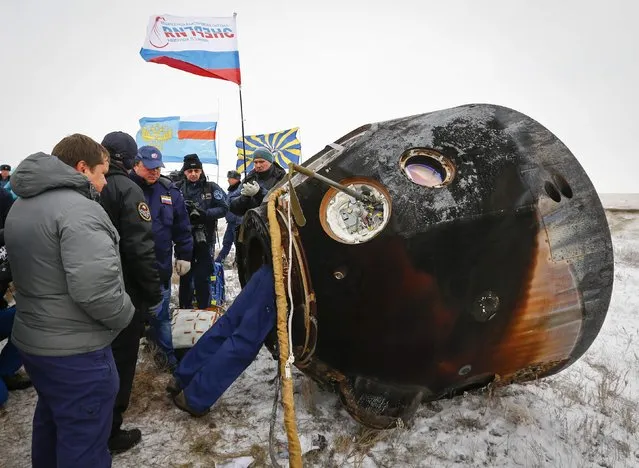
Ground personnel work next to the Soyuz TMA-13M capsule of the International Space Station (ISS) crew of Alexander Gerst of Germany, Maxim Suraev of Russia and Reid Wiseman of the U.S. after its landing near the town of Arkalyk in northern Kazakhstan November 10, 2014. (Photo by Shamil Zhumatov/Reuters)

Ground personnel work next to the Soyuz TMA-13M capsule of the International Space Station (ISS) crew of Alexander Gerst of Germany, Maxim Suraev of Russia and Reid Wiseman of the U.S. after its landing near the town of Arkalyk in northern Kazakhstan November 10, 2014. A veteran Russian cosmonaut and two International Space Station crewmates, one from the United States and one from Germany, returned safely to Earth on Sunday with a parachute landing of their Soyuz capsule in Kazakhstan, ending 5-1/2 months in orbit. (Photo by Shamil Zhumatov/Reuters)
Details
10 Nov 2014 13:58:00
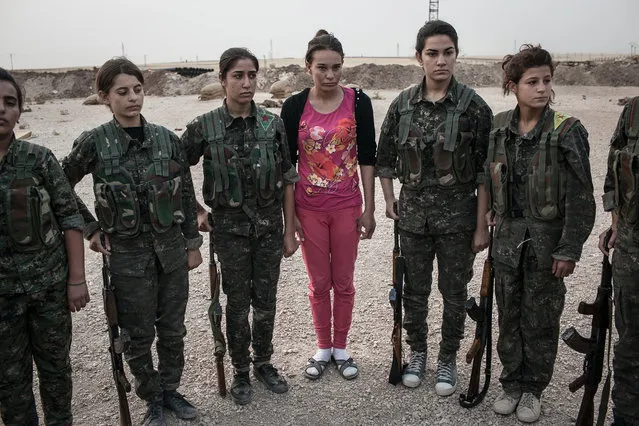
A young YPJ recruit (in pink) arrives to the training base for her first day in training near Derek City, Syria. The YPJ schedule is demanding and requires discipline – new soldiers in training get about 6 hours of sleep a night and wake up at 4 AM to begin exercising; afterwards, their day consists of a full schedule of drills and classroom lessons. Before joining the YPJ many of the girls had never participated in physical activity or sports before. (Photo by Erin Trieb/NBC News)

A young YPJ recruit (in pink) arrives to the training base for her first day in training near Derek City, Syria. The YPJ schedule is demanding and requires discipline – new soldiers in training get about 6 hours of sleep a night and wake up at 4 AM to begin exercising; afterwards, their day consists of a full schedule of drills and classroom lessons. Before joining the YPJ many of the girls had never participated in physical activity or sports before. (Photo by Erin Trieb/NBC News)
Details
10 Sep 2014 12:01:00