Loading...
Done
Cormorant Fishing

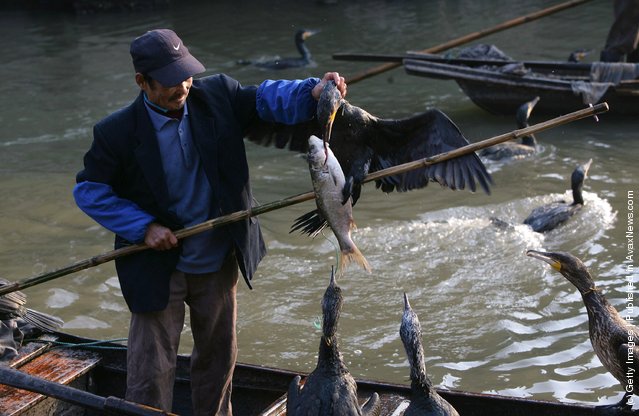
“Cormorant fishing is a traditional fishing method in which fishermen use trained cormorants to fish in rivers. Historically, cormorant fishing has taken place in Japan and China from around 960 AD. and recorded from other places throughout the world”. – Wikipedia

Photo: A cormorant raised by a fisherman catches a fish on a canal on November 27, 2007 in Xitang Town of Jiashan County, Zhejiang Province, China. (Photo by China Photos/Getty Images)
Details
07 Oct 2011 09:34:00
Courthouse Facility Dog

Courthouse facility dogs are professionally trained facility dogs that are graduates from an accredited assistance dog organization that is a member of Assistance Dogs International. They assist crime victims, witnesses and others during the investigation and prosecution of crimes as well as other legal proceedings. Courthouse facility dogs also provide assistance to Drug Court and Mental Health Court participants during their recovery from drugs, alcohol, mental illness and post-traumatic stress disorder.
Details
03 Sep 2015 08:59:00
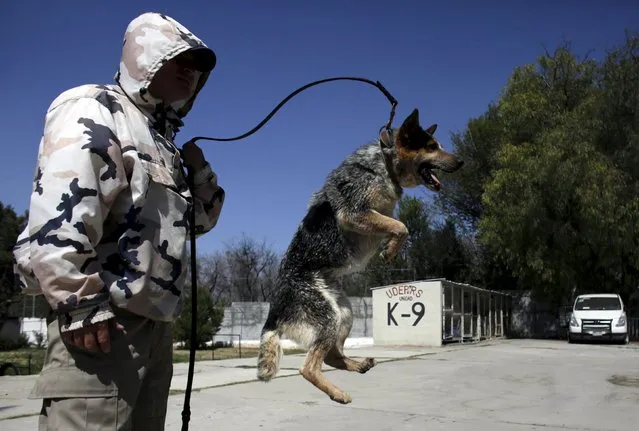
A dog trainer works with a previously abandoned dog at a police centre in Saltillo, Mexico March 4, 2016. (Photo by Daniel Becerril/Reuters)

A dog trainer works with a previously abandoned dog at a police centre in Saltillo, Mexico March 4, 2016. Stray dogs are adopted by the police from a municipal anti-rabies centre and then trained to help the police patrol the streets, and search for drugs, explosives and weapons. (Photo by Daniel Becerril/Reuters)
Details
07 Mar 2016 11:16:00
Kawakanih Yawalapiti, 9, Upper Xingu region of Mato Grosso, Brazil, 2018: Kawakanih lives with her tribe, the Yawalapiti, in Xingu national park, a preserve in the Amazon basin of Brazil. The Yawalapiti collect seeds to preserve species unique to their ecosystem, which lies between the rain forest and savannah. Kawakanih’s diet is simple, consisting mainly of fish, cassava, porridge, fruit and nuts. “It takes five minutes to catch dinner”, says Kawakanih. “When you’re hungry, you just go to the river with your net”. (Photo by Gregg Segal/The Guardian)

Photographer Gregg Segal travelled the world to document children and the food they eat in a week. Partly inspired by the increasing problems of childhood obesity, he tracked traditional regional diets as yet unaffected by globalisation, and ironically, found that the healthiest diets were often eaten by the least well off. (Photo by Gregg Segal/The Guardian)
Details
03 Jul 2019 00:03:00
A Cat As Model By Joann Biondi

For 20 years, Joann Biondi worked as a freelance writer. Then one day she adopted a kitten that had been tossed in a garbage can and left for dead. That kitten had an unusual quirk; he liked to wear clothes and pose for the camera. So Joann started shooting, and then she got serious about photography. Fast forward four years and that kitten is now Lorenzo the Cat, a feline art photography project that has gotten both the cat and the photographer a lot of attention; gallery shows, museum exhibits, and stories in major media outlets throughout the world. Amid it all Lorenzo has remained a mellow dude who still likes to roll around in the dirt, chase lizards, and knock things off the kitchen counter when his food bowl is empty.
Details
21 Jun 2014 10:13:00
Tridacna Gigas, or Giant Clams

“The giant clam, Tridacna gigas (known as pā’ua in Cook Islands Māori), is the largest living bivalve mollusc. T. gigas is one of the most endangered clam species. It was mentioned as early as 1825 in scientific reports. One of a number of large clam species native to the shallow coral reefs of the South Pacific and Indian oceans, they can weigh more than 200 kilograms (440 lb) measure as much as 120 cm (47 in) across, and have an average lifespan in the wild of 100 years or more”. – Wikipedia

Photo: Tridacna Gigas, or Giant Clams spew water as a traditional fisherman passes by a small sanctuary on January 23, 2004 near Bolinao in the Northern Philippines. The clams, prime builders for coral reefs and providing shelter for spawning fish and other marine life, are exposed by low tides in the sanctuary. Overfishing and pollution throughout the country are not only threatening food security, but are also starting to choke one of the few working clam sanctuaries in the world. (Photo by David Greedy/Getty Images)
Details
01 Oct 2011 13:10:00
An aerial view of the holy Muslim Shiite shrine of Imam Moussa al-Kazim as pilgrims gather to commemorate his death, in the Shiite district of Kazimiyah, Baghdad, Iraq, Wednesday, May 13, 2015. (Photo by Hadi Mizban/AP Photo)

An aerial view of the holy Muslim Shiite shrine of Imam Moussa al-Kazim as pilgrims gather to commemorate his death, in the Shiite district of Kazimiyah, Baghdad, Iraq, Wednesday, May 13, 2015. The anniversary of 8th century Shiite Imam Moussa al- Kazim drew tens of thousands of Shiites from all walks to converge on his golden-domed shrine in northern Baghdad. The pilgrims typically march to the shrine while hundreds of tents are erected to offer them free food, drinks and services. (Photo by Hadi Mizban/AP Photo)
Details
14 May 2015 12:08:00


“The Mahamasthakabhisheka (or Mahamasthak Abhishek) is an important Jain festival held once every twelve years in the town of Shravanabelagola in Karnataka state, India. The festival is held in veneration of an immense 18 meter high statue of the Bhagwan (or Saint) Gomateshwara Bahubali. The anointing last took place in February 2006, and the next ceremony will occur in 2018”. – Wikipedia

Photo: A Jain Sadhu (2nd L) and devotees gather and pray at the feet of the monolithic statue of Jain sage Gomateswara during preparations for the Mahamastak Abhisheka ceremony February 7, 2006 in Shravanabelagola, India. The Mahamastak Abhisheka ceremony is held just once every twelve years where the statue will be bathed with milk, yogurt, saffron, gold coins and other religious items. The statue is said to be the world's largest monolith. The ceremony officially runs February 8-19. (Photo by Mario Tama/Getty Images)
Details
21 Jun 2011 12:27:00