Loading...
Done
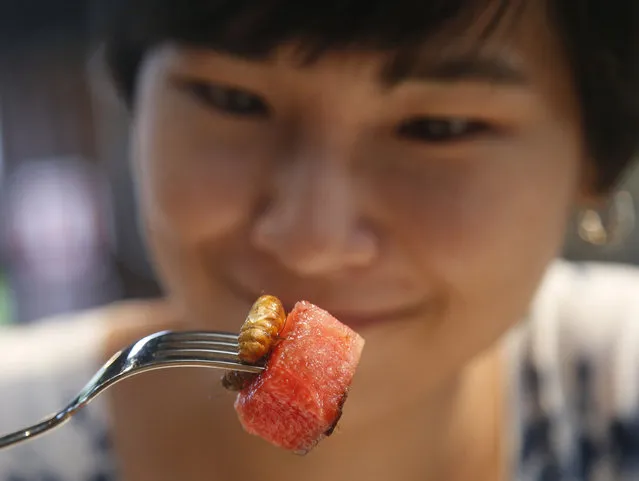
In this Tuesday, September 12, 2017 photo, Amornrat Simapsaisan, a local shop manager, watches before she ate watermelon salad with bamboo worms, at Inspects in the Backyard restaurant, Bangkok, Thailand. Tucking into insects is nothing new in Thailand, where street vendors pushing carts of fried crickets and buttery silkworms have long fed locals and adventurous tourists alike. But bugs are now fine-dining at the Bangkok bistro aiming to revolutionize views of nature’s least-loved creatures and what you can do with them. She tucked in quite happily to her watermelon and cricket salad on a recent evening.  “It’s tasty. It’s munchy”, she said. (Photo by Sakchai Lalit/AP Photo)

In this Tuesday, September 12, 2017 photo, Amornrat Simapsaisan, a local shop manager, watches before she ate watermelon salad with bamboo worms, at Inspects in the Backyard restaurant, Bangkok, Thailand. Tucking into insects is nothing new in Thailand, where street vendors pushing carts of fried crickets and buttery silkworms have long fed locals and adventurous tourists alike. But bugs are now fine-dining at the Bangkok bistro aiming to revolutionize views of nature’s least-loved creatures and what you can do with them. She tucked in quite happily to her watermelon and cricket salad on a recent evening. “It’s tasty. It’s munchy”, she said. (Photo by Sakchai Lalit/AP Photo)
Details
04 Oct 2017 06:54:00
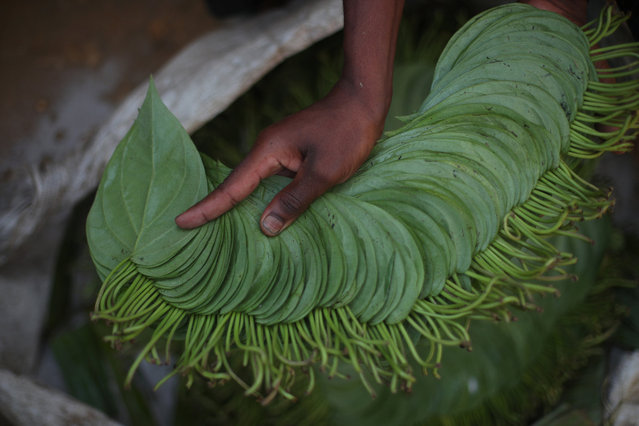
Faruk, 17, a Rohingya refugee trader holds betel leaves which are on sale at a stall in Palong Khali refugee camp near Cox's Bazar, Bangladesh, November 3, 2017. He left his village in Myanmar when the military opened fire towards the Rohingya. “I buy this betel leaf from Palong Khali market, in one bundle there are 160 pieces, I buy it for 80 taka and I sell it for 100 taka. Bangladeshi's and I sell for the same rate in the camp. Outside in the local market it is 80 taka per bundle. My problem is that I don't have money so I can't buy anything to eat, I can't buy fish to eat”, he said. (Photo by Hannah McKay/Reuters)

Faruk, 17, a Rohingya refugee trader holds betel leaves which are on sale at a stall in Palong Khali refugee camp near Cox's Bazar, Bangladesh, November 3, 2017. He left his village in Myanmar when the military opened fire towards the Rohingya. “I buy this betel leaf from Palong Khali market, in one bundle there are 160 pieces, I buy it for 80 taka and I sell it for 100 taka (1 Bangladeshi Taka = 0.012 US Dollar). Bangladeshi's and I sell for the same rate in the camp. Outside in the local market it is 80 taka per bundle. My problem is that I don't have money so I can't buy anything to eat, I can't buy fish to eat”, he said. (Photo by Hannah McKay/Reuters)
Details
27 Nov 2017 08:54:00
Malabon Zoo owner Manny Tangco holds a full-grown but very small rooster named “Small But Terrible” from Malaysia to compare it with the giant red rooster from France named “Mr. Universe” as they are shown to the media as part of the “Roosters of the World” exhibition to celebrate the “Red Fire Rooster” in the Chinese lunar calendar Friday, January 27, 2017 in suburban Malabon city north of Manila, Philippines. The Roosters of the World exhibition features roosters from countries as the United States, Japan, United Kingdom, France, China, Malaysia, Indonesia and Poland. (Photo by Bullit Marquez/AP Photo)

Malabon Zoo owner Manny Tangco holds a full-grown but very small rooster named “Small But Terrible” from Malaysia to compare it with the giant red rooster from France named “Mr. Universe” as they are shown to the media as part of the “Roosters of the World” exhibition to celebrate the “Red Fire Rooster” in the Chinese lunar calendar Friday, January 27, 2017 in suburban Malabon city north of Manila, Philippines. The Roosters of the World exhibition features roosters from countries as the United States, Japan, United Kingdom, France, China, Malaysia, Indonesia and Poland. (Photo by Bullit Marquez/AP Photo)
Details
29 Jan 2017 11:42:00
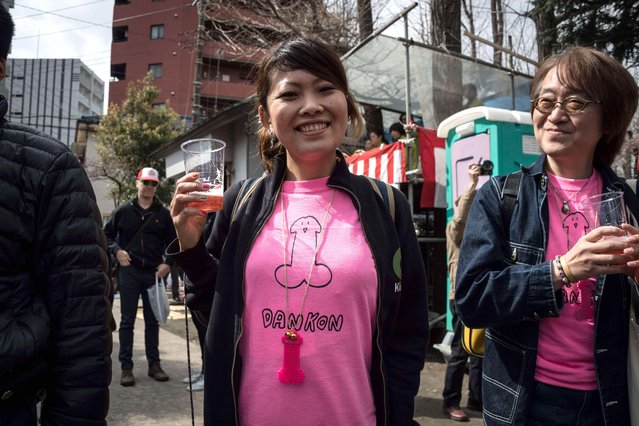
Festival goer with phallus logo t-shirt during the Kanamara Matsuri Steel Phallus Festival at Kawasaki, Japan on April 2, 2017. The Kanamara Matsuri or Festival of the Steel Phallus is held on the first Sunday of April at the Kanayama shrine. The shrine celebrates a legend of a steel pen*s and was frequented by prostitutes who wished to pray for protection from sexually transmitted diseases. Visitors now wish for easy delivery, marriage and matrimonial harmony. Because of the large steel phallus the unusual festival has become a tourist attraction attracting many overseas visitors and is used to raise money for HIV charities. Phallus shaped candy, carved vegetables, decorations, and a big parade are all part of the festival. (Photo by DELETREE/SIPA Press/Rex Features/Shutterstock)

Festival goer with phallus logo t-shirt during the Kanamara Matsuri Steel Phallus Festival at Kawasaki, Japan on April 2, 2017. The Kanamara Matsuri or Festival of the Steel Phallus is held on the first Sunday of April at the Kanayama shrine. The shrine celebrates a legend of a steel pen*s and was frequented by prostitutes who wished to pray for protection from sexually transmitted diseases. Visitors now wish for easy delivery, marriage and matrimonial harmony. Because of the large steel phallus the unusual festival has become a tourist attraction attracting many overseas visitors and is used to raise money for HIV charities. Phallus shaped candy, carved vegetables, decorations, and a big parade are all part of the festival. (Photo by DELETREE/SIPA Press/Rex Features/Shutterstock)
Details
04 Apr 2017 09:48:00
In a photo taken on July 6, 2017 soldiers of the Korean People' s Army (KPA) watch a fireworks display as part of celebrations marking the July 4 launch of the Hwasong-14 intercontinental ballistic missile, in Pyongyang Fireworks lit up the sky over Pyongyang' s Juche Tower as North Korea celebrated its launch of intercontinental ballistic missile, a milestone in its decades- long weapons drive. On July 4 – the United States' Independence Day – it launched a Hwasong-14 rocket that analysts and overseas officials said had a range of up to 8,000 kilometres, which would put Alaska and Hawaii within reach. (Photo by Kim Won-Jin/AFP Photo)

In a photo taken on July 6, 2017 soldiers of the Korean People' s Army (KPA) watch a fireworks display as part of celebrations marking the July 4 launch of the Hwasong-14 intercontinental ballistic missile, in Pyongyang Fireworks lit up the sky over Pyongyang' s Juche Tower as North Korea celebrated its launch of intercontinental ballistic missile, a milestone in its decades- long weapons drive. On July 4 – the United States' Independence Day – it launched a Hwasong-14 rocket that analysts and overseas officials said had a range of up to 8,000 kilometres, which would put Alaska and Hawaii within reach. (Photo by Kim Won-Jin/AFP Photo)
Details
14 Jul 2017 07:17:00
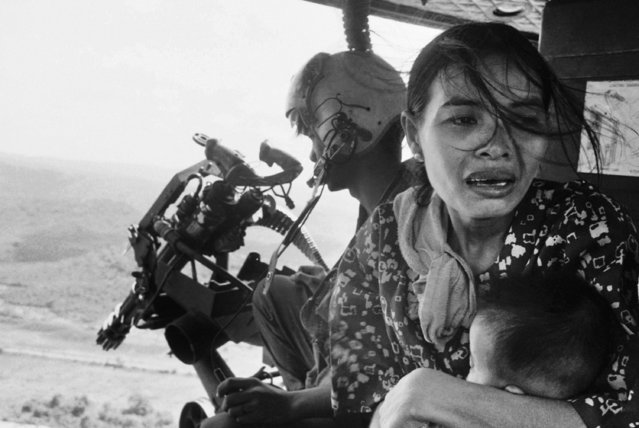
In this March 22, 1975 file photo, a refugee clutches a baby as a government helicopter gunship carries them away near Tuy Hoa, Vietnam, 235 miles northeast of Saigon. They were among thousands fleeing from Communist advances. (Photo by Nick Ut/AP Photo)

In this March 22, 1975 file photo, a refugee clutches a baby as a government helicopter gunship carries them away near Tuy Hoa, Vietnam, 235 miles northeast of Saigon. They were among thousands fleeing from Communist advances. AP Photographer Nick Ut will be retiring from the AP in March 2017 after 51 years of taking photographs from the front lines of the Vietnam War to the red carpets of Hollywood. (Photo by Nick Ut/AP Photo)
Details
14 Mar 2017 00:02:00
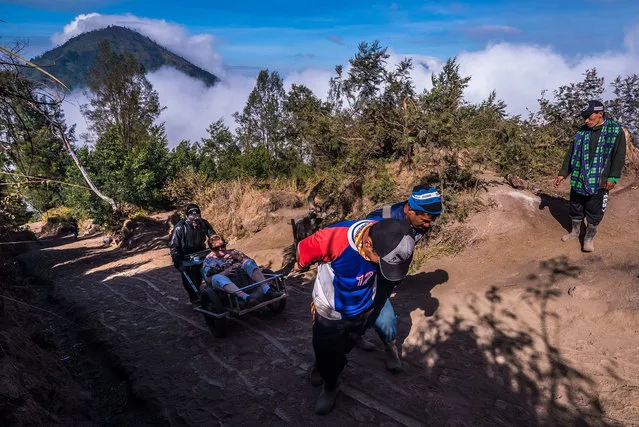
Miners pulling up lazy tourists to the rim of Kawah Ijen (Ijen Volcano), East Java, Indonesia on September 21, 2017. They will earn as much as they would bring down a load of sulfur. Nomadic Explorer, Cultural Lifestyle Photographer Claudio Sieber captured striking images of miners working at Ijen volcanic range in East Java, Indonesia. The sulphur miners risk their lives daily as they climb the active volcano carrying heavy loads, which they sell to sugar refineries. Shortly after midnight curious tourists are flocking in hundreds through the gate of Ijen's foothills to be right on time, driven by the images others took before them. Kawah Ijen is the one of the world's largest acidic volcanic crater lake; famous for its turquoise color as well as the unreal atmosphere it offers during darkness. A dusty path zigzags 3 kilometers up to the crater rim. This doesn't mean anything challenging; in particular, special sights have to be deserved anyway. The irritating smell of sulfur announces the near of the crater's existence. Arriving on the crater's rim the reward for the torture becomes visible. Blue fire darts its tongues through the fumes of sulfur dioxide. Somehow, the spectacle isn't as romantic as expected, since it is also the rough working space of approx. 150 sulfur miners who start their shift at 1 am. Lately, harvesting the abundance of devil's gold received international attention. This did obviously not really improve a miner's lifestyle; neither did it contribute to a better wage. (Photo by Claudio Sieber/Barcroft Images)

Miners pulling up lazy tourists to the rim of Kawah Ijen (Ijen Volcano), East Java, Indonesia on September 21, 2017. They will earn as much as they would bring down a load of sulfur. Nomadic Explorer, Cultural Lifestyle Photographer Claudio Sieber captured striking images of miners working at Ijen volcanic range in East Java, Indonesia. The sulphur miners risk their lives daily as they climb the active volcano carrying heavy loads, which they sell to sugar refineries. (Photo by Claudio Sieber/Barcroft Images)
Details
02 Oct 2017 08:31:00
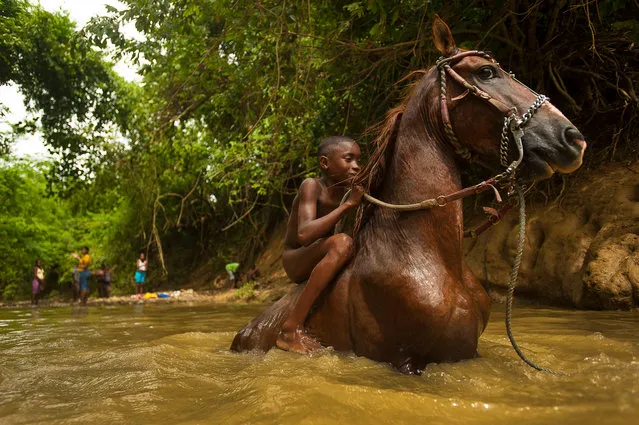
This image of a young bareback rider was taken in the village of Palenque de San Basilio, in Colombia’s Bolívar department. Founded by freed slaves in the 17th century, it became the first free town in the Americas, following a decree by the Spanish crown. Most of today’s inhabitants are direct descendants of those slaves and have preserved many of their customs, including their own language, Palenquero. (Photo by Sebastián Suki Beláustegui/The Guardian)

This image of a young bareback rider was taken in the village of Palenque de San Basilio, in Colombia’s Bolívar department. Founded by freed slaves in the 17th century, it became the first free town in the Americas, following a decree by the Spanish crown. Most of today’s inhabitants are direct descendants of those slaves and have preserved many of their customs, including their own language, Palenquero. (Photo by Sebastián Suki Beláustegui/The Guardian)
Details
07 Sep 2017 09:13:00