Loading...
Done
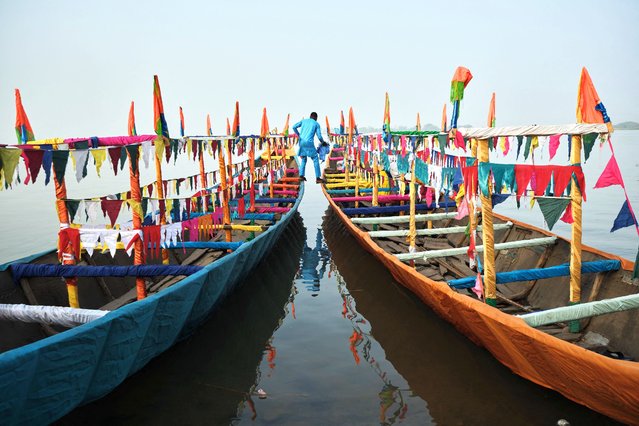
A man crosses from a pirogue to another pirogue during the annual boat regatta in Yauri, Kebbi State, on February 15, 2025. The regatta festival started about 200 years ago as a display of naval strength of the Gungu people, where the Gungu warriors annually attacked dangerous hippopotamus that were destroying farmlands. Warriors would board various sizes of canoes with different types of weapons to attack the animal on the River Niger. This required expertise in canoe paddling and naval warfare. It also served as training exercise for upcoming Gungu warriors. (Photo by Toyin Adedokun/AFP Photo)

A man crosses from a pirogue to another pirogue during the annual boat regatta in Yauri, Kebbi State, on February 15, 2025. The regatta festival started about 200 years ago as a display of naval strength of the Gungu people, where the Gungu warriors annually attacked dangerous hippopotamus that were destroying farmlands. Warriors would board various sizes of canoes with different types of weapons to attack the animal on the River Niger. This required expertise in canoe paddling and naval warfare. It also served as training exercise for upcoming Gungu warriors. (Photo by Toyin Adedokun/AFP Photo)
Details
25 Feb 2025 01:59:00
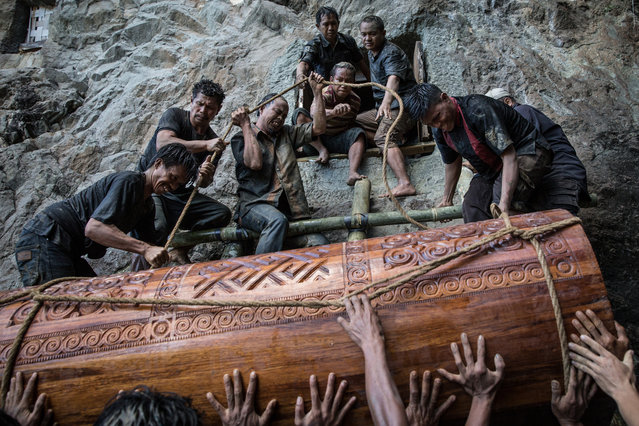
It is said that Torajans are people who “live to die”. For this Indonesian ethnic group, funerals are such extravagant events that they sometimes attract tourists. Families can postpone burials years (and the deceased are considered sick and hosted at home until the funeral) until the family can raise enough money and gather as many relatives as possible. And then it’s a jubilant multiday social event with a parade, dances and animal sacrifices. Agung Parameswara photographed these funerary practices when he traveled to South Sulawesi province, where the Torajans live. But often, their funeral isn’t the last time the dead are seen. In August, crypts are opened, coffins are slid back out and bodies delicately unsheathed. This tender ritual is known as Ma’Nene, which is customarily performed every few years. (Photo by Agung Parameswara/The Washington Post)

It is said that Torajans are people who “live to die”. For this Indonesian ethnic group, funerals are such extravagant events that they sometimes attract tourists. Families can postpone burials years (and the deceased are considered sick and hosted at home until the funeral) until the family can raise enough money and gather as many relatives as possible. And then it’s a jubilant multiday social event with a parade, dances and animal sacrifices. Agung Parameswara photographed these funerary practices when he traveled to South Sulawesi province, where the Torajans live. (Photo by Agung Parameswara/The Washington Post)
Details
06 Oct 2016 09:15:00
Performers dressed as Pikachu, the popular animation Pokemon series character, perform in the Pikachu parade in Yokohama on August 7, 2016. Some 50 life-size Pikachu characters, the most famous from the Pokemon game, marched along the city’s waterfront street as visitors took mobile phone pictures and videos of them in scorching sunshine. Some participants said they attended the event to search for rare characters of Pokemon – a word short for “pocket monster” – for the megahit smartphone app, which was launched in several countries around the world last month. (Photo by Kazuhiro Nogi/AFP Photo)

Performers dressed as Pikachu, the popular animation Pokemon series character, perform in the Pikachu parade in Yokohama on August 7, 2016. Some 50 life-size Pikachu characters, the most famous from the Pokemon game, marched along the city’s waterfront street as visitors took mobile phone pictures and videos of them in scorching sunshine. Some participants said they attended the event to search for rare characters of Pokemon – a word short for “pocket monster” – for the megahit smartphone app, which was launched in several countries around the world last month. (Photo by Kazuhiro Nogi/AFP Photo)
Details
08 Aug 2016 10:41:00
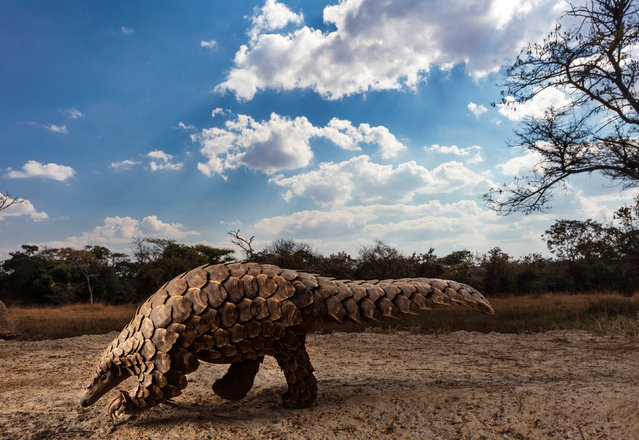
Pangolins in Crisis: Brent Stirton, South Africa; 1st place, Natural world and wildlife. “Pangolins are the world’s most illegally trafficked mammals, with an estimated one million trafficked to Asia in the last 10 years. Their scales are used in traditional Chinese and Vietnamese medicine, and their meat is sold as a high-priced delicacy. As a result, pangolins are listed as critically endangered and anyone who trades or consumes them is breaking the law. This body of work exposes the trade, while exploring aspects of illegality and celebrating the people who are trying to save these animals”. (Photo by Brent Stirton/Sony World Photography Awards 2020)

Pangolins in Crisis: Brent Stirton, South Africa; 1st place, Natural world and wildlife. “Pangolins are the world’s most illegally trafficked mammals, with an estimated one million trafficked to Asia in the last 10 years. Their scales are used in traditional Chinese and Vietnamese medicine, and their meat is sold as a high-priced delicacy. As a result, pangolins are listed as critically endangered and anyone who trades or consumes them is breaking the law. This body of work exposes the trade, while exploring aspects of illegality and celebrating the people who are trying to save these animals”. (Photo by Brent Stirton/Sony World Photography Awards 2020)
Details
11 Jun 2020 00:05:00
Women wear the traditional costume of the Alto Tio Diego carnival during the Women's Afro-Mestizo Carnival of Alto Tio Diego on February 11, 2024 in Veracruz, Mexico. Alto Tio Diego is a small town near the State capital Xalapa where every year inhabitants celebrate their traditional carnival. Women of the town demanded a special day for them to parade and few years ago, they started to do it by walking through the streets wearing traditional costumes and masks (mostly of animals) but the attires have evolved to more modern characters. (Photo by Hector AD Quintanar/Getty Images)

Women wear the traditional costume of the Alto Tio Diego carnival during the Women's Afro-Mestizo Carnival of Alto Tio Diego on February 11, 2024 in Veracruz, Mexico. Alto Tio Diego is a small town near the State capital Xalapa where every year inhabitants celebrate their traditional carnival. Women of the town demanded a special day for them to parade and few years ago, they started to do it by walking through the streets wearing traditional costumes and masks (mostly of animals) but the attires have evolved to more modern characters. (Photo by Hector AD Quintanar/Getty Images)
Details
24 May 2025 02:27:00


“Sektor gaza” (Russian: Сектор газа) was a Russian rock band formed on 5 December 1987 in the city of Voronezh, Russia. Despite only semi-officially existing (due to obscene lyrics), the group remains popular in Russia today. The group name was taken from an eponymous industrial district of Voronezh (itself named for high levels of environmental contamination). Their music style could be defined as Russian punk, integrated with elements of different musical genres such as rock, rap, and Russian folk. On 4 July 2000, group leader Yuri “Hoy” Klinskih complained of strong pains in his stomach and the left side of his chest. He suffered heart failure shortly thereafter. Klinskikh died in Voronezh (Russia)at the age of 35. He is buried in the Levoberezhniy Cemetery. The group ceased to exist.

About the music video: The First Chechen War, also known as the War in Chechnya, was a conflict between the Russian Federation and the Chechen Republic of Ichkeria, fought from December 1994 to August 1996. After the initial campaign of 1994 – 1995, culminating in the devastating Battle of Grozny, Russian federal forces attempted to seize control of the mountainous area of Chechnya but were set back by Chechen guerrilla warfare and raids on the flatlands in spite of Russia's overwhelming manpower, weaponry, and air support...

Details
24 May 2012 14:38:00
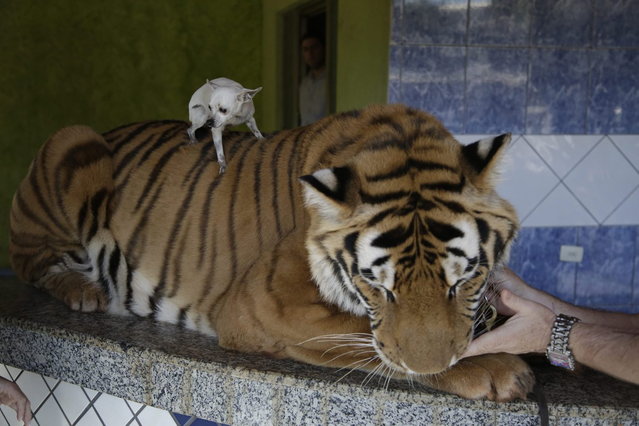
The Borges' family pet dog, Little, is placed on the back of Tom, their tiger, for a photo to be taken, in Maringa, Brazil, Friday, September 27, 2013. The Brazilian family is now locked in a legal dispute for the big cats, they have eight tigers and two lions, with federal wildlife officials working to take them away. While Borges does have a license to raise the animals, Brazilian wildlife officials say he illegally bred the cats, creating a public danger. (Photo by Renata Brito/AP Photo)

“Ary Borges and his family live in southern Brazil like most families the Borges' love animals and have an array of cats living in their home. The only difference between the cats owned by the Borges family and the cat that is cuddled up on your lap as you read this is the Borges' cats weigh over 700 pounds and could kill you just as soon as look at you. The Borges family shares their home with nine tigers, two lionesses, a chimp and a Chihuahua”. – Amanda Schiavo via Latin Times. Photo: The Borges' family pet dog, Little, is placed on the back of Tom, their tiger, for a photo to be taken, in Maringa, Brazil, Friday, September 27, 2013. (Photo by Renata Brito/AP Photo)
Details
04 Oct 2013 11:51:00
Galapagos – Rocking the Cradle: Four major ocean currents converge along the Galapagos archipelago, creating the conditions for an extraordinary diversity of animal life, April 25, 2016. The islands are home to at least 7,000 flora and fauna species, of which 97 percent of the reptiles, 80 percent of the land birds, 50 percent of the insects and 30 percent of the plants are endemic. The local ecosystem is highly sensitive to the changes in temperature, rainfall and ocean currents that characterize the climatic events known as El Niño and La Niña. These changes cause marked fluctuations in weather and food availability. Many scientists expect the frequency of El Niño and La Niña to increase as a result of climate change, making the Galapagos a possible early-warning location for its effects. (Photo by Thomas P. Peschak for National Geographic/World Press Photo)

Galapagos – Rocking the Cradle: Four major ocean currents converge along the Galapagos archipelago, creating the conditions for an extraordinary diversity of animal life, April 25, 2016. The islands are home to at least 7,000 flora and fauna species, of which 97 percent of the reptiles, 80 percent of the land birds, 50 percent of the insects and 30 percent of the plants are endemic. (Photo by Thomas P. Peschak for National Geographic/World Press Photo)
Details
16 Apr 2018 00:01:00