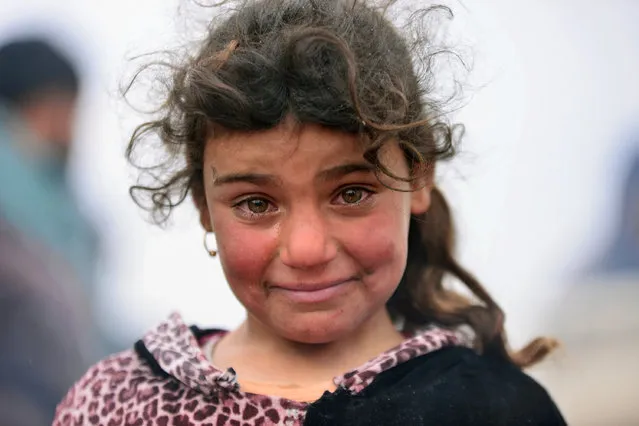
A displaced Iraqi girl, who fled her home, cries during a battle between Iraqi forces and Islamic State militants, near Badush, Iraq, March 16, 2017. (Photo by Reuters/Stringer)
A woman jumps on a giant fried egg art installation as part of “Hecho en Casa” (Made at home) urban artwork festival in downtown Santiago, Chile, November 8, 2016. (Photo by Pablo Sanhueza/Reuters)
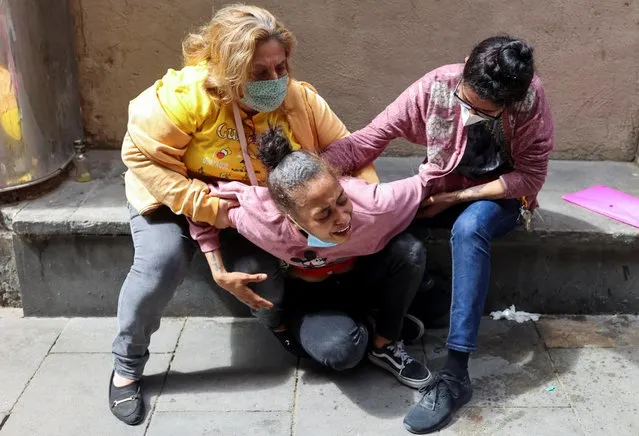
The granddaughter of one of the family members cries after the eviction from their home in El Raval neighbourhood, amid the coronavirus disease (COVID-19) pandemic, in Barcelona, Spain, May 12, 2021. (Photo by Nacho Doce/Reuters)
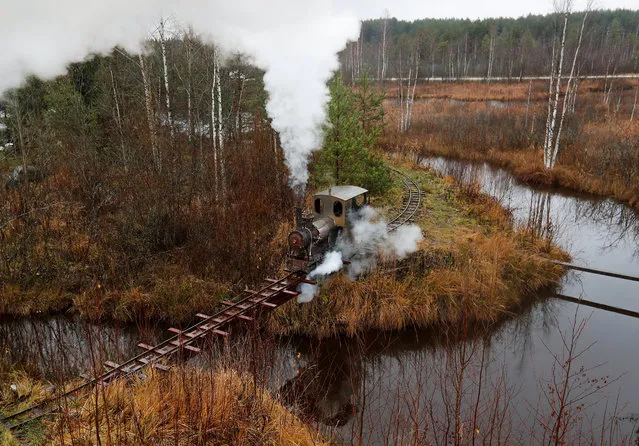
A home-made steam train, designed by Pavel Chilin, rides on a make-shift railway across country house neighborhood in the settlement of Ulyanovka in Leningrad region, Russia on November 4, 2019. (Photo by Anton Vaganov/Reuters)
Personnel from Maharashtra Home Guards, a volunteer force practice yoga near the Gateway of India monument as they mark International Yoga Day in Mumbai, India, Friday, June 21, 2024. (Photo by Rajanish Kakade/AP Photo)
The sea otter (Enhydra lutris) is a marine mammal native to the coasts of the northern and eastern North Pacific Ocean. Adult sea otters typically weigh between 14 and 45 kg (31 and 99 lb), making them the heaviest members of the weasel family, but among the smallest marine mammals. Unlike most marine mammals, the sea otter's primary form of insulation is an exceptionally thick coat of fur, the densest in the animal kingdom. Although it can walk on land, the sea otter lives mostly in the ocean.
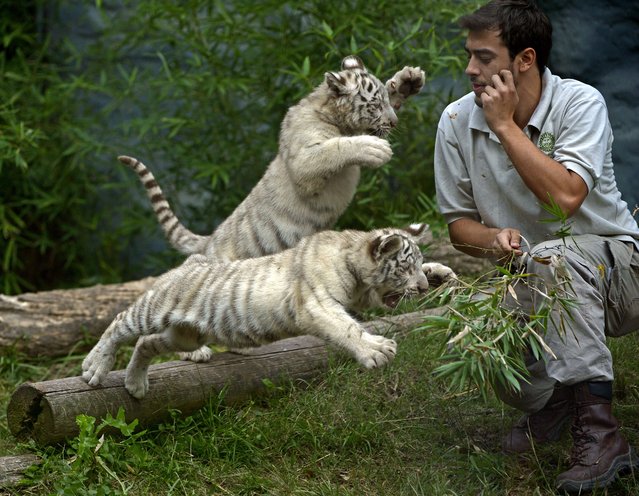
Two three-month-old female white Bengal tiger cubs play with a zoo keeper in their enclosure at the Buenos Aires' Zoo, in Argentina, on April 17, 2014. Captive white Bengal tiger Cloe, gave birth to three cubs – two females and one male – on January 14, 2014. (Photo by Juan Mabromata/AFP Photo)
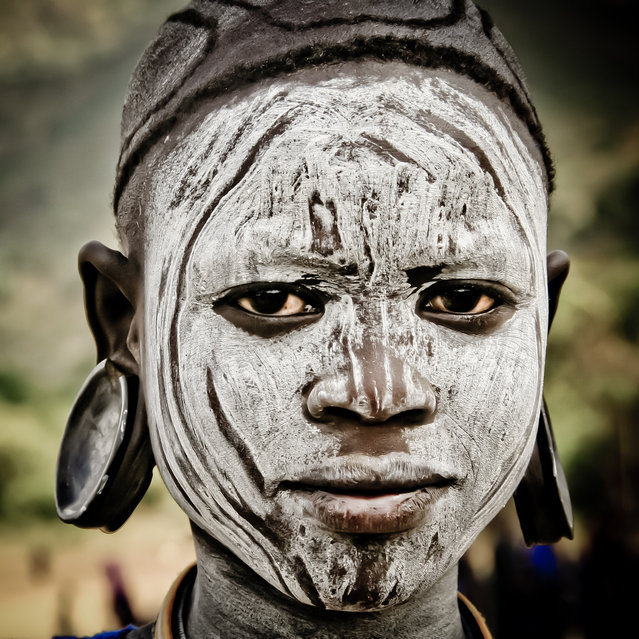
“The Omo River is an important river of southern Ethiopia. Its course is entirely contained within the boundaries of Ethiopia, and empties into Lake Turkana on the border with Kenya. The lower valley of the Omo is currently believed by some to have been a crossroads for thousands of years as various cultures and ethnic groups migrated around the region. To this day, the people of the Lower Valley of the Omo, including the Mursi, Suri, Nyangatom, Dizi and Me'en, are studied for their diversity”. – Wikipedia (Photo by Hamerscat)