Loading...
Done
Competitors release their hens during the World Championship Hen Racing Championships in Bonsall, Britain August 1, 2015. (Photo by Darren Staples/Reuters)

Competitors release their hens during the World Championship Hen Racing Championships in Bonsall, Britain August 1, 2015. (Photo by Darren Staples/Reuters)
Details
02 Aug 2015 13:16:00
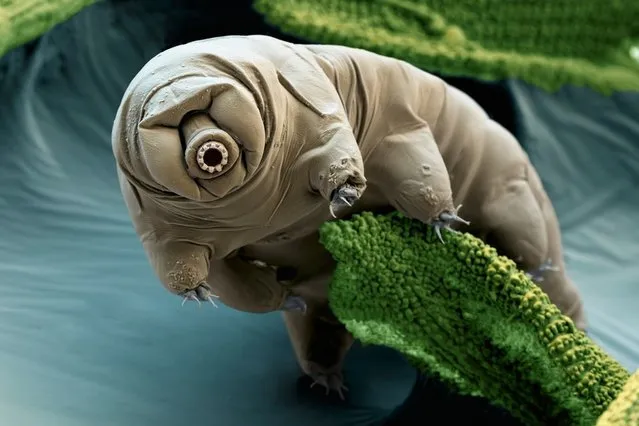
Tardigrades (commonly known as waterbears or moss piglets). (Photo by SPL/East News)

“Tardigrades (commonly known as waterbears or moss piglets) are small, water-dwelling, segmented animals with eight legs. Tardigrades were first discovered in 1773 by Johann August Ephraim Goeze, who called them kleiner Wasserbär, meaning “little water bear” in German. The name Tardigrada means “slow walker” and was given by Lazzaro Spallanzani in 1777. The name water bear comes from the way they walk, reminiscent of a bear's gait. The biggest adults may reach a body length of 1.5 millimetres (0.059 in), the smallest below 0.1 mm. Freshly hatched tardigrades may be smaller than 0.05 mm”. – Wikipedia. Photo: Tardigrades. (Photo by SPL/East News)
Details
26 Sep 2012 09:55:00
A man demonstrates outside Republican presidential candidate Donald Trump's news conference at Trump Tower in New York, U.S., May 31, 2016. (Photo by Shannon Stapleton/Reuters)

A man demonstrates outside Republican presidential candidate Donald Trump's news conference at Trump Tower in New York, U.S., May 31, 2016. (Photo by Shannon Stapleton/Reuters)
Details
04 Jun 2016 12:24:00
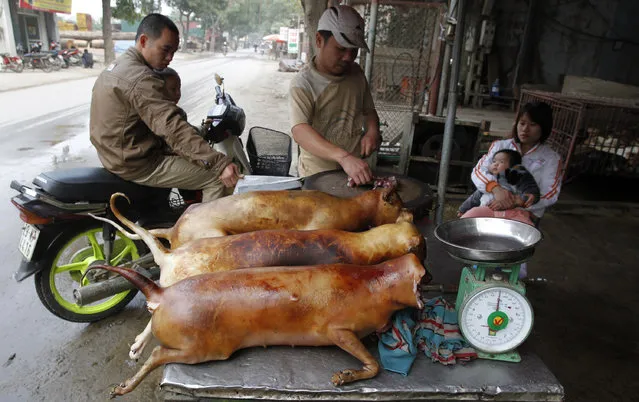
A vendor (C) cuts slaughtered dogs for sale at his roadside stall in Duong Noi village, outside Hanoi December 16, 2011. While animal rights activists have condemned eating dog meat as cruel treatment of the animals, it is still an accepted popular delicacy for some Vietnamese, as well in some other Asian countries. (Photo by Reuters/Kham)

A vendor (C) cuts slaughtered dogs for sale at his roadside stall in Duong Noi village, outside Hanoi December 16, 2011. While animal rights activists have condemned eating dog meat as cruel treatment of the animals, it is still an accepted popular delicacy for some Vietnamese, as well in some other Asian countries. Duong Noi is well-known as a dog-meat village, where hundreds of dogs are killed each day for sale as popular traditional food. Dog-eating as a custom is rooted in Vietnam and was developed as a result of poverty. One kilogram of dog meat costs about 130,000 dongs ($6.2). (Photo by Reuters/Kham)
Details
16 Jul 2013 11:40:00
Members of the Colombian Navy stand guard on top of a seized submarine built by drug smugglers in a makeshift shipyard in Timbiqui, department of Cauca February 14, 2011. Colombian authorities said the submersible craft was to be used to transport 8 tons of cocaine illegally into Mexico. (Photo by Jaime Saldarriaga/Reuters)

Members of the Colombian Navy stand guard on top of a seized submarine built by drug smugglers in a makeshift shipyard in Timbiqui, department of Cauca February 14, 2011. Colombian authorities said the submersible craft was to be used to transport 8 tons of cocaine illegally into Mexico. (Photo by Jaime Saldarriaga/Reuters)
Details
14 Aug 2015 13:34:00
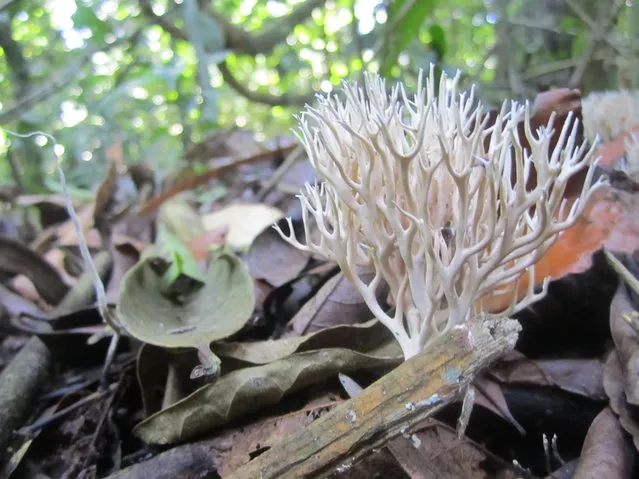
This strange coral-looking specimen is actually a mushroom. The photo, “Beautiful Destroyer”, was taken in the Panamanian tropical rainforest where the mushroom produces nitrogen, an element vital to soil health. (Photo by Sarah A. Batterman)

This strange coral-looking specimen is actually a mushroom. The photo, “Beautiful Destroyer”, was taken in the Panamanian tropical rainforest where the mushroom produces nitrogen, an element vital to soil health. (Photo by Sarah A. Batterman)
Details
13 Aug 2014 09:49:00
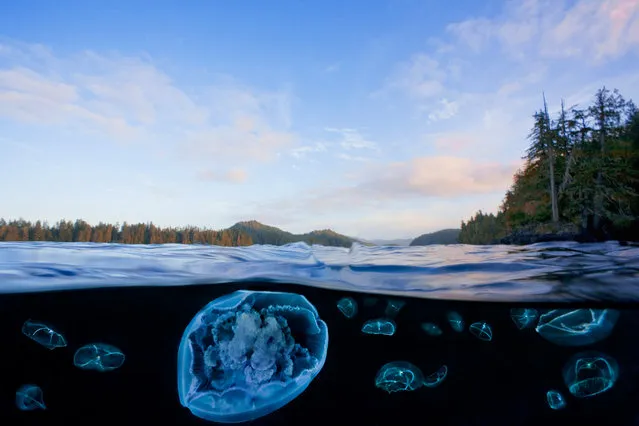
Moon jellyfish and cross jellies. (Photo by David Hall)

David Hall’s photographs of scenery and creatures off the coast of Canada in the Pacific Northwest portray serenity under the water, which belie the extreme challenges he faces to get his images. For each shoot, Hall wears a dry suit, a neoprene body suit that covers all of his body but his head and traps air inside to keep him warm. Water temperature in Canada’s British Columbia typically ranges between 45 and 50 degrees Fahrenheit. Photo: Moon jellyfish and cross jellies. (Photo by David Hall)
Details
16 Sep 2014 12:57:00
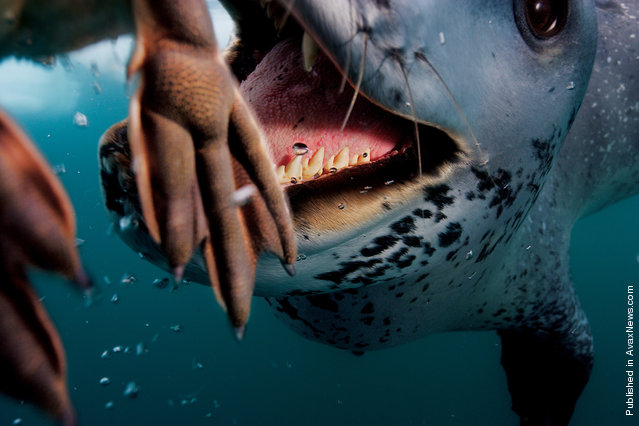
A leopard seal feeds Paul Nicklen a penguin

A leopard seal feeds Paul Nicklen a penguin. (Photo by Paul Nicklen/National Geographic). Antarctic Peninsula, 2011
Details
11 Apr 2012 13:39:00