Loading...
Done
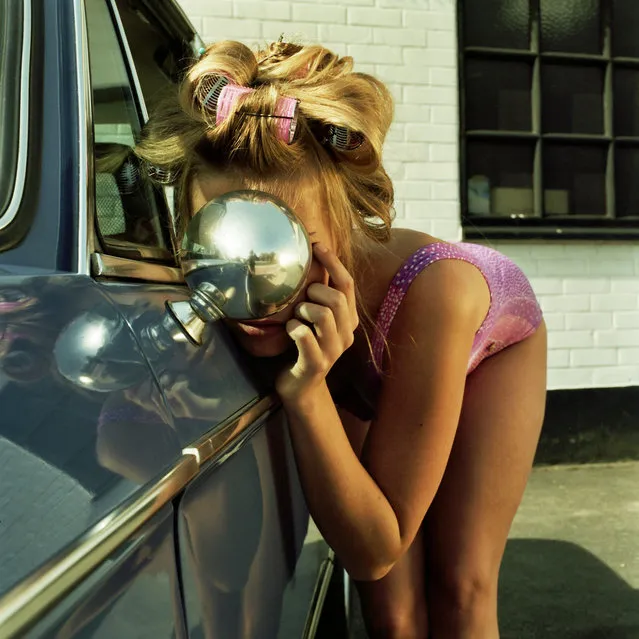
Photo Art by Annelie Vandendael

Annelie Vandendael was born in Belgium and grew up in the South of France. After college she came back to Belgium to study at the Royal Academy of Fine Arts (Kask) in Genth where she got a master degree in Photography; Images have always been a passion for her. After finishing her studies, she was invited to “La Fabrica”, the Benetton Communication and Research Center in Treviso, Italy. She was also nominated for the photo academy Award in the Netherlands and won the Award of the Roorda Agency, Amsterdam. (Photo by Annelie Vandendael)
Details
23 Jul 2014 10:08:00
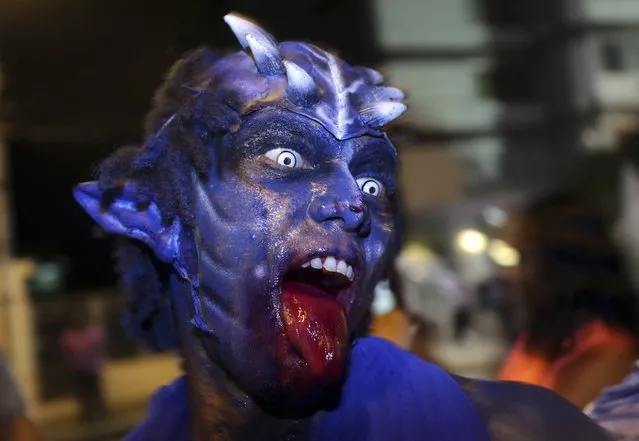
A masquerader from the Paramin Blue Devils parades before judges during the traditional mas competition held by the National Carnival Commission at Victoria Square, in the capital Port-of-Spain, February 12, 2015. (Photo by Andrea De Silva/Reuters)

A masquerader from the Paramin Blue Devils parades before judges during the traditional mas competition held by the National Carnival Commission at Victoria Square, in the capital Port-of-Spain, February 12, 2015. (Photo by Andrea De Silva/Reuters)
Details
14 Feb 2015 12:54:00
The Eastern City Gate apartment buildings complex stands in the Konjarnik neighbourhood in Belgrade, Serbia, July 30, 2019. Brutalism, an architectural style popular in the 1950s and 1960s, based on crude, block-like forms cast from concrete was popular throughout the eastern bloc. (Photo by Marko Djurica/Reuters)

The Eastern City Gate apartment buildings complex stands in the Konjarnik neighbourhood in Belgrade, Serbia, July 30, 2019. Brutalism, an architectural style popular in the 1950s and 1960s, based on crude, block-like forms cast from concrete was popular throughout the eastern bloc. (Photo by Marko Djurica/Reuters)
Details
01 Nov 2019 00:05:00
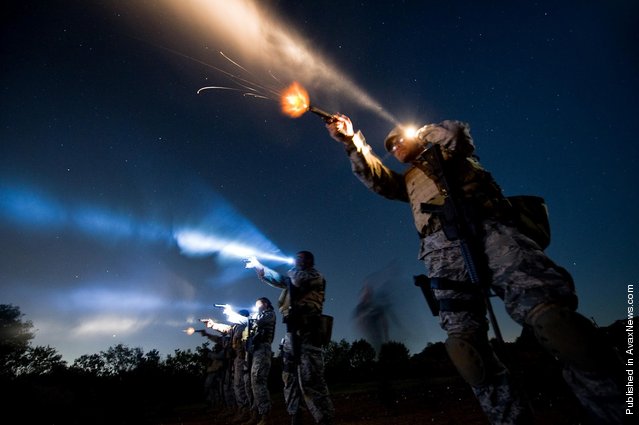
Tech. Sgt. Milo Hinson, 3rd Combat Camera Squadron, uses a flashlight while shooting a Berretta 9mm during the night-fire portion of Advance Weapons, Tactics and Techniques training in San Antonio. During night-fire training, airmen learn how to tactically illuminate targets with flashlights and practice using night vision goggles

Tech. Sgt. Milo Hinson, 3rd Combat Camera Squadron, uses a flashlight while shooting a Berretta 9mm during the night-fire portion of Advance Weapons, Tactics and Techniques training in San Antonio. During night-fire training, airmen learn how to tactically illuminate targets with flashlights and practice using night vision goggles. (Photo by Staff Sgt. Jonathan Snyder/U.S. Air Force). 2011
Details
12 Apr 2012 12:53:00
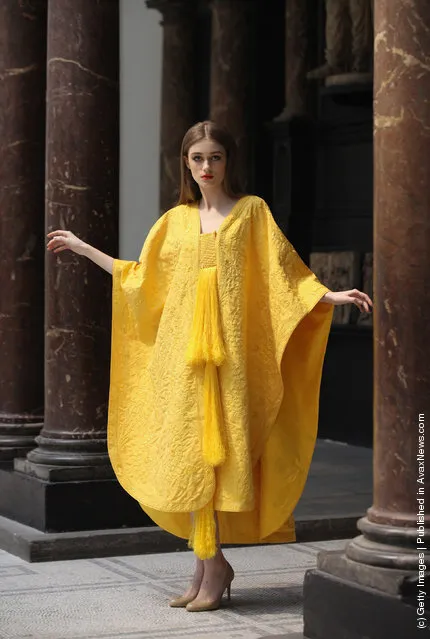
Model Bianca Gavrilas wears a a hand-embroidered cape made from the silk of the Golden Orb Spider in the V&A Museum's Medieval and Renaissance Gallery

Model Bianca Gavrilas wears a a hand-embroidered cape made from the silk of the Golden Orb Spider in the V&A Museum's Medieval and Renaissance Gallery on January 23, 2012 in London, England. The cape is one of two golden spider silk textiles that exist in the world, it was made in Madagascar over a period of 8 years and using the silk of silk of 1.2million spiders. (Photo by Oli Scarff/Getty Images)
Details
26 Jan 2012 12:02:00
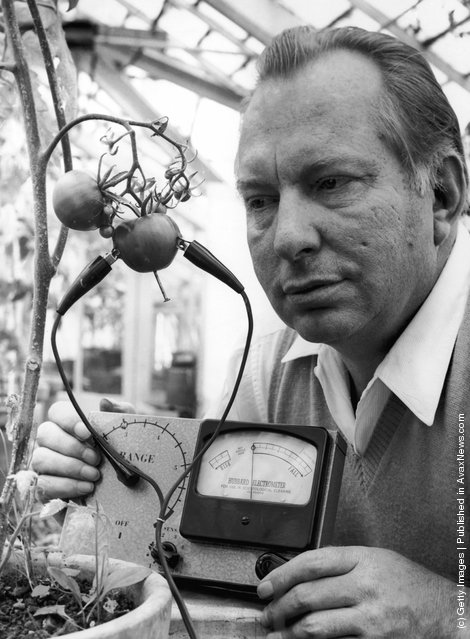
American science fiction writer L. Ron Hubbard, founder of the Church of Scientology, uses his Hubbard Electrometer

“Lafayette Ronald Hubbard (March 13, 1911 – January 24, 1986), better known as L. Ron Hubbard (and often referred to by his initials, LRH), was an American pulp fiction author and religious leader who founded the Church of Scientology. After establishing a career as a writer, becoming best known for his science fiction and fantasy stories, he developed a self-help system called Dianetics which was first published in May 1950. He subsequently developed his ideas into a wide-ranging set of doctrines and rituals as part of a new religious movement that he called Scientology. His writings became the guiding texts for the Church of Scientology and a number of affiliated organizations that address such diverse topics as business administration, literacy and drug rehabilitation”. – Wikipedia

Photo: American science fiction writer L. Ron Hubbard, founder of the Church of Scientology, uses his Hubbard Electrometer (patent pending) to determine whether tomatoes experience pain, 1959. His work led him to the conclusion that tomatoes “scream when sliced”. (Photo by Scott Lauder/Evening Standard/Hulton Archive/Getty Images)
Details
09 Sep 2011 09:34:00
Initially the project started when I was working in Atlanta. About four years ago, a roommate of mine had a Yorkie and we thought it would be funny to take some photos of this really cute dog with a few handguns. Once my friends saw the photos they started asking me to take pictures of their dogs with other firearms. (Photo and caption by Ben Haulenbeek/Puppies with guns calendar 2015)

Initially the project started when I was working in Atlanta. About four years ago, a roommate of mine had a Yorkie and we thought it would be funny to take some photos of this really cute dog with a few handguns. Once my friends saw the photos they started asking me to take pictures of their dogs with other firearms... (Photo and caption by Ben Haulenbeek/Puppies with guns calendar 2015)
Details
14 Dec 2014 11:59:00
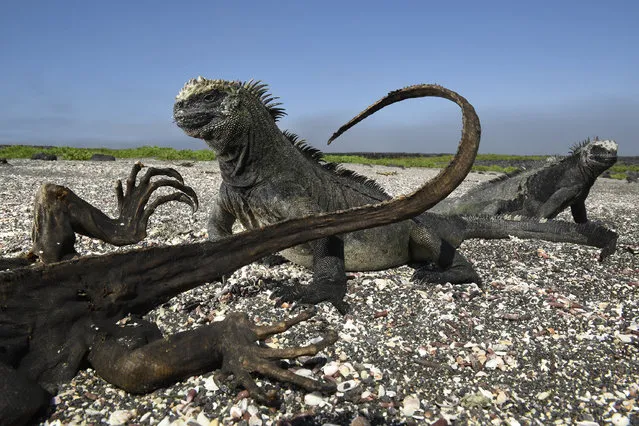
Galapagos – Rocking the Cradle: Four major ocean currents converge along the Galapagos archipelago, creating the conditions for an extraordinary diversity of animal life, April 25, 2016. The islands are home to at least 7,000 flora and fauna species, of which 97 percent of the reptiles, 80 percent of the land birds, 50 percent of the insects and 30 percent of the plants are endemic. The local ecosystem is highly sensitive to the changes in temperature, rainfall and ocean currents that characterize the climatic events known as El Niño and La Niña. These changes cause marked fluctuations in weather and food availability. Many scientists expect the frequency of El Niño and La Niña to increase as a result of climate change, making the Galapagos a possible early-warning location for its effects. (Photo by Thomas P. Peschak for National Geographic/World Press Photo)

Galapagos – Rocking the Cradle: Four major ocean currents converge along the Galapagos archipelago, creating the conditions for an extraordinary diversity of animal life, April 25, 2016. The islands are home to at least 7,000 flora and fauna species, of which 97 percent of the reptiles, 80 percent of the land birds, 50 percent of the insects and 30 percent of the plants are endemic. (Photo by Thomas P. Peschak for National Geographic/World Press Photo)
Details
16 Apr 2018 00:01:00