Loading...
Done
A herd of wildebeest cross the skyline against the fading light in Masai Mara, Kenya, 25 August 2017. Stunning sunset photos silhouette Africa’s wildlife against streaks of orange and red sky. In August, German photographer Ingo Gerlach was on safari in the Masai Mara when he convinced his safari guide to stop and take in the sunset. The wildlife photographer was rewarded with his patience by an eye-catching sunset, which cast Africa’s wildlife into dark shadows against the vibrant skies. (Photo by Ingo Gerlach/Barcroft Images)

A herd of wildebeest cross the skyline against the fading light in Masai Mara, Kenya, 25 August 2017. Stunning sunset photos silhouette Africa’s wildlife against streaks of orange and red sky. In August, German photographer Ingo Gerlach was on safari in the Masai Mara when he convinced his safari guide to stop and take in the sunset. The wildlife photographer was rewarded with his patience by an eye-catching sunset, which cast Africa’s wildlife into dark shadows against the vibrant skies. (Photo by Ingo Gerlach/Barcroft Images)
Details
14 Sep 2017 08:17:00
Chieftain Japarupi Waiapi shows a roasted monkey -part of Waiapi's diet, also based in Manioc and fruits- at the reserve in Amapa state in Brazil on October 13, 2017. When Waiapis walks into the Amazon forest surrounding their village, they do not see trees, but a kind of shopping mall providing medicine, food, shelter, tools and weapons  all under the eye of multiple spirits. (Photo by Apu Gomes/AFP Photo)

Chieftain Japarupi Waiapi shows a roasted monkey -part of Waiapi's diet, also based in Manioc and fruits- at the reserve in Amapa state in Brazil on October 13, 2017. When Waiapis walks into the Amazon forest surrounding their village, they do not see trees, but a kind of shopping mall providing medicine, food, shelter, tools and weapons all under the eye of multiple spirits. (Photo by Apu Gomes/AFP Photo)
Details
27 Oct 2017 08:39:00
An Iraqi woman and foreigners use  pair of compact discs as a filter to watch the partial solar eclipse in war-torn Baghdad, 29 March 2006. Without access to proper equipment to protect their eyes from the sun's rays, eclipse watchers in Iraq used makeshift filters.  The moon blotted out the sun over northwest Africa early Wednesday, turning day into night in a total solar eclipse as it swept a shadowy path from the outer tip of Brazil to the steppes of Mongolia. (Photo by Hassan Ammar/AFP Photo)

An Iraqi woman and foreigners use pair of compact discs as a filter to watch the partial solar eclipse in war-torn Baghdad, 29 March 2006. Without access to proper equipment to protect their eyes from the sun's rays, eclipse watchers in Iraq used makeshift filters. The moon blotted out the sun over northwest Africa early Wednesday, turning day into night in a total solar eclipse as it swept a shadowy path from the outer tip of Brazil to the steppes of Mongolia. (Photo by Hassan Ammar/AFP Photo)
Details
25 Jul 2017 09:31:00
Mexico City resident Romina Montoya takes a playful selfie wearing a protective face mask over her eyes and nose, in Playa del Carmen, Quintana Roo state, Mexico, Wednesday, January 6, 2021. Concern is spreading that the critical winter holiday tourism success could be fleeting because it came as COVID-19 infections in both Mexico and the United States were reaching new heights. (Photo by Emilio Espejel/AP Photo)

Mexico City resident Romina Montoya takes a playful selfie wearing a protective face mask over her eyes and nose, in Playa del Carmen, Quintana Roo state, Mexico, Wednesday, January 6, 2021. Concern is spreading that the critical winter holiday tourism success could be fleeting because it came as COVID-19 infections in both Mexico and the United States were reaching new heights. (Photo by Emilio Espejel/AP Photo)
Details
09 Jan 2022 05:17:00
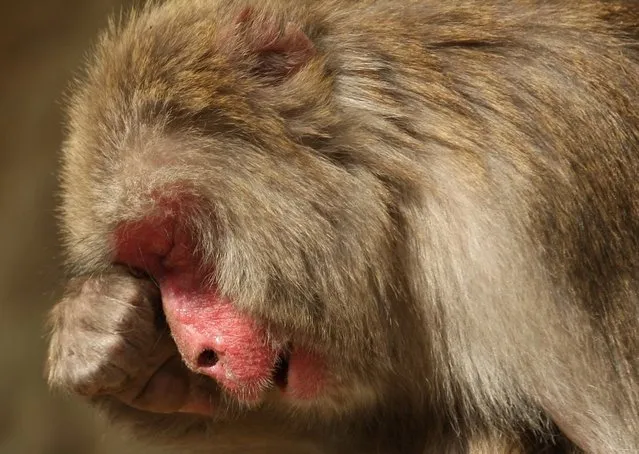
A 20-year-old Japanese macaque monkey named Monday scratches her eyes while suffering an allergy to pollen from the cedar tree at Awajishima Monkey Centre on March 17, 2013 in Sumoto, Japan. Many monkeys are suffering the effects of hay fever at this time of the year, with the typical symptoms being the same as with humans.  According to Awajishima Monkey center this year hay fever is higher than last year, the pollen season is from February to April.  (Photo by Buddhika Weerasinghe)

A 20-year-old Japanese macaque monkey named Monday scratches her eyes while suffering an allergy to pollen from the cedar tree at Awajishima Monkey Centre on March 17, 2013 in Sumoto, Japan. Many monkeys are suffering the effects of hay fever at this time of the year, with the typical symptoms being the same as with humans. According to Awajishima Monkey center this year hay fever is higher than last year, the pollen season is from February to April. (Photo by Buddhika Weerasinghe)
Details
18 Mar 2013 09:48:00
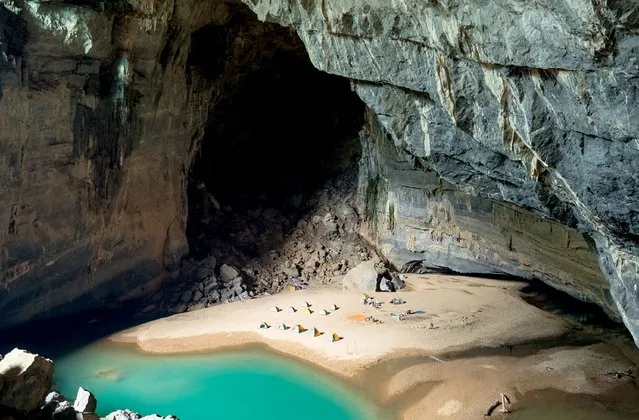
These breathtaking images capture the hidden depths of one of the worlds largest caves, which is so big its home to a beach, a river and a jungle. At more than 130m high, and 150m across, the imposing cave is so big as high as the London Eye and wider than one-and-a-half football pitches. (Photo by Lars Krux/Caters News)

These breathtaking images capture the hidden depths of one of the worlds largest caves, which is so big its home to a beach, a river and a jungle. At more than 130m high, and 150m across, the imposing cave is so big as high as the London Eye and wider than one-and-a-half football pitches. Here: The campers set up inside the cave on the beach. (Photo by Lars Krux/Caters News)
Details
07 May 2015 12:25:00
Sculptures entitled “The Rising Tide” by British sculptor Jason deCaires Taylor are seen beside the River Thames in front of the Houses of Parliament and the London Eye ferris wheel in London, September 3, 2015. The representations of four horses and riders are fully visible at low tide but become immersed underwater twice a day as the Thames rises to reach full tide. The installation will be on display throughout September as part of the annual Totally Thames festival. (Photo by Toby Melville/Reuters)

Sculptures entitled “The Rising Tide” by British sculptor Jason deCaires Taylor are seen beside the River Thames in front of the Houses of Parliament and the London Eye ferris wheel in London, September 3, 2015. The representations of four horses and riders are fully visible at low tide but become immersed underwater twice a day as the Thames rises to reach full tide. The installation will be on display throughout September as part of the annual Totally Thames festival. (Photo by Toby Melville/Reuters)
Details
04 Sep 2015 13:58:00
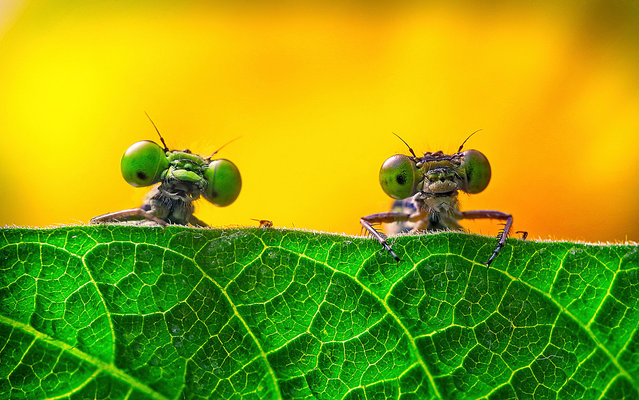
Shortlisted: “Two big eyes” by Miao Yong (Zejiang province, China). Damselflies look over the leaves. “I was photographing insects in a park near my home when suddenly I found two damselflies in the grass. They kept flying and it was very difficult to focus until suddenly they parked behind a leaf”. (Photo by Miao Yong/2017 Royal Society of Biology Photographer of the Year)

Shortlisted: “Two big eyes” by Miao Yong (Zejiang province, China). Damselflies look over the leaves. “I was photographing insects in a park near my home when suddenly I found two damselflies in the grass. They kept flying and it was very difficult to focus until suddenly they parked behind a leaf”. (Photo by Miao Yong/2017 Royal Society of Biology Photographer of the Year)
Details
16 Oct 2017 09:04:00