Loading...
Done
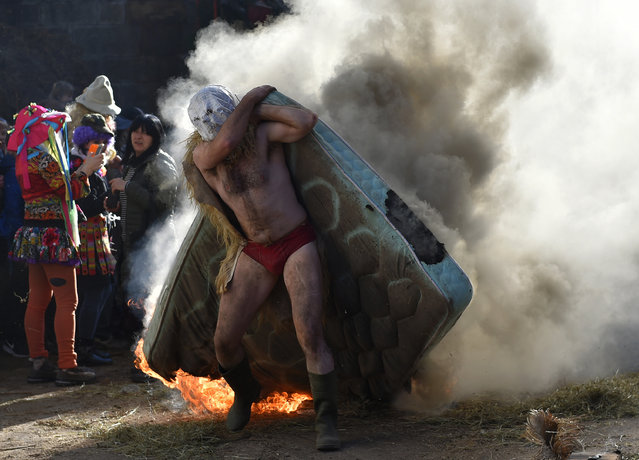
A masked participant carries a burning matress during the ancient carnival of Zubieta, in the northern Spanish Navarra province on January 30, 2018. The yearly three day festivities, revolving mainly around agriculture and principally sheep hearding, run on the last Sunday, Monday and Tuesday of January where Navarra Valley locals from two villages dress up and participate in a variety of activites as they perform a pilgrimage through each village. (Photo by Ander Gillenea/AFP Photo)

A masked participant carries a burning matress during the ancient carnival of Zubieta, in the northern Spanish Navarra province on January 30, 2018. The yearly three day festivities, revolving mainly around agriculture and principally sheep hearding, run on the last Sunday, Monday and Tuesday of January where Navarra Valley locals from two villages dress up and participate in a variety of activites as they perform a pilgrimage through each village. (Photo by Ander Gillenea/AFP Photo)
Details
01 Feb 2018 08:52:00
Demonstrators made barricades during clashes with police following a protest condemning the arrest of rap artist Pablo Hasél in Barcelona, Spain, Thursday, February 18, 2021. The imprisonment of a rap artist for his music praising terrorist violence and insulting the Spanish monarchy has set off a powder keg of pent-up rage this week in Spain. The arrest of Pablo Hasél has brought thousands to the streets for different reasons. The majority march under the banner of freedom of speech, but Hasél's lyrics also tap into a debate about the role of Spain's parliamentary monarchy after financial scandals involving the royal house. (Photo by Emilio Morenatti/AP Photo)

Demonstrators made barricades during clashes with police following a protest condemning the arrest of rap artist Pablo Hasél in Barcelona, Spain, Thursday, February 18, 2021. The imprisonment of a rap artist for his music praising terrorist violence and insulting the Spanish monarchy has set off a powder keg of pent-up rage this week in Spain. (Photo by Emilio Morenatti/AP Photo)
Details
04 Jul 2021 09:43:00
A woman reacts during the annual tomato fight fiesta called “Tomatina”, tomato fight fiesta, in the village of Bunol near Valencia, Spain, Wednesday, August 30, 2023. Thousands gather in this eastern Spanish town for the annual street tomato battle that leaves the streets and participants drenched in red pulp from 120,000 kilos of tomatoes. (Photo by Alberto Saiz/AP Photo)

A woman reacts during the annual tomato fight fiesta called “Tomatina”, tomato fight fiesta, in the village of Bunol near Valencia, Spain, Wednesday, August 30, 2023. Thousands gather in this eastern Spanish town for the annual street tomato battle that leaves the streets and participants drenched in red pulp from 120,000 kilos of tomatoes. (Photo by Alberto Saiz/AP Photo)
Details
10 Sep 2023 03:07:00
People wearing face masks to prevent the spread of coronavirus gather in a discotheque in Madrid, Spain, early Saturday, July 25, 2020. Nightlife is becoming the new target of Spanish authorities attempting to contain a spike in coronavirus infections since the country ended a lockdown. The Catalonia regional government has shut nightlife venues in Barcelona, and on Friday officials in Madrid said they were considering a similar step. (Photo by Manu Fernandez/AP Photo)

People wearing face masks to prevent the spread of coronavirus gather in a discotheque in Madrid, Spain, early Saturday, July 25, 2020. Nightlife is becoming the new target of Spanish authorities attempting to contain a spike in coronavirus infections since the country ended a lockdown. The Catalonia regional government has shut nightlife venues in Barcelona, and on Friday officials in Madrid said they were considering a similar step. (Photo by Manu Fernandez/AP Photo)
Details
27 Jul 2020 00:07:00
A tourist carries her luggage in a flooded St. Mark's Square, in Venice, Wednesday, November 13, 2019. The high-water mark hit 187 centimeters (74 inches) late Tuesday, Nov. 12, 2019, meaning more than 85% of the city was flooded. The highest level ever recorded was 194 centimeters (76 inches) during infamous flooding in 1966. (Photo by Luca Bruno/AP Photo)

A tourist carries her luggage in a flooded St. Mark's Square, in Venice, Wednesday, November 13, 2019. The high-water mark hit 187 centimeters (74 inches) late Tuesday, Nov. 12, 2019, meaning more than 85% of the city was flooded. The highest level ever recorded was 194 centimeters (76 inches) during infamous flooding in 1966. (Photo by Luca Bruno/AP Photo)
Details
05 Feb 2020 00:01:00
A 13-month-old chimp named Fumo carries a “Christmas present” of food treats in wrapping paper under his arm during a Christmas-themed feeding time at Sydney's Taronga Park Zoo, December 9, 2014. Fumo, meaning “chief” or “spear” in Swahili, is one of the latest additions to the zoo's successful primate breeding program. (Photo by Jason Reed/Reuters)

A 13-month-old chimp named Fumo carries a “Christmas present” of food treats in wrapping paper under his arm during a Christmas-themed feeding time at Sydney's Taronga Park Zoo, December 9, 2014. Fumo, meaning “chief” or “spear” in Swahili, is one of the latest additions to the zoo's successful primate breeding program. (Photo by Jason Reed/Reuters)
Details
09 Dec 2014 09:32:00
Tardigrades (commonly known as waterbears or moss piglets). (Photo by SPL/East News)

“Tardigrades (commonly known as waterbears or moss piglets) are small, water-dwelling, segmented animals with eight legs. Tardigrades were first discovered in 1773 by Johann August Ephraim Goeze, who called them kleiner Wasserbär, meaning “little water bear” in German. The name Tardigrada means “slow walker” and was given by Lazzaro Spallanzani in 1777. The name water bear comes from the way they walk, reminiscent of a bear's gait. The biggest adults may reach a body length of 1.5 millimetres (0.059 in), the smallest below 0.1 mm. Freshly hatched tardigrades may be smaller than 0.05 mm”. – Wikipedia. Photo: Tardigrades. (Photo by SPL/East News)
Details
26 Sep 2012 09:55:00
Concept Design Home Reversible Destiny Lofts MITAKA: In Memory Of Helen Keller By Reversible Destiny Foundation and Shusaku Arakawa

“The Reversible Destiny Lofts – Mitaka (In Memory of Helen Keller) is a nine-unit multiple dwelling. It was first completed example of procedural architecture put to residential use. These lofts reflexively articulate the residents’ operative tendencies and coordinating skills essential to and determinative of human thought and behavior; which means to say, the lofts manage, by virtue of how they are constructed, to reveal to their residents the ins and outs of what makes a person, in this case the resident. This is the same set of tendencies and skills to which Arakawa and Madeline Gins gave diagrammatic form in their decades-long research project The Mechanism of Meaning”. – Wikipedia

Photo: The exterior of the concept design home “Reversible Destiny Lofts MITAKA: In Memory of Helen Keller” is seen on October 27, 2005 in Tokyo, Japan. (Photo by Koichi Kamoshida/Getty Images)
Details
30 Nov 2011 11:58:00