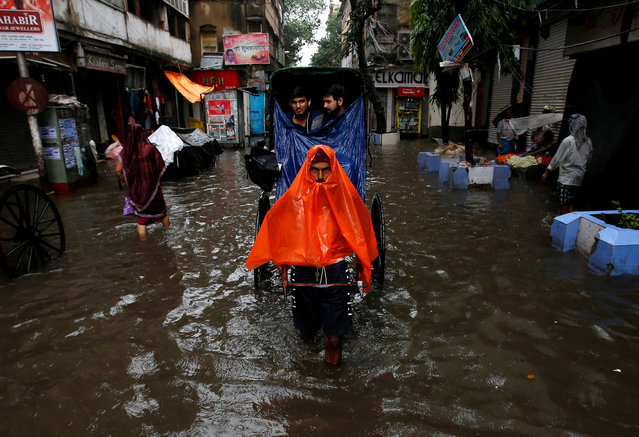
A rickshaw puller transports passengers through a water-logged street after heavy rain in Kolkata, India on June 26, 2018. (Photo by Rupak De Chowdhuri/Reuters)
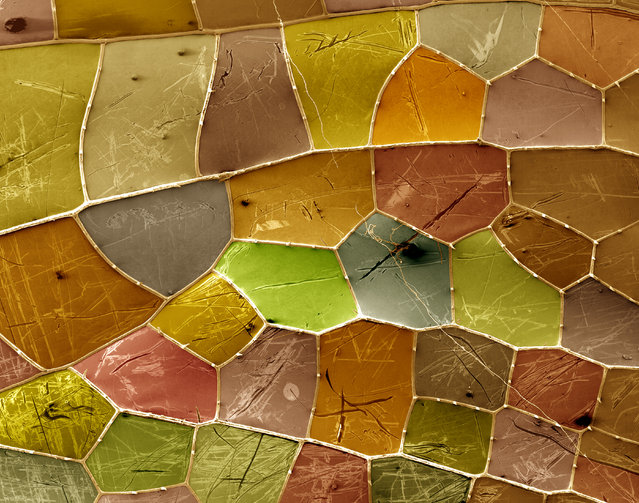
Macro or Micro? Scientists’ pictures baffle our sense of scale. It began when Stephen Young, a geography professor at Salem State University in Massachusetts, tricked his biologist colleague Paul Kelly into thinking a satellite image was one of his electron microscope scans. Can you guess whether they are close-up or very far away? (Photo by Paul Kelly)
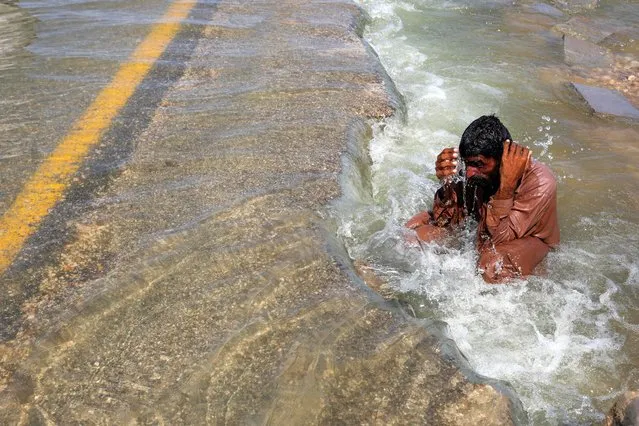
A displaced man cools off to avoid heat on flooded highway, following rains and floods during the monsoon season in Sehwan, Pakistan on September 16, 2022. (Photo by Akhtar Soomro/Reuters)
Peasants in the re-taken Somme District work in the fields, circa 1916- 1917, in this Library of Congress handout photo. For women 100 years ago, opportunities to work beyond the home and take part in political life were very limited. As the 20th century progressed, hard-won progress included gradually improved voting rights, while the upheaval of war pushed doors ajar as women worked as part of the war effort. U.S. Library of Congress archive photos show women's workplaces ranging from a flour mill in England to a coal mine in Belgium or Lincoln Motor Co.'s welding department in Detroit. International Women's Day is celebrated on March 8. (Photo by Reuters/Bain Collection/Library of Congress)
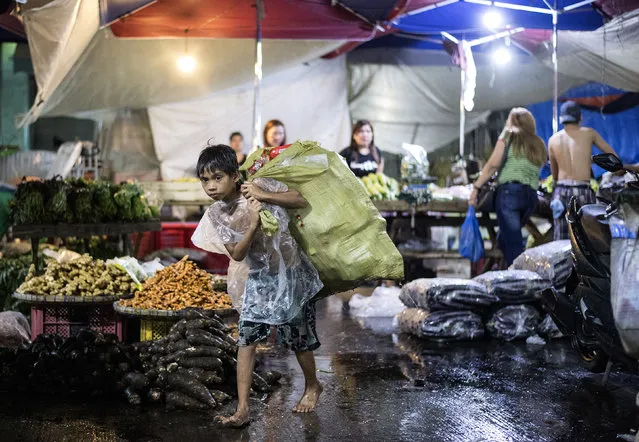
A Philippine boy collects used plastic bottles to be sold at a junk shop at Divisoria market in Manila on November 29, 2017. (Photo by Noel Celis/AFP Photo)
“Grit and Glamour”, a retrospective of the late British photographer Elsbeth Juda, who fled Nazi occupation and came to England in 1933, is at the Jewish Museum, in London, until July 1, 2018. Here: Shelagh Wilson, Copacabana beach, Rio de Janeiro, 1951. (Photo by Elsbeth Juda Archive/Victoria and Albert Museum)
Galapagos – Rocking the Cradle: Four major ocean currents converge along the Galapagos archipelago, creating the conditions for an extraordinary diversity of animal life, April 25, 2016. The islands are home to at least 7,000 flora and fauna species, of which 97 percent of the reptiles, 80 percent of the land birds, 50 percent of the insects and 30 percent of the plants are endemic. (Photo by Thomas P. Peschak for National Geographic/World Press Photo)